

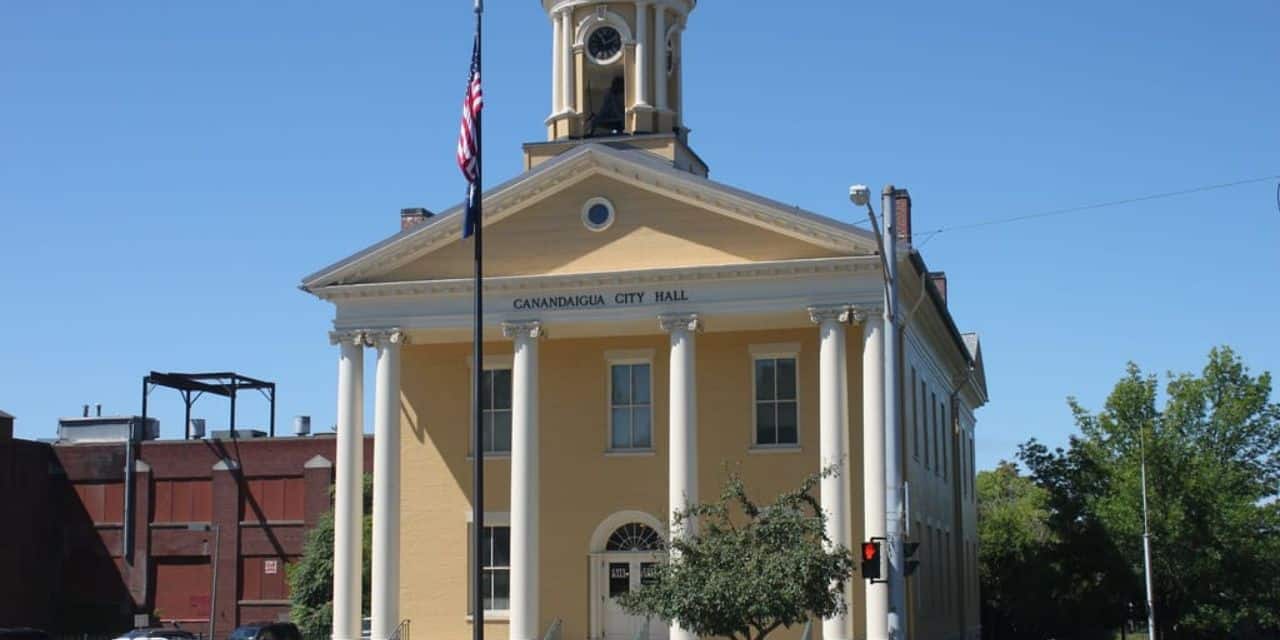
Canandaigua City Council committees advanced a new two-year fire protection agreement with the Town of Canandaigua, backed changes to a police department position and reviewed the city’s 2025 audit Monday night, while putting a broader package of pro-housing zoning changes on hold until next year.
The joint Finance and Planning Committee session also included a $20,000 funding request from the Ontario County Historical Society, proposed changes to the Canandaigua Local Development Corporation and an easement adjustment involving Atwater Meadows Park.

One of the most consequential items was a tentative agreement extending the city’s fire protection services in portions of the Town of Canandaigua through the end of 2028.
Under the proposed agreement, the town would pay the city $1.5 million in 2027 and $1.6 million in 2028. The city would continue providing fire and emergency response around the clock in its designated town coverage area and would continue operating from the town-owned Parkside Drive fire station.
City Manager John Goodwin said the new arrangement uses a formula rather than negotiating a fixed contribution from scratch each year. The formula incorporates factors including assessed value within the coverage area and the town’s share of overall fire call volume, resulting in the town covering about 28% of the cost.
Goodwin said the city’s coverage area would remain unchanged under the extension. The city’s current direction is also to maintain its fire department staffing at 20 positions. Finance Committee members unanimously moved the agreement forward to the full City Council.
Goodwin also told council members the city is seeing more mutual aid calls beyond the immediate Canandaigua city-town service area. If that trend continues, he said officials may eventually have to approach neighboring municipalities about sharing some of those costs.
Audit shows stronger-than-budgeted 2025 results
The Finance Committee also accepted the city’s independent audit for 2025 following a presentation from Mike DeBots of Mengel, Metzger, Barr & Co.
Auditors issued an unmodified opinion, meaning the financial statements were found to fairly present the city’s financial position in all material respects. The auditors reported no material weaknesses in internal controls, although they identified several areas for improvement, including incompatible accounting-system access tied to staffing changes and several invoices that lacked signatures confirming goods or services had been received.
The city’s general fund finished 2025 stronger than budgeted. General fund revenues totaled about $21.15 million, roughly $351,000 above the amended budget, while expenditures came in about $1.19 million below budget before encumbrances.
Sales tax revenue accounted for a significant share of the better-than-expected revenue, coming in about $572,000 above budget. The general fund ended the year with a balance of roughly $10.3 million, up about $725,000 during 2025.
The audit also shows the city ended 2025 with about $47.7 million in outstanding serial bonds across its governmental, water and sewer operations.
Historical Society seeks larger city contribution
The Ontario County Historical Society used Monday’s meeting to make its case for a larger allocation in the city’s 2027 budget.
Executive Director Ulana Fuller requested $20,000, up $6,800 from the current city contribution. She told council members the organization has faced years of underfunding, rising operating expenses and repeated leadership turnover.
Fuller said the organization plans to add a part-time custodial and maintenance position, increase visitor-services hours and absorb higher payroll, utility, insurance, technology and programming costs. The Historical Society estimates its baseline operating expenses are increasing by nearly $40,000.
The organization also cares for nine Frank Townsend Hutchens paintings owned by the city and insured collectively for more than $280,000. Fuller said the Historical Society’s collection approaches 100,000 items, with significant portions tied directly to Canandaigua history.
No final decision was made on the request Monday. It will be considered as part of the city’s broader 2027 budget process.
Police position, CLDC changes advance
The Finance Committee also recommended formally creating a Property and Evidence Clerk position within the Canandaigua Police Department.
Goodwin said one of the department’s two civilian administrative positions has evolved well beyond its existing civil service title and now centers on evidence and property management. The proposed 2027 budget would increase the salary for the reclassified position from about $53,000 to $63,000.
The job would be responsible for maintaining evidence inventory, chain-of-custody records, secure storage and coordination with courts, forensic laboratories and other agencies.
Committee members also approved proposed changes to the Canandaigua Local Development Corporation after the Ontario County Chamber of Commerce decided to withdraw as a voting member.
The CLDC currently has five members. The proposed structure would expand the board to 11, with the city and town each appointing four members and the CLDC appointing the remaining three. Both the City Council and Town Board must approve the change.
Housing changes delayed after lengthy discussion
The Planning Committee spent much of its meeting revisiting a set of zoning changes intended to increase housing opportunities, but ultimately decided not to advance them now.
The package includes eliminating the R-1A large-lot residential district, reducing minimum R-1 lot sizes to 6,000 square feet, allowing townhouses in more districts and permitting detached accessory dwelling units through special-use approval. Other changes would make it easier to consider multifamily housing and reduce minimum lot sizes for some multifamily development.
Council members and staff repeatedly noted that Canandaigua is largely built out, meaning some changes could produce relatively few new housing units while still generating significant concern among homeowners whose zoning would change.
Planning Director Richard Brown said consolidating the city’s R-1A and R-1B districts would likely have little immediate impact on existing neighborhoods, but acknowledged that previous rezoning efforts involving similar areas drew significant opposition.
Several council members said they supported continuing the conversation but questioned whether now was the right time, particularly as the city heads into budget season. No member made a motion to move the package to full council.
The committee instead settled on revisiting the recommendations after the start of 2027, potentially considering individual pieces of the housing package separately.
The committee did advance a separate easement adjustment involving Atwater Meadows Park. The change would transfer an existing right-of-way and access to a boathouse from one West Lake Road property to an adjacent property owned by the same person. City officials said the practical use of the park would not change.
The committees entered executive session at the end of Monday night’s meeting to discuss collective bargaining negotiations.

FingerLakes1.com is the region’s leading all-digital news publication. The company was founded in 1998 and has been keeping residents informed for more than two decades. Have a lead? Send it to news@fingerlakes1.com.