


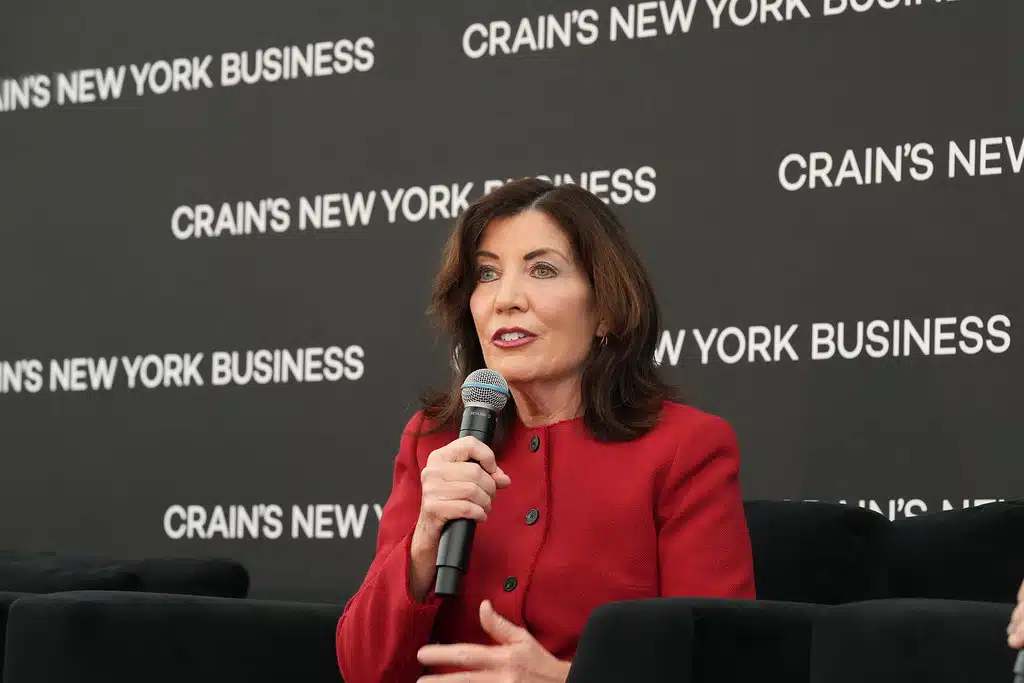
New York utility rebates worth up to $200 for a family will begin going out Monday, Gov. Kathy Hochul said during a wide-ranging Long Island radio interview focused on affordability, taxes, transportation and public safety.
Hochul told LI News Radio host Jay Oliver that the state is also promoting an Energy Assistance Program that she said can lower monthly utility bills for households earning up to $300,000 a year. She did not describe the application process or the size of the monthly savings during the interview.
The governor described the rebates as part of a $1 billion agreement with the Legislature and linked them to a broader Ratepayer Protection Plan. She said the state has placed limits on certain utility increases while trying to reduce costs for households.
Hochul also pointed to earlier middle-class tax-rate cuts, inflation rebate checks, expanded child care and free school breakfast and lunch as parts of her affordability agenda. She said school meals can save a family about $1,700 per child each year.
The interview came about six and a half weeks before the general election. Hochul, who is seeking voter support for another term, framed the programs and several major public investments as evidence of her approach to governing.
Taxes, energy and housing dominate affordability debate
Hochul said she does not plan to raise personal taxes on higher earners or corporate taxes, arguing that increases could encourage residents and businesses to leave New York. She said the state's middle-class income-tax rate is at its lowest level in 70 years following changes made early in her tenure.
Property and school taxes remain a major concern on Long Island, where the governor said local bills can exceed state income taxes. She said this year's state budget provided an additional $211 million for Long Island schools and argued that districts holding surpluses above legal limits should return money to taxpayers.
Those property taxes are levied locally, and Hochul called on county executives, legislatures and school districts to control spending. She said her 14 years in local government shaped her view that state aid should be paired with local efforts to lower costs.
The governor also blamed high gasoline prices on the war with Iran, saying prices were approaching $4.50 per gallon in parts of New York. That explanation was Hochul's assessment during the interview; no independent price or market data was provided in the transcript.
Housing supply is another major part of the state's affordability strategy, Hochul said. She argued that Nassau and Suffolk counties need more market-rate and income-restricted housing so younger residents, teachers and police officers can afford to live near their families and jobs.
Hochul said restoring the full federal deduction for state and local taxes would also help New York retain high-income residents. She called the current $40,000 cap an improvement but said Congress should return the deduction to its pre-2017 structure.
MacArthur rail link remains tied up locally
Hochul said $150 million in state funding remains available for a proposed Long Island Rail Road connection to the terminal at Long Island MacArthur Airport, but the project needs action by local government.
The governor said the plan she announced with Islip Supervisor Angie Carpenter and Suffolk County Executive Ed Romaine has become tied up at the town-board level. She said she would not withdraw the state money but urged local officials to resolve the dispute and move the project forward.
Hochul did not identify the specific approvals still needed or give a construction timetable. She suggested politics may be contributing to the delay but did not provide evidence for that claim during the interview.
On the Metropolitan Transportation Authority, Hochul said decades of deferred work left the system with aging tracks, signals and inaccessible stations. She said the state provided additional funding to avoid service cuts while requiring the authority to identify as much as $500 million in expense reductions.
The governor said more savings could come from overtime controls and efforts to reduce fare evasion on commuter rail and subway systems. She acknowledged continued frustration with the authority's costs but said service and finances have improved.
The host raised the prospect of another fare increase in March 2027 and questioned the impact of congestion pricing. Hochul did not make a commitment on either issue during the exchange.
Hochul defends public-safety record
Hochul said New York has invested $4 billion in local law enforcement and changed bail and criminal-discovery laws after crime rose during and after the pandemic. She credited those actions with helping reduce shootings and homicides, though the interview did not include statewide crime data.
She said the bail changes restored criteria judges can consider when deciding whether to hold someone before trial, including prior offenses and whether a gun was involved. Hochul said judges still retain discretion after reviewing those factors.
Oliver pressed the governor for additional changes involving young offenders and the state's Raise the Age law. Hochul said public safety remains an ongoing priority and that she is willing to keep refining policy, but she did not propose a specific change during the interview.
Hochul also said the summer was the safest on record for New York City's subways and railroads. That claim was not accompanied by figures in the transcript.
Major venues and local economic claims
The interview began with Belmont Park, where Hochul was headed for the reopening of the rebuilt racetrack. The $555 million reconstruction was supported by a $455 million state loan and is expected to restore the Belmont Stakes and bring the Breeders' Cup to the track in 2027.
Hochul also defended the state's investment in the Buffalo Bills' new Highmark Stadium. She said New York is covering about 29% of the total cost and argued that tax collections and an estimated $300 million local economic impact will repay the state's share before the midpoint of the lease.
The governor said a roof had been considered for the stadium but that surveys showed fans preferred an open-air venue in Orchard Park. She said maintaining tailgating space and the team's outdoor identity influenced the decision.
Hochul used the Belmont and stadium projects to argue that the state can support large regional investments while providing direct household assistance. She acknowledged criticism of the stadium's public cost while defending the investment as an economic benefit for Western New York.
Election and relationships with other governments
Asked about New York City Mayor Zohran Mamdani, Hochul said she would work with elected officials where their priorities overlap, including child care and public safety. She cited Mamdani's decision to retain Police Commissioner Jessica Tisch as an example of cooperation.
Hochul said she takes the same approach with President Donald Trump when state and federal interests align, while opposing administration actions she considers harmful. She criticized the withholding of $187 million in homeland-security money that she said was intended for police and firefighters.
As the election approaches, Hochul described herself as campaigning with an underdog mentality shaped by her Buffalo background. She said she takes no result for granted and plans to continue visiting Long Island communities while making affordability central to her campaign.

FingerLakes1.com is the region’s leading all-digital news publication. The company was founded in 1998 and has been keeping residents informed for more than two decades. Have a lead? Send it to news@fingerlakes1.com.