

A video doorbell can capture a visitor clearly and still miss a package placed inches below it. The problem is often the viewing angle, not the image quality: a forward-facing lens is positioned to see the person at your door, while the area against the wall or directly beneath the camera may fall outside the frame.
A dual camera doorbell addresses that blind spot by dividing the doorstep between two lenses. The forward-facing camera shows the visitor; the downward-facing camera shows more of the landing. Together, they answer two separate questions: Who is here? and What is at my feet?
That is what head-to-toe coverage means in practical terms. It can reduce the low blind spot created by mounting height and camera angle, which is especially useful for frequent deliveries, raised stoops, and higher mounting positions. It does not extend the doorbell’s job to the driveway or side yard, and results still depend on placement, lighting, and an unobstructed view.
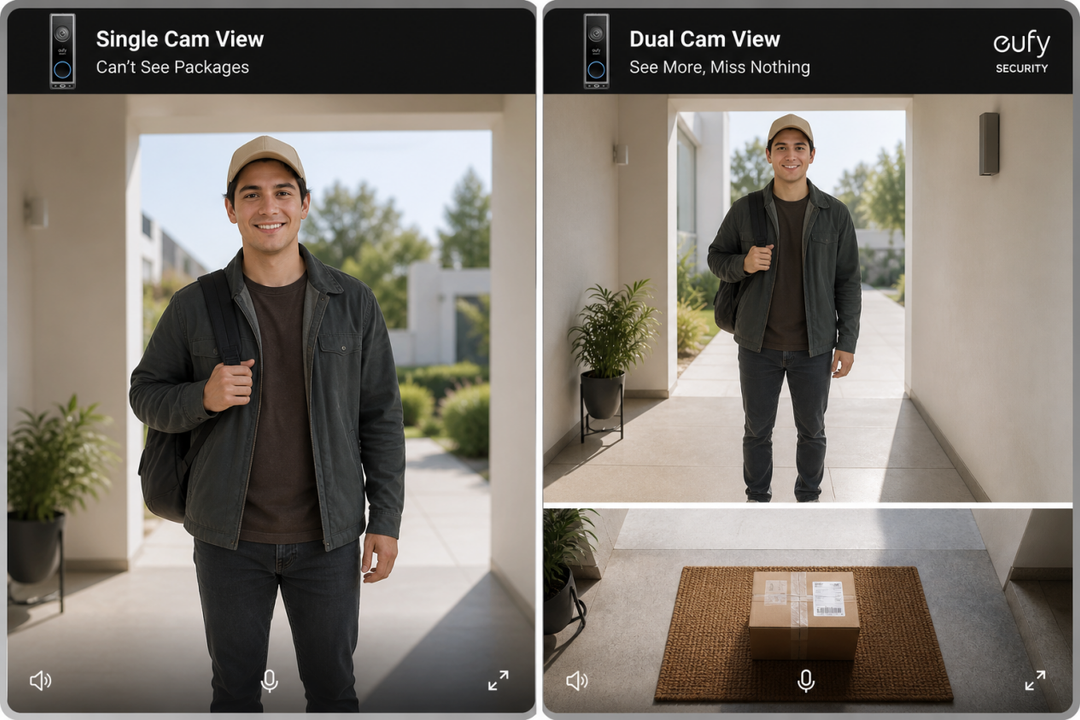
Why a Dual Camera Doorbell Can See the Doormat
A conventional doorbell camera has an awkward assignment. From one fixed position around hand height, it must show a visitor’s face, part of the approach, and the ground directly below. If you tilt the lens down, you may reveal the mat but cut off a tall visitor. Tilt it up, and you may improve the face view while deepening the blind spot against the wall.
A dual lens doorbell separates those competing angles. The main, forward-facing lens handles people at your entrance. The lower lens looks toward the floor, where a parcel, grocery bag, pet, or child’s shoes may sit. You may see this described as a package view doorbell, but the benefit is geometric rather than magical: the second camera observes an area the first camera cannot frame well.
The distinction is easiest to see side by side.
| Doorstep question | Single forward-facing lens | Forward lens plus downward lens |
| Who is standing at the door? | Usually the main strength, subject to height, lighting, and placement | Remains the job of the forward camera |
| What was placed near the mat? | May fall below the frame, especially close to the wall | Lower feed can show more of the landing directly beneath the doorbell |
| Can I see a tall step or raised stoop? | The nearest tread may be hidden by the camera angle | Downward view can make the near edge and landing easier to check |
| Will it look at the driveway or side yard? | Only if that area happens to be inside the forward frame | The second lens is still aimed at the doorstep, not across the property |
Two feeds do not remove ordinary obstructions. A planter can block the lower lens. One large box can hide a smaller one behind it. A storm door, deep brick recess, railing, or reflective siding can also change the final view. The value comes from better framing, not certainty.
When Two Cameras Make Sense for Your Doorstep
The second lens earns its place when the missing part of the scene is close to your door and matters in daily life. Before paying for it, picture an ordinary week at home rather than an imagined emergency.
Frequent Deliveries Make the Lower View Useful
If you receive groceries, prescriptions, pet supplies, or work shipments several times a week, your landing may change throughout the day. A downward feed lets you check whether an item is still by the mat before you open the door or ask a neighbor to bring it inside.
That view also helps when drivers tuck small parcels tight against the wall. The main camera may record the approach, then lose sight of the item as it enters the lowest part of the frame. The second lens gives you another angle to review. It cannot guarantee a package alert or show what happened outside the captured scene.
High Steps and High Mounting Points Create a Steeper Blind Spot
Your existing doorbell wiring may not sit at an ideal camera height. Trim, stonework, a narrow door frame, or accessibility needs can also force the unit higher than expected. From that position, the doormat sits at a steep downward angle.
A raised stoop makes the problem more noticeable. You may see a visitor clearly from the knees up while a box on the top tread disappears. A lower lens can cover the transition between the visitor and the landing without sacrificing the forward view just to see the floor.
Some Doorsteps Do Not Need Extra Lens
You may not need a second doorbell camera if a separate porch camera already looks down at the landing and gives you a useful image. The same applies if you rarely receive deliveries, already get a wide head-to-toe view from one well-placed lens, or send parcels to a locker away from the front door.
In those cases, prioritize the features that solve your actual problem: compatible power, a reliable chime, clear nighttime footage, manageable storage, or a simpler price. When you compare video doorbell options, start with power and camera layout instead of treating two lenses as a requirement.
Test the Doorstep Before You Install
Field-of-view diagrams cannot account for the height of your stoop, the depth of a door frame, or the place where drivers usually leave parcels. Before drilling, check both feeds from the actual mounting position under the conditions your doorbell will face.
Test People and Packages Together
A battery model makes a temporary trial easier because you can test a position without following existing wires. Hold or temporarily secure the doorbell safely, complete the required app setup, and open both camera feeds.
Run the test in this order:
- Place a padded envelope close to the wall, an average box on the mat, and a larger box in the usual delivery spot. Check that the downward feed shows the area where parcels normally land.
- Ask adults of different heights to stand where visitors naturally wait. Confirm that the forward feed provides a useful view without losing the package area below.
- Move the larger box through likely drop positions. Check whether it hides a smaller parcel or blocks too much of the lower view.
Now look for fixed obstructions. A railing, large planter, or deep door-frame recess can block part of the ground view from every test position. If that happens, adjust the mounting point and repeat all three checks before drilling.
Repeat the Test After Dark
Repeat the same test after dark. Look for glare from a porch light, reflections from house numbers or a glass storm door, and heavy shadows created by an overhang. A position that works at noon may need a small angle change to remain useful at night.
Set Privacy and Audio Boundaries
While both feeds are open, inspect the edges as carefully as the center. Keep the frame on your own landing and immediate approach rather than a neighbor’s porch, doorway, or windows. Activity and privacy zones may help, but a physically narrower angle is the stronger starting point.
The Federal Trade Commission recommends considering what a camera feed reveals, using a strong password, and keeping camera software current. [Source: Federal Trade Commission, How To Secure Your Home Security Cameras]
Make audio a separate setup decision. Two-way talk can help you speak with someone at the door, but saved audio may capture conversations beyond that exchange. Recording laws vary by state and context, and some states require consent from all parties in certain circumstances. Check the law that applies where you install the device, provide notice when appropriate, and disable audio recording if you do not need it. [Source: Reporters Committee for Freedom of the Press, Reporter’s Recording Guide]
Choosing a Setup That Fits Your Door
If the missing area is the space directly below your current doorbell, our Video Doorbell E340 applies the same two-view approach described above. Its forward-facing camera covers the visitor, while the downward-facing camera fills in more of the floor near your door. The practical benefit is being able to check the person and the usual package spot without sacrificing one view for the other.
Battery mode is a useful place to start when you do not have suitable wiring or want to confirm the angle before committing to it. You can choose the position around the shape of your doorway, run the tests above, and remove the quick-release battery when it needs charging. How often that happens depends on activity, live viewing, settings, temperature, and network conditions rather than one fixed schedule.
If compatible doorbell wiring is available, you can use it to keep the battery topped up. E340 still operates from its battery in wired mode, so the battery must remain installed. The power source needs to meet the model’s 8–24V and above-10VA requirement; the presence of two old doorbell wires alone does not confirm that. This gives you a simple decision path: begin with the placement that produces the right two views, then choose battery charging or compatible wired top-up based on what your door supports.
What You Can Learn From Two Views
The value of two cameras is not simply a wider picture. The forward feed can show a courier arriving, while the lower feed can show where the parcel was placed. If you check later, the ground view can help you see whether the landing has changed. That sequence gives you a more useful doorstep context than either angle alone.
It is still limited to what the doorbell records. Motion settings, network reliability, lighting, clip timing, a visitor’s route, and blocked lenses can all affect the result. Package detection can help with notifications on supported models, but it cannot remove blind spots or occasional missed alerts. Use the downward lens for the doormat, top step, and space against your door; a driveway, side gate, or long walkway needs a camera positioned for that separate area.
Conclusion
Test your intended position with real boxes, check the view in daylight and after dark, and keep neighboring private areas outside the frame. With our E340, battery mode offers an easy starting point, while wired mode still requires you to leave the battery installed. The second lens solves one precise problem: the downward blind spot within the first few feet of your door — not the driveway, curb, or side yard.

This content is brought to you by the FingerLakes1.com Team. Support our mission by visiting www.patreon.com/fl1 or learn how you send us your local content here.