

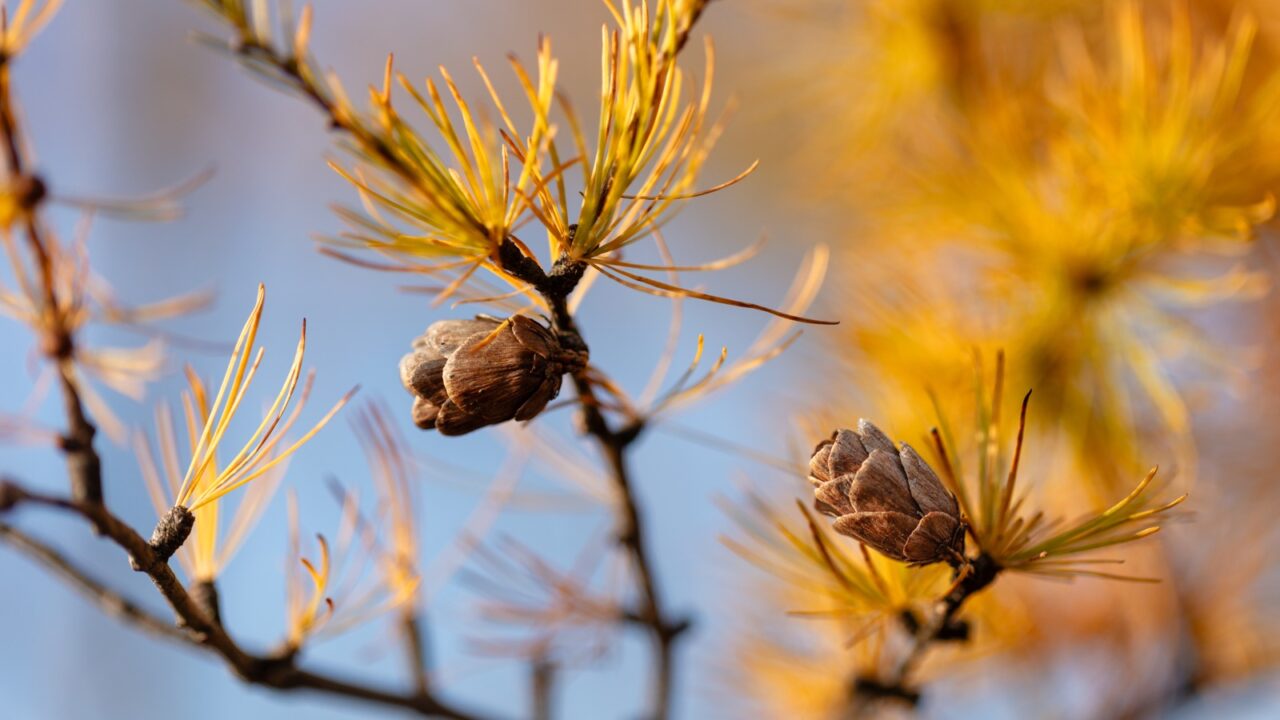
An American larch that turns golden and drops its needles in autumn is following its normal seasonal cycle. Its bare winter branches do not, by themselves, mean the tree is dying.
The unusual conifer, also called tamarack, is the subject of a Finger Lakes Land Trust feature by Jacqueline Stuhmiller exploring its adaptations, wetland habitat and long history of human uses.

American larch, Larix laricina, grows across northern North America, with a range that reaches the Finger Lakes. Mature trees are relatively uncommon in the region and can be found in some wetlands, the land trust notes. The similar European larch, Larix decidua, has also been planted locally, including in state forests.
Why larch needles fall
Many conifers retain tough, waxy needles that can function through the year. Those leaves require an investment of energy, and needle-covered branches can collect snow. Broadleaf deciduous trees take a different approach, growing leaves for a season and shedding them as light fades.
Larches combine traits of both groups. Their needles last one growing season, turning gold before falling. The tree recovers reusable materials from the needles before shedding them, and snow can pass through the bare branches during dormancy.
Spring brings fresh clusters of soft green needles about an inch long. Small cones, sometimes no larger than a thumbnail, begin with a reddish or maroon appearance and mature to brown. The fine needles and small cones contribute to the tree’s open, airy outline.
Stuhmiller describes those features as adaptations to demanding conditions: short needles take less energy to produce, while small cones are less vulnerable to being knocked off by strong winds.
A wetland tree with a working history
Tamaracks can move into peat bogs, growing alongside black spruce and plants suited to acidic northern wetlands. The land trust feature names bog laurel, pitcher plants and small orchids among their neighbors.
The tree’s usefulness extends well beyond its appearance. Stuhmiller traces the name hackmatack to an Algonquian term meaning wood for snowshoes and describes Indigenous uses of root fibers to stitch birch bark canoes and resin to seal them.
European settlers valued the wood’s resistance to decay in wet conditions. They used it in shipbuilding, with curved roots serving as boat ribs. Trunks laid across muddy tracks also formed corduroy roads, providing a timber surface over difficult ground.
The feature connects the larch’s annual transformation with another historical use: a single tree was sometimes planted in a town cemetery before the Civil War. Its apparent decline in winter and renewal in spring served as a Christian symbol of resurrection.
Stuhmiller’s essay originally appeared in the Winter 2024-25 issue of the land trust’s quarterly newsletter, The Land Steward. For Finger Lakes observers, its habitat and seasonal changes offer clues to recognizing the native tree while remembering that planted European larches also grow in the region.
Featured photo: Tamarack needles and cones in Aitkin, Minnesota, by Lorie Shaull, used under CC BY 2.0. Cropped to fit.


FingerLakes1.com is the region’s leading all-digital news publication. The company was founded in 1998 and has been keeping residents informed for more than two decades. Have a lead? Send it to news@fingerlakes1.com.