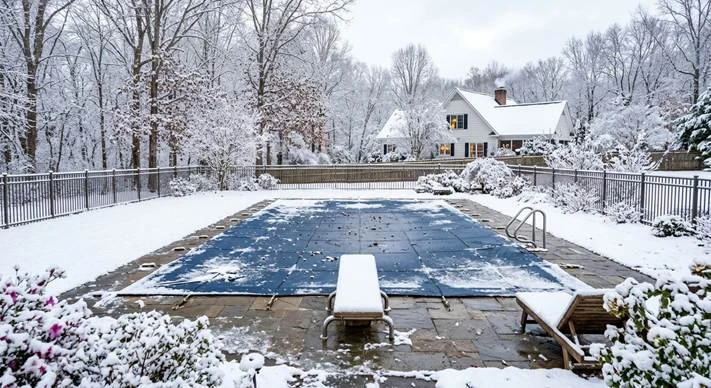
As temperatures drop across the Finger Lakes, pool owners face the same seasonal decision: how to protect the pool until spring. A good winter pool cover sits at the center of that plan, and choosing one before the first hard freeze is far easier than scrambling for one afterward.
A winter cover has a simple job. It keeps leaves, debris and sunlight out of the water and holds the pool steady through months of changing weather. Which style does that best depends on the type of pool, how much debris falls on it, and how much attention you are willing to give it between November and April.
What the forecast does and does not tell you
It is tempting to buy a lighter cover when the outlook is mild. NOAA’s 2026-27 U.S. Winter Outlook, released October 15, 2026, favors warmer-than-average conditions for much of the East for December through February, with wetter-than-average conditions most likely along the East Coast and elevated odds of drier conditions in some areas of the Great Lakes.
The release also makes an important caveat: the outlook does not project seasonal snowfall accumulations, because snow generally can’t be predicted more than a week in advance. In practical terms, that means a seasonal outlook is a reason to plan, not a reason to cut corners. A winter in this region can still deliver ice, heavy snow and wind, so choose a cover for the worst week rather than the average one.
Solid, mesh or leaf net
The main styles trade protection against upkeep. Solid covers generally block sunlight, which helps keep algae from getting a head start, but they collect water, snow and debris on top and need to be monitored and cleared. Mesh covers let melting snow and rain drain through, so there is less standing weight to manage, although some fine debris can reach the water. Leaf nets are a lighter option aimed at keeping leaves out rather than sealing the pool for the season.
Doheny’s, a family-owned pool supplier that says it has served pool owners since 1967, organizes its winter covers section by pool type, with solid covers for above ground pools, rectangular mesh covers for inground pools, and leaf nets among the options. That structure is helpful when you are comparing, because the right cover often depends more on the pool’s shape and construction than on the cover’s price.
Prep matters as much as the cover
A cover cannot make up for a pool that is closed carelessly. A seasonal closing checklist hosted by the Pool & Hot Tub Alliance, the Seasonal Closing Checklist, lists the basics: clean and vacuum the pool, adjust the chemical balance to recommended levels, lower the water level to below the skimmers and return lines for plaster pools, and install the winter safety cover.
One caution is worth repeating. The checklist’s water-level instruction is written for plaster pools, so owners of vinyl-liner or fiberglass pools should follow their manufacturer’s or builder’s guidance rather than assume the same level applies. Doheny’s also offers winter closing kits that bundle the chemicals for this step, which can simplify the process for first-time pool owners.
Common mistakes to avoid
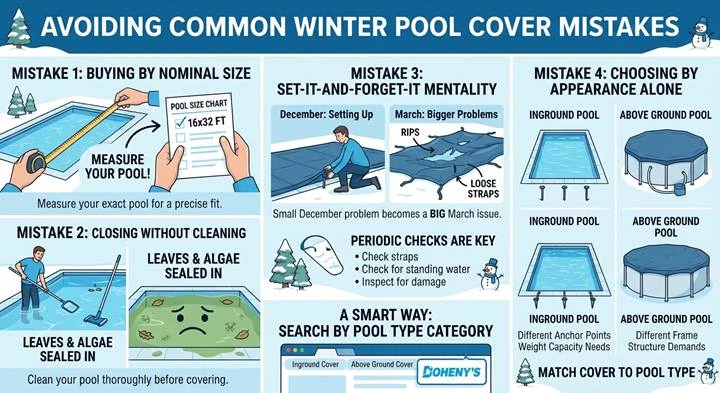
Most winter cover problems trace back to a handful of avoidable errors. The first is buying by nominal pool size instead of measuring. The second is closing the pool without cleaning it first, which leaves algae and debris sealed in for months. The third is treating the cover as a set it and forget it item: straps loosen, water pools in low spots, and a small problem in December becomes a bigger one by March.
A fourth, less obvious mistake is choosing a cover for appearance alone. Above ground and inground pools put different demands on a cover, from how it is anchored to how much weight it must carry, which is why matching the cover to the pool type matters more than matching it to the yard. Browsing a category organized by pool type, as Doheny’s does, is one way to avoid that mismatch.
Questions homeowners ask
How do I know what size to buy? Measure the pool’s actual dimensions, then match them to the cover’s stated fit, including any overlap the manufacturer specifies. Guessing from a nominal pool size is a common reason covers fit badly.
Does a cover need maintenance over the winter? Yes. Check it after storms, remove standing water or heavy debris according to the manufacturer’s instructions, and make sure anchors and straps stay secure.
When should I buy? Early. Selection and sizing are better before the rush, and the cover should be on before leaves and cold weather make closing the pool a chore.
Once the pool is clean, balanced and covered, the next step is simply to check on it periodically. Doheny’s winter covers category is a practical place to compare styles by pool type, and the NOAA outlook and closing checklist above give a sensible frame for the decision: prepare for variable weather, close the pool methodically, and confirm that the cover you choose fits your pool before the cold arrives.
Make FL1 part of your day.
Local reporting. Useful updates. More ways to stay close to your community.
Go ad-free
Support independent local reporting and enjoy FL1 without display ads.
$4.99 / month
Become a member →Cancel anytime. Third-party media players may contain ads.Get the daily briefing
Start your morning with the headlines that matter across the Finger Lakes.
Find more FL1 on Google
Choose FingerLakes1.com as a preferred source to see more of our reporting in your Google news results.

This content is brought to you by the FingerLakes1.com Team. Support our mission by visiting www.patreon.com/fl1 or learn how you send us your local content here.