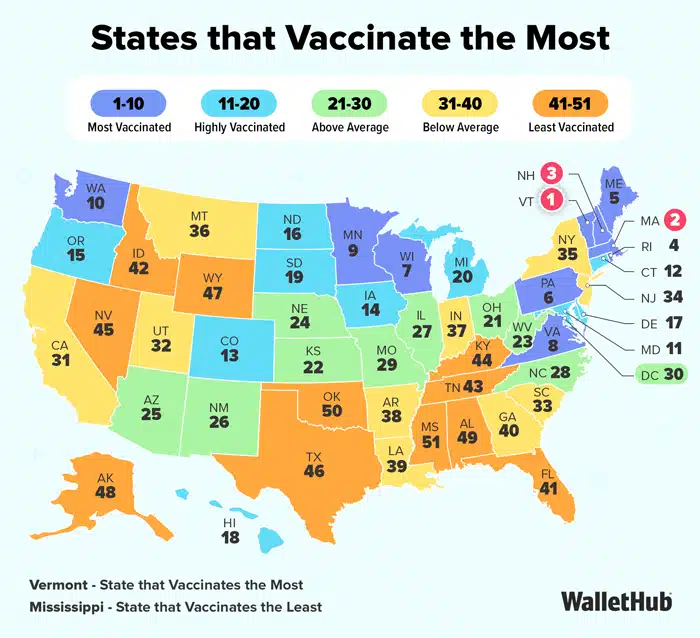
New York ranks 35th among the 50 states and District of Columbia in a new WalletHub analysis of vaccination rates, with relatively strong results for several childhood and teen vaccines offset by much weaker rankings for some adult vaccinations.
The personal-finance company gave New York an overall score of 52.25 in its 2026 “States that Vaccinate the Most” report. New York ranked 19th for children and teenagers, 37th for adults and older residents, and 29th for disparities and other factors that can influence vaccination uptake.

The study compared all 50 states and Washington, D.C., using 16 measures drawn from federal agencies and other organizations. The data were collected as of Aug. 12 and included vaccination rates among children, teenagers and adults, insurance coverage, participation in immunization information systems and access-related factors.
Vermont ranked first overall with a score of 84.77, followed by Massachusetts, New Hampshire, Rhode Island and Maine. Mississippi ranked last with a score of 17.54.
New York performs better on some childhood and teen vaccinations
New York’s strongest individual results were concentrated among younger residents.
The state ranked fifth nationally for the share of teenagers ages 13 to 17 who had received the MenACWY vaccine, which protects against four strains of meningococcal bacteria that can cause meningitis and bloodstream infections.
New York ranked eighth for influenza vaccination among children ages 6 months to 17 years and ninth for the share of teenagers ages 13 to 17 who were up to date on HPV vaccination.
It also ranked 16th for the share of children younger than 6 participating in an immunization information system. Those systems are confidential databases used by participating providers to record vaccination doses and track immunization coverage.
WalletHub’s broader children and teenagers category also considered vaccination rates among children up to 35 months old, Tdap vaccination among teens, vaccine requirements for public school kindergarten enrollment and whether minors can receive vaccines without parental consent.
Adult vaccination rates pull New York lower
New York’s weakest results came in several measures involving adults and older residents.
The state ranked 46th for the share of adults who had received a tetanus vaccination and 40th for the share of adults age 60 and older who had received a shingles, or zoster, vaccination.
New York performed better on seasonal influenza vaccination among adults, ranking 16th nationally.
WalletHub weighted adult and elderly vaccination measures as 40% of each state’s overall score. In addition to flu, tetanus and shingles vaccination, the study examined pneumococcal vaccination among adults ages 18 to 64 who were considered at increased risk.
The children and teenagers category also accounted for 40% of the final score, while disparities and other factors influencing vaccination uptake made up the remaining 20%.
Poverty measure also weighs on New York’s ranking
New York ranked 46th for the share of children ages 19 to 35 months living in poverty who had received the combined seven-vaccine series.
That series includes multiple doses protecting against diseases including diphtheria, tetanus, pertussis, polio, measles, mumps, rubella, hepatitis B, chickenpox and pneumococcal disease.
New York ranked ninth on another access-related measure: the share of the civilian noninstitutionalized population without health insurance coverage. WalletHub treated lower uninsured rates as more favorable because vaccination coverage is generally lower among adults without health insurance.
The study also examined changes in childhood immunization uptake from 2019 to 2024 and the share of residents living in designated primary-care health professional shortage areas.
How the ranking was calculated
WalletHub assigned each of the 16 metrics a weight and graded states on a 100-point scale before calculating a weighted average.
The combined seven-vaccine series for children up to 35 months carried the greatest weight within the youth category, while childhood flu vaccination received double weight. HPV, Tdap and meningococcal vaccinations were among the other measures included.
Among adults, flu vaccination, pneumococcal vaccination among higher-risk adults and tetanus vaccination each received full weight, while shingles vaccination received half weight.
The data used by WalletHub came from the U.S. Census Bureau, Centers for Disease Control and Prevention, Health Resources and Services Administration, Kaiser Family Foundation, IBTimes and ProCon.org.
Because the report combines several different measures into a single score, New York’s 35th-place overall ranking does not mean the state ranks 35th for every vaccine or population group. Its results varied sharply depending on age and vaccine type.
Expert says convenience can improve vaccination uptake
Abram L. Wagner, an assistant professor at the University of Michigan, told WalletHub that making vaccines easier to obtain is one of the most important steps health providers and local officials can take to improve vaccination rates.
That could include offering evening and weekend appointments and making vaccines available when families are already interacting with other parts of the health care system, Wagner said.
He also pointed to state vaccination policies as an important factor in maintaining childhood immunization levels. States control many vaccination requirements, including rules governing school attendance and exemptions.
Wagner said states can require families seeking waivers to receive vaccine education before an exemption is granted.
He also said media coverage can play a role by explaining the risks posed by vaccine-preventable diseases including measles, whooping cough and meningitis.
WalletHub cited a World Health Organization estimate that vaccines prevent between 3.5 million and 5 million deaths worldwide each year.

FingerLakes1.com is the region’s leading all-digital news publication. The company was founded in 1998 and has been keeping residents informed for more than two decades. Have a lead? Send it to news@fingerlakes1.com.