

New York is moving from talking about artificial intelligence to planning for what happens when it changes people’s jobs.
Gov. Kathy Hochul has launched a series of statewide listening sessions through the FutureWorks Commission, a 20-member group tasked with examining how AI could reshape work and recommending policies to help New Yorkers adapt. The commission is expected to deliver recommendations by the end of the year.

The effort is part of a broader balancing act for the state. New York is investing heavily in artificial intelligence research, workforce training and business adoption while also acknowledging that the technology could disrupt occupations that have long provided stable, middle-class employment.
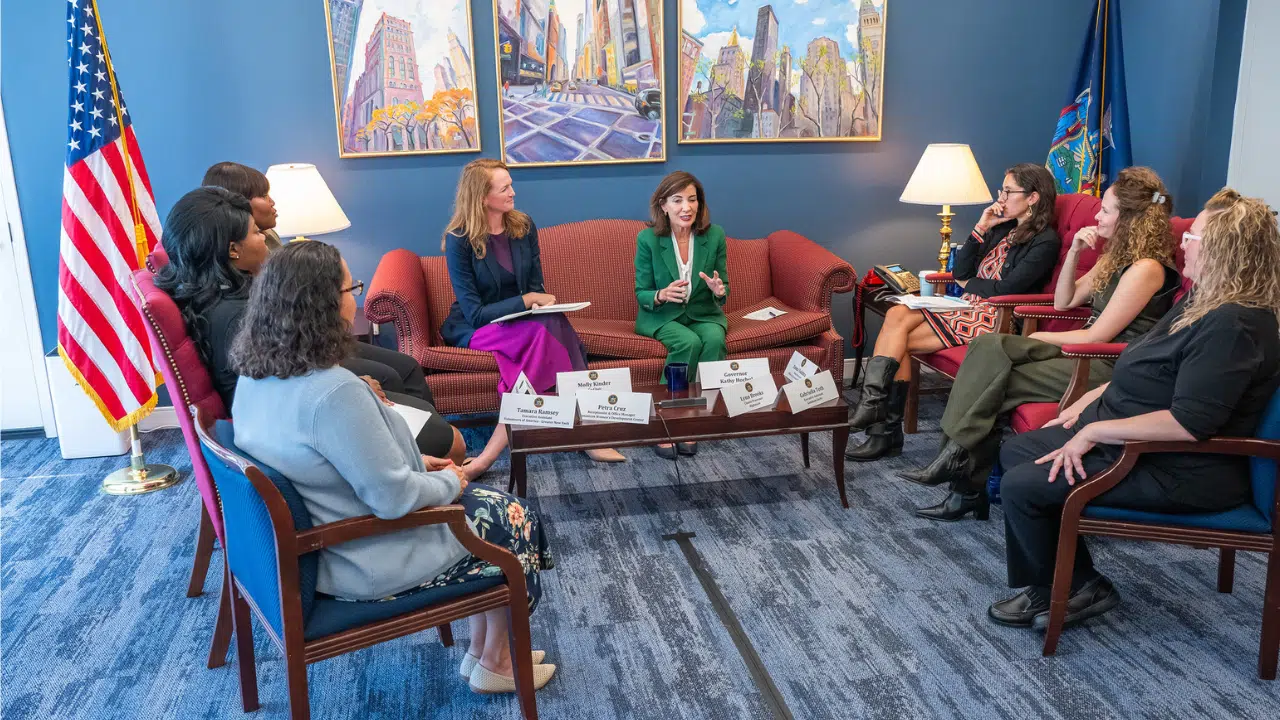
The state’s first FutureWorks listening session focused on women working in jobs that are already being changed, or could soon be changed, by AI. Hochul’s office specifically pointed to administrative, clerical and customer service work as areas where artificial intelligence may automate or shift tasks.

That concern is especially significant in New York because women account for 84% of employment in administrative back-office roles across the state, according to the governor’s office. Those positions have traditionally served as an important pathway into the middle class.
The commission plans to hold additional listening sessions with potentially affected workers, small businesses and other stakeholders over the coming weeks.
Hochul said the goal is to ensure that New York’s push into artificial intelligence doesn’t leave workers behind.
“As New York continues to lead the nation on AI and tech innovation, I’m fighting to ensure that progress doesn’t come at the expense of working New Yorkers,” Hochul said.
New York is investing heavily in AI at the same time
The workforce initiative comes as the state accelerates its own investment in artificial intelligence.
New York has committed $500 million to Empire AI, a partnership involving public and private universities centered on an advanced AI computing facility at the University at Buffalo. The state says the project is designed to make New York a national leader in AI research and development.
The Hochul administration has also launched programs aimed at training students for AI-enabled jobs, supporting New York-based AI startups, helping small businesses use the technology and tracking its potential effect on employment.
State government itself is also adopting AI.
New York has expanded responsible AI training and tools to more than 100,000 state employees. The Office of Information Technology Services has issued statewide rules governing acceptable AI use and additional guidance intended to help agencies deploy the technology safely.
That means the FutureWorks Commission isn’t being asked whether New York should use artificial intelligence. The state has already answered that question.
The issue now is how to manage the workforce consequences.
Commission will look at jobs, training and economic security
The FutureWorks Commission is chaired by former U.S. Labor Secretary Tom Perez, TIAA’s Thasunda Brown Duckett and Breakwater Initiative founder Molly Kinder.
Its 20 members have backgrounds in technology, education, workforce development and economics. The commission is expected to examine real-time data on how AI is affecting jobs and develop recommendations for both government and the private sector.
State officials say they want the benefits of AI to extend beyond large technology companies and reach workers, families and small businesses across New York.
That could mean recommendations involving worker retraining, education, job transition programs, AI literacy or new ways to monitor displacement, although the administration has not yet detailed what specific policies the commission will propose.
State Sen. Jessica Ramos said the measure of New York’s success with AI shouldn’t simply be how quickly the technology is adopted.
She said the larger question is whether AI creates opportunity, strengthens workers’ economic security and allows working people to share in the benefits of technological change.
Younger workers are increasingly worried about what AI means for jobs
The New York initiative is unfolding as national polling shows growing concern about the effect artificial intelligence could have on employment.
Pew Research Center found 73% of Americans under 30 believe AI will lead to fewer jobs in the United States over the next 20 years, up from 61% in 2024. Across all age groups, 71% expect AI to reduce the number of jobs.
That trend gives New York’s workforce planning a sharper edge.
For younger New Yorkers entering the workforce now, artificial intelligence may not be a temporary disruption. It could shape virtually their entire working lives.
The risk isn’t necessarily that AI eliminates entire occupations overnight. More often, the technology may change individual tasks, reduce staffing needs or increase the skills employers expect from workers.
That’s why the state’s focus on administrative and clerical employment matters. Those jobs are among the first areas where generative AI can potentially handle work that previously required human employees, from scheduling and document preparation to customer communication and data processing.
New York is trying to manage both sides of the AI economy
The state is effectively pursuing two goals at once.
On one side, it wants New York to become a major center for AI research, development and business growth.
On the other, it wants to avoid a scenario where the economic gains from that growth are concentrated among large companies while workers absorb the disruption.
The FutureWorks Commission is intended to sit between those two objectives.
Its recommendations, due by the end of 2026, could help shape how New York approaches workforce training, education, economic development and worker protections as artificial intelligence becomes more deeply embedded in the economy.
The central question isn’t whether AI is coming to New York workplaces. It’s already here.
The question the state is now trying to answer is who benefits from it, who is most at risk, and what New York does before those changes become harder to manage.

FingerLakes1.com is the region’s leading all-digital news publication. The company was founded in 1998 and has been keeping residents informed for more than two decades. Have a lead? Send it to news@fingerlakes1.com.