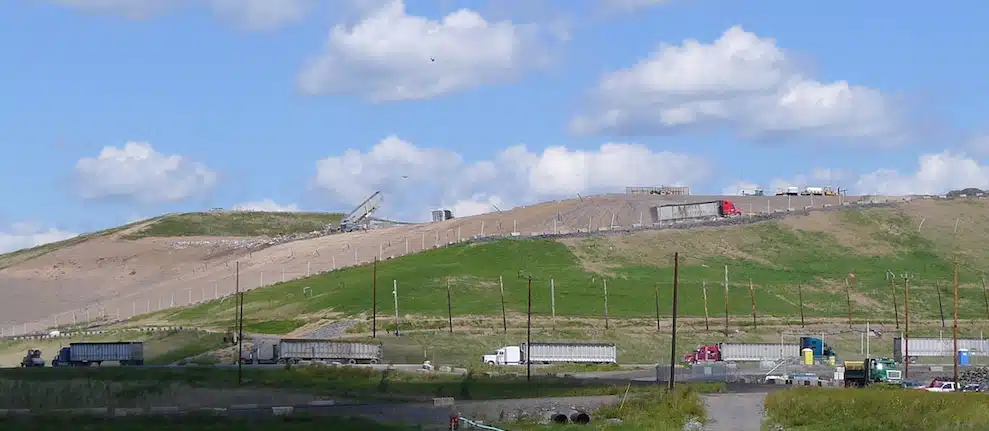
In its recent 20-page report on elevated lung cancer rates around Seneca Meadows Inc., the state Department of Health officially declares that the state’s largest municipal waste landfill deserves no blame.
That conclusion has hardly soothed those who have long complained of sickening odors and respiratory ailments that have for years disrupted nearby workplaces and schools.
“The report is more a PR thing to get people to back off a little,” said Mark Pitifer, an employee at Waterloo Container’s facility across the road from Seneca Meadows.
“I didn’t see where DOH was denying that there are high rates of lung cancer around the landfill,” he added. “They were just saying they found no direct correlation, which is their way of saying, ‘It’s not the landfill.’”
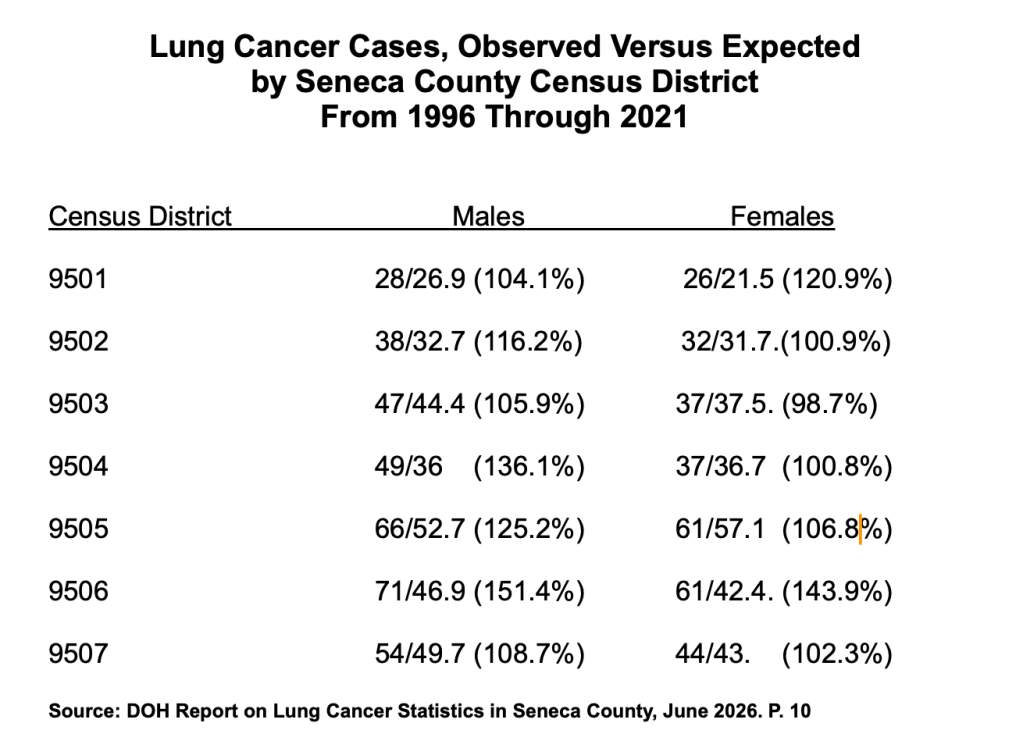
In an analysis released late last month, Health Department officials reported on lung cancer diagnoses in seven census tracts around Seneca Meadows over a 26-year period — from 1996 to 2021. For all seven tracts, they found more male cases than expected, statistically. Females cases exceeded expectations in six of seven tracts.
“That alarms me greatly,” said Dr. David Carpenter, a health sciences professor at the University at Albany. “The DOH tries to pass this off, saying (residents of these tracts) smoke more than others. That’s not convincing.
“It ignores the possible impact of benzene, which I suspect is the cause of those elevations in lung cancer around the landfill.”
Carpenter, a former director of the DOH’s Wadsworth Laboratory in Albany, noted that several recent peer reviewed articles have reported “striking associations specific to benzene and lung cancer.” According to the Environmental Protection Agency, Seneca Meadows and its adjacent energy plant were the largest emitters of benzene in Seneca County in 2017, the last year for which the EPA has released statistics.
The DOH report does not mention benzene, but it does say: “…we examined the available information about components of landfill gas, how it is controlled, how it is measured, and the available information on air quality” around the landfill. It provides few details.
Meanwhile, it devotes several pages to rates of smoking.
The report goes on to downplay Seneca Meadows’ potential contribution to the higher than expected lung cancer rates by stating that “the areas showing elevated rates are primarily distant from the landfill.”
A close look at the report’s data and census tract map seems to show just the opposite.
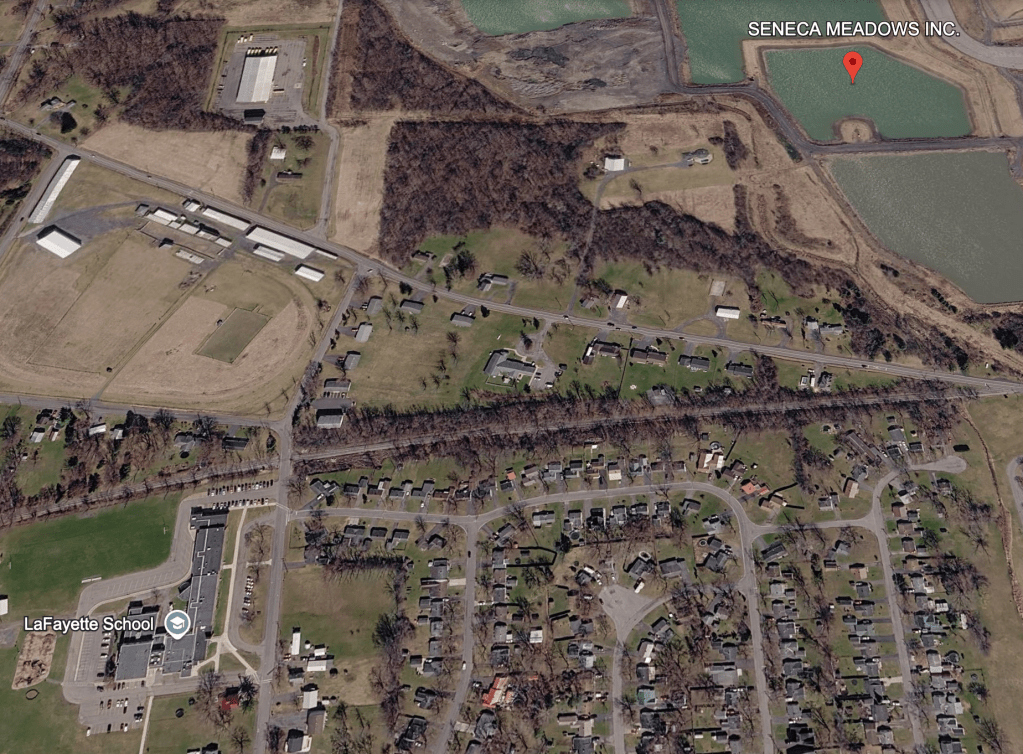
For example, the census tract with the most elevated lung cancer rates for both men (observed cases 151.4 percent higher than expected) and women (143.9 percent higher) covers much of the village of Waterloo, including its high school and middle school. The eastern border of that census tract — 9506 — is only about 1000 meters from the border of the landfill.
The two census tracts with the next most elevated lung cancer rates for males are 9505 and 9504. The landfill is situated on the border between them.
The report notes that only the 26-year results for males in census tracts 9504 and 9506 and for females in tract 9506 were were statistically significant.
The DOH’s report comes 33 months after the Seneca Falls Town Board asked the state Department of Environmental Conservation for a review of lung cancer rates around Seneca Meadows. That request was spurred a June 2023 report in WaterFront about a DOH-identified lung cancer cluster in an area that included the landfill.
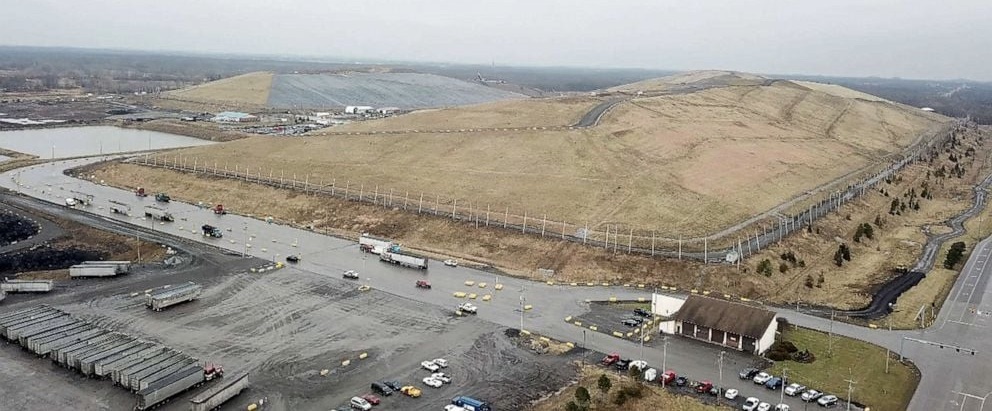
Now the DEC is considering the landfill’s application for a state permit to undertake a proposed major expansion that would allow it to continue operating until at least 2040.
Lung cancer rates don’t appear to be a lingering issue for the DEC. Engineering matters seem to be the agency’s main concerns, according to a list recently published in The Finger Lakes Times.
The agency must also decide whether or not to apply the state’s Green Amendment, which provides New York residents a constitutional right to breathe clean air. And it is legally required to give special consideration to state-designated disadvantaged communities, including census tract 9504 in Seneca Falls.
For many years, residents and workers around the landfill have complained about degraded air quality.
“The odors are getting worse and not getting better,” Pitifer said. “There are many mornings where you get that horrible, awful garbage cocktail … like you stuck your head in a dumpster on a hot humid day.”
The smell was particularly offensive on May 15, he said. That morning, about 20 employees complained of overwhelming landfill gas odors within the company’s building, including its break room. Company officials measured hydrogen sulfide (H2S) levels as high as 29 parts per billion.
Hydrogen sulfide is not a carcinogen, but when it is detected, other carcinogenic gases are often present as well.
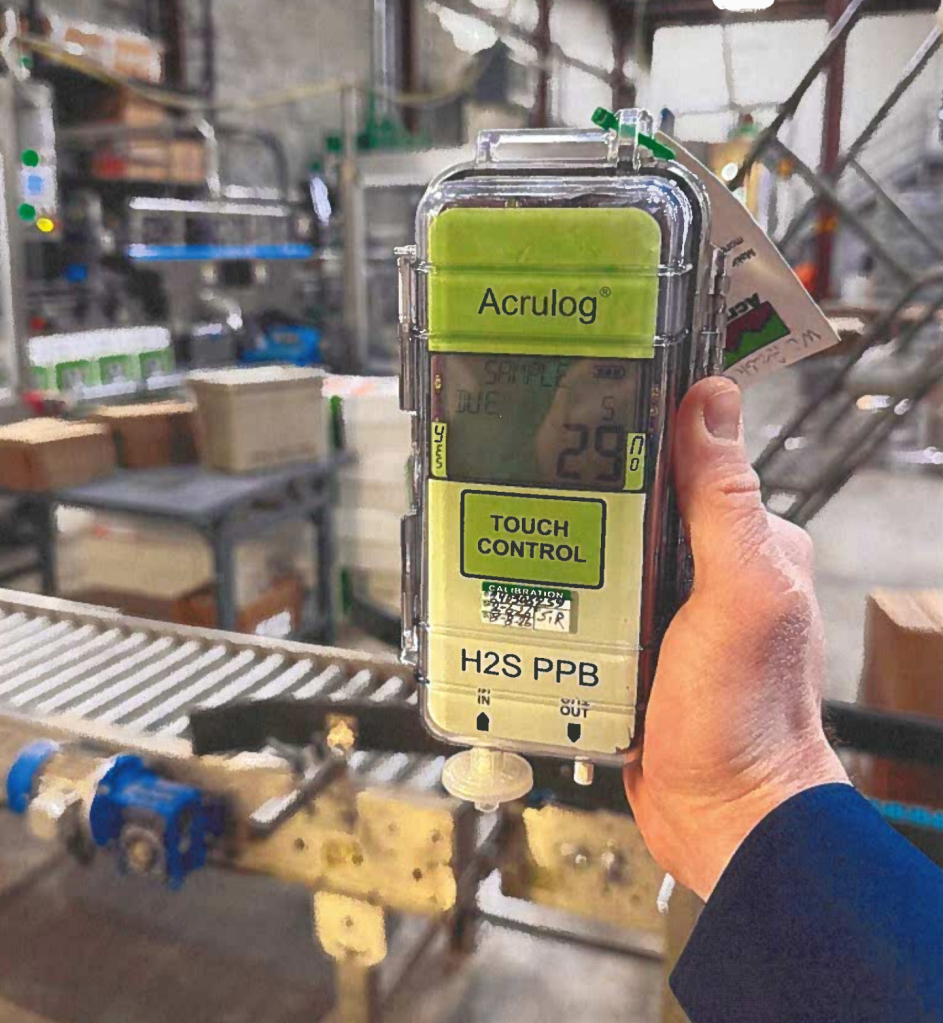
Seneca Meadows has four H2S monitors on the borders of its property. Readings that average above 10 ppb for an hour must be reported to the DEC. The recent DOH report said “data from the hydrogen sulfide monitors indicate that potential exceedances of the ambient air standard have occurred but are infrequent.”
In many cases, if not most, the landfill has said it could not confirm odor reports.
“At the last Seneca Falls board meeting, I gave them copies of the last 10 odor reports that I called in,” Pitifer said. “And only one of those 10 was confirmed by Seneca Meadows.”
Waterloo Container officials have been complaining about landfill odors for years. They have not been lone voices.

At a DEC public hearing in 2017, more than 20 people stood up to explain that landfill odors were wrecking their way life.
“The smell is breaking our brain cells,” one young student said.
In a recent interview, Michelle Grillone of Waterloo said she has made hundreds of odor complaints over the years and now has the landfill on speed dial.
She has three sons who have attended Waterloo schools, four of which are located within two miles of the landfill. The primary school for pre-K through second grade is about 1.7 miles away. LaFayette Intermediate School, serving grades 3 through 5, is only about half a mile from the landfill. The middle school and high school are on the same campus about 1.2 miles away.
“You can smell it first-hand in the schools,” Grillone said. “It’s rancid. It’s a garbage smell that makes you feel dizzy right away. I makes you feel nauseous. It gives you a headache.
“One time I went to bring them to school and it was so bad that I just turned back around and brought them all home.”
Grillone, who recently wrote an OP-ED column for the Rochester Democrat and Chronicle, said one of her sons experienced his first acute asthma attack while playing youth football at LaFayette Intermediate School. Now 15, his asthma persists and he has experienced several bouts of pneumonia.
She acknowledged that her son may have been pre-disposed to respiratory ailments and that landfill gasses may have had a negligible effect. But she said her family doctor attributes his breathing troubles to the landfill and has repeatedly advised the family to move away if they want his condition to improve.
The recent DOH report states that its analysis “cannot prove whether specific exposures may have caused or contributed to health outcomes.”
But it also says that smoking “is known to cause approximately 80 percent of lung cancer cases” and that radon gas is the second leading cause of the disease.
The Health Department report skims over radon’s affect in Seneca County, saying its own test results for the county “do not appear elevated compared to the rest of the state.” It does not mention that it found 47 counties had higher indoor basement levels of radon than Seneca, while only 12 counties were lower— relevant facts that would tend to lower observed-to-expected lung cancer ratios.
Meanwhile, the report provides pages of detail on smoking rates.
It said the “current” smoking rate for those 18 years and older in relevant Seneca County zip codes was 17.3 percent, compared to a statewide average of 13.0 percent. Those figures were based on phone inquires from 2016 to 2021.
But smoking rates are tricky to quantify, and they are highly time-sensitive because rates have been plunging nationally in recent years. Phone survey results can vary widely.
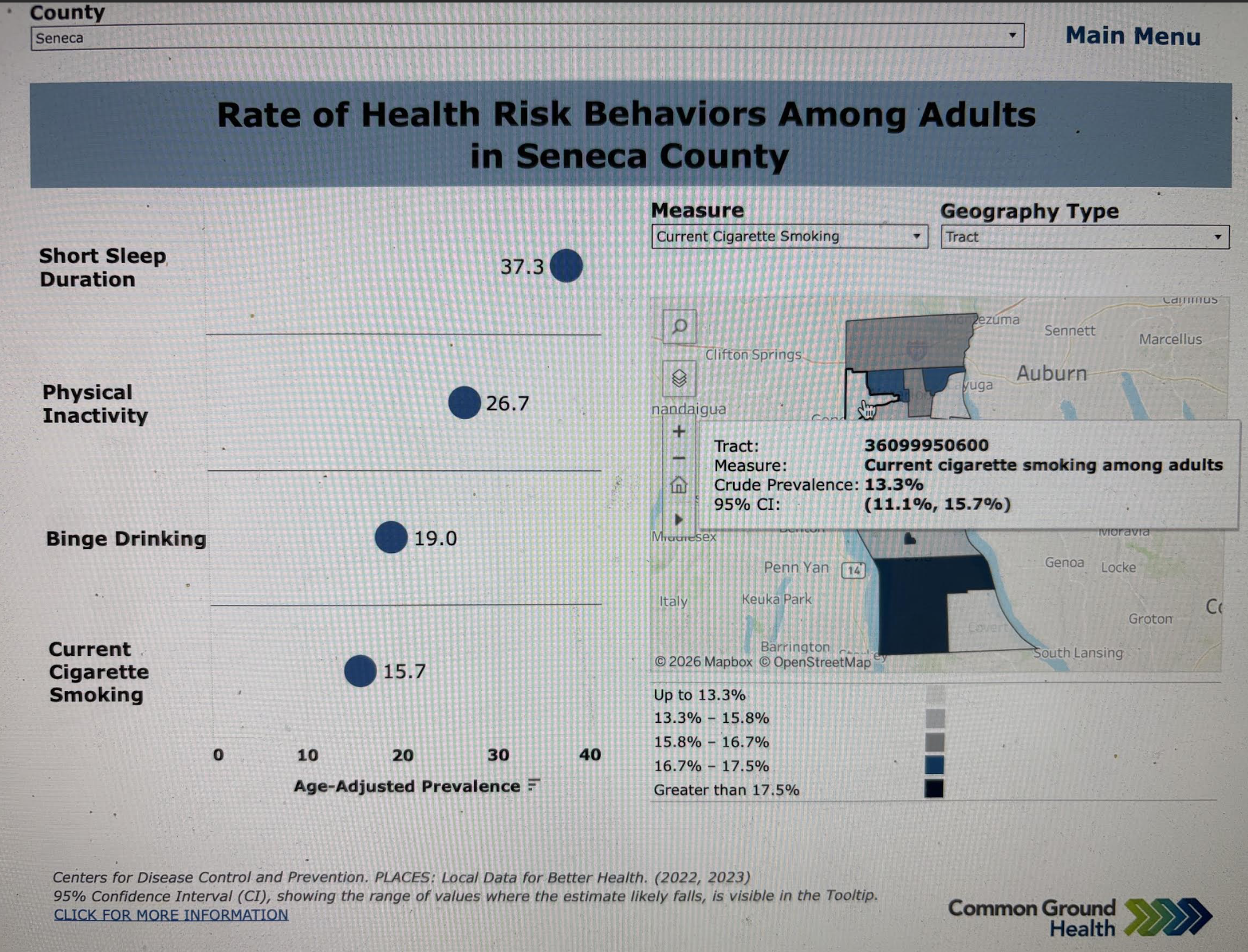
For example, Common Ground Health reported a current smoking rate of 13.3 percent for census tract 9506, the Seneca County tract with the most highly elevated (and statistically significant) lung cancer rates for both males and females. That number was based on data from the Centers for Disease Control and Prevention gathered in 2022 and 2023.
Several years ago, the DOH identified portions of Seneca County, including the landfill, as part of a lung cancer cluster based on its own data from 2011-2015.
At the time, the Health Department based its “expected case” calculations on lung cancer rates statewide, including New York City.
Since then it has changed its methodology, and as a result Seneca Meadows no longer falls within a lung cancer cluster.
The 26-year data provided in the recent DOH report used “expected case” numbers derived from statewide averages that exclude stats from New York City, which has sharply lower smoking rates that the rest of the state.
Carpenter, a 1964 graduate of Harvard Medical School, said he agreed with the agency’s decision to change its methodology, given that upstate counties do tend to have more smokers than counties in the city.
But he added that “it’s just inexcusable that DOH shows so little interest in even looking at anything other than smoking.”
Actually, the DOH said in its report that it had reviewed a 2019 DEC air quality report that did analyze landfill emissions of benzene and other carcinogens in Seneca County. The DEC found that the results were not alarming and that there was no need to conduct follow-up testing.
Seneca Meadows has consistently denied that its emissions contribute to elevated lung cancer rates. Its July 2024 draft environmental impact statement for its proposed Valley Infill expansion states categorically:
“The Seneca Meadows Landfill has no impact and the SMI Valley Infill will have no impact on lung cancer rates.”
That stance was supported later in 2024 by a Seneca Meadows-funded report written by a pair of waste industry executives.
“Although the landfill’s air emissions yield occasional odors,” that report says, “odor does not cause lung cancer.” Furthermore, no chemical releases from the landfill contribute to exposure levels that can cause health problems, and therefore, the report concludes, “without exposure, there can be no risk.” A 2024 post on WaterFront challenged some of the report’s conclusions.
Last month, Kyle Black, manager of Seneca Meadows, wrote a letter to the Finger Lakes Times that criticized Waterloo Container’s public complaints about landfill gas odors it claimed on May 15.
Black called those public statements “a deliberate attempt to influence a regulatory process through headlines rather than evidence…. The data simply does not support claims of persist or harmful offsite impacts.”

Peter is a three-time Pulitzer nominated reporter covering environmental issues through his first-of-its-kind digital publication The Water Front. He’s won an array of Associated Press, UPI, and Society of Professional Journalist awards. His reporting on environmental issues continues to be featured in prominent New York publications and is available on FingerLakes1.com through an exclusive content partnership. Have a question or lead? Send it to peter@fingerlakes1.com.