

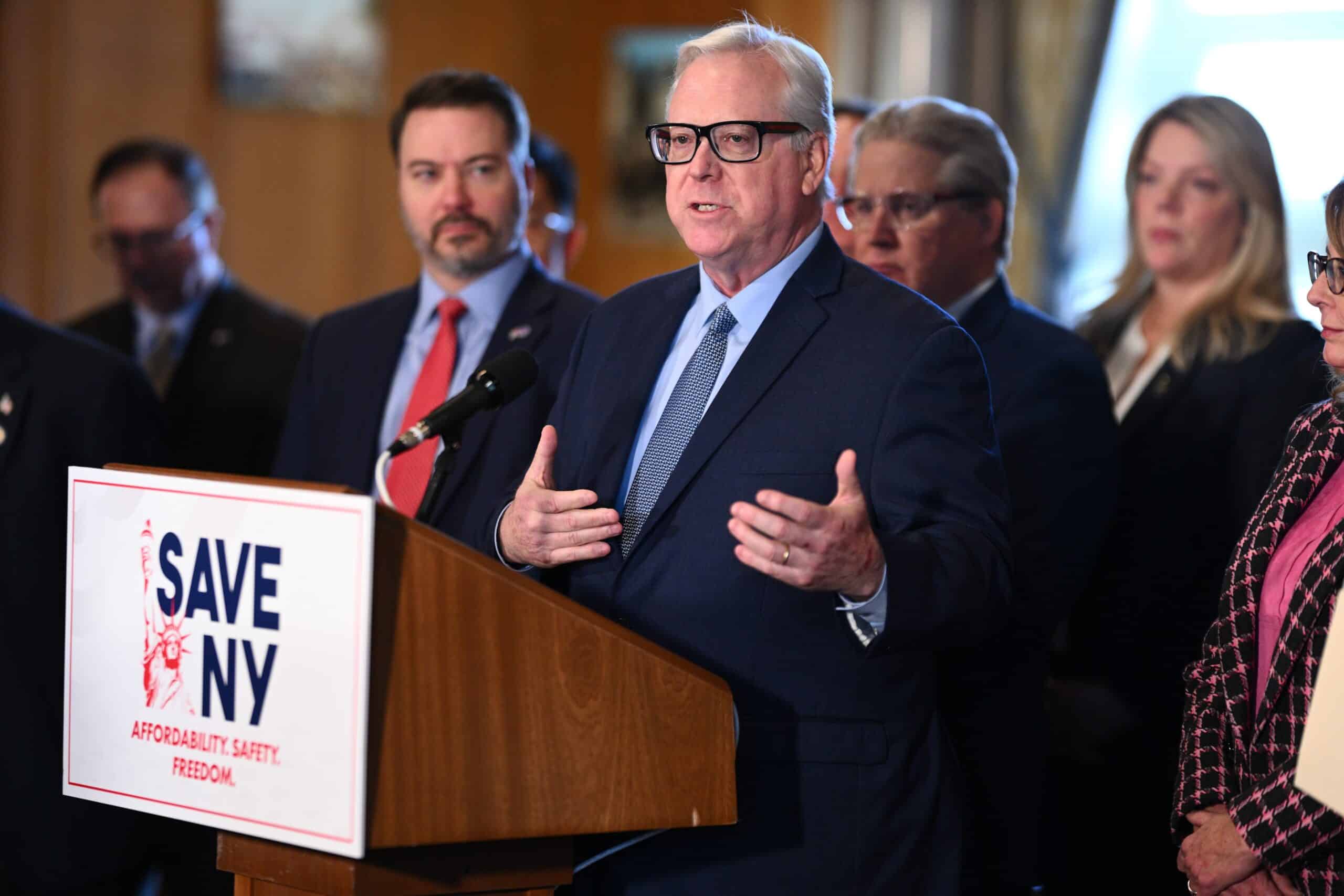
Republican lawmakers representing the Finger Lakes and surrounding regions are sharply criticizing Governor Kathy Hochul’s proposed $260 billion state budget, arguing it continues a pattern of unchecked spending while failing to deliver meaningful affordability relief for New Yorkers.
The executive budget for fiscal year 2026–2027 would increase state spending by billions of dollars and comes as lawmakers warn of long-term fiscal risks, rising costs for households and businesses, and projected multiyear budget gaps.
State Sen. Tom O’Mara, the ranking Republican on the Senate Finance Committee, said the proposal reflects Albany’s ongoing inability to rein in spending.

“It’s a budget plan and a fiscal strategy that remains focused on maintaining irresponsible levels of spending,” O’Mara said, pointing to roughly $85 billion in state spending growth since Democrats took full control of state government in 2019 — an increase he said far exceeds inflation.
O’Mara argued the spending plan does little to address affordability for middle-class taxpayers and small businesses, warning it will continue to push residents and employers out of New York. He also criticized what he described as a lack of mandate relief, regulatory reform, energy policy changes, and broad-based tax relief.
Other Finger Lakes lawmakers echoed those concerns, framing affordability as the central test of the budget.
State Sen. Pam Helming said the executive budget must be judged on whether it delivers real relief for New Yorkers facing rising costs.
“As we begin these discussions and negotiations, there is one crucial question I will be asking myself, my colleagues, and the Governor: does this budget provide meaningful relief for New Yorkers?” Helming said. She cited rising expenses tied to taxes, utilities, housing, insurance, and health care, and said her focus will be on policies that keep businesses, jobs, and families in New York.
In the Assembly, Rep. Jeff Gallahan criticized the administration for what he called a habit of pouring money into broken systems without addressing underlying problems.
“Continuing to dump billions more into a state budget that is projected to once again exceed a quarter of a trillion dollars is not in New Yorkers’ best interest,” Gallahan said. He rejected claims that federal actions are responsible for New York’s fiscal instability, instead blaming Albany’s policies and spending decisions.
“The federal government did not create our state’s fiscal insecurity — it was Albany Democrats’ flawed policies and out-of-control budgets riddled with overspending,” Gallahan said.
Gallahan represents the 131st Assembly District, which includes portions of Ontario, Seneca, Cayuga, Cortland, Madison, Broome, and Chenango counties.
Assembly Minority Leader Will Barclay also warned that the governor’s proposal represents only the starting point of negotiations and is likely to grow.
“Gov. Hochul’s $260 billion executive budget proposal continues the disturbing pattern of reckless spending in New York,” Barclay said, noting the state budget has grown by more than $80 billion over the past five years. He argued that larger budgets have failed to reduce the cost of living.
Barclay pointed to the Division of the Budget identifying an additional $17 billion in revenue beyond earlier estimates and questioned why more of that money is not being returned to taxpayers burdened by high taxes and soaring energy costs.
He also cautioned that enacted budgets in recent election years have exceeded the governor’s original proposal by billions of dollars.
“If a bloated $260 billion proposal is the floor,” Barclay said, “our state budget is about to cave in under its own weight.”
Hochul’s budget avoids new income tax increases, maintains $14.6 billion in state reserves, and projects total spending of $260 billion. State Comptroller Thomas DiNapoli said the plan emphasizes affordability but warned that long-term fiscal pressures remain, including projected out-year budget gaps totaling $27.5 billion.
Joint Senate-Assembly budget hearings are scheduled to begin next week. Republican lawmakers said they will push for changes focused on affordability, fiscal restraint, and economic competitiveness as negotiations move forward.

FingerLakes1.com is the region’s leading all-digital news publication. The company was founded in 1998 and has been keeping residents informed for more than two decades. Have a lead? Send it to news@fingerlakes1.com.