

The Seneca Falls Town Board voted Tuesday to approved key resolutions regarding leachate and a host community agreement with Seneca Meadows Landfill, clearing both measures after a lengthy meeting dominated by concerns about operations, future expansion and the town’s environmental oversight process.
The board issued negative SEQRA declarations for both agreements — determining that neither action would create significant adverse environmental impacts — and then adopted each agreement with majority support. Councilor Jackson Puylara abstained from the host community agreement vote; while all other members backed both measures.

The votes came after two sharply contrasting views on Seneca Meadows were shared: One from Waterloo Container’s Mark Pitifer, who urged the board to delay action, and a response from Seneca Meadows District Manager Kyle Black, who defended the landfill’s record and the agreements before the board.
Opposition pushes for delay, citing health risks and unanswered DEC questions
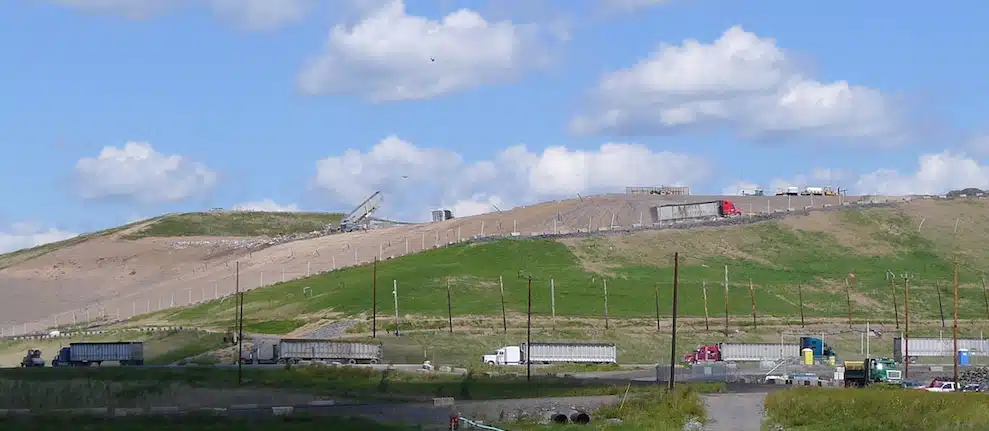
Speaking on behalf of Waterloo Container and its president, Bill Lutz, Pitifer delivered an extensive presentation urging the board to postpone both SEQRA reviews until the town obtained missing information about Seneca Meadows’ operations and its proposed PFAS treatment technology.
Pitifer argued the town was preparing to approve the leachate agreement without key data about the landfill’s planned “LEEF” PFAS-removal system, including:
- Its success rate, longevity, operational costs and performance with Seneca Meadows’ specific leachate;
- Independent validation of the company’s 99.99% PFAS-removal claim;
- Whether resulting concentrates would be considered hazardous waste;
- How many facilities currently use LEEF and with what results;
- The system’s capacity and hours of operation;
- What would happen to the treated liquid; and
- How LEEF compares to the landfill’s existing evaporators and RO system.
He cited historical problems with Seneca Meadows’ leachate management — including untreated discharges into the sewer system before 2014, RO concentrate recirculated back into the landfill as reported in SMI’s own annual report, and leachate evaporators that caught fire — arguing that the town must demand more detail before taking action.
Pitifer also devoted significant time to documented odor and gas-migration incidents, pointing to FOIL’d records showing landfill-related gases entering Waterloo Container and other businesses through sewer lines. He framed those incidents as symptoms of “systemic failure” in landfill maintenance and a continuing threat to public health.
He further warned that DEC had required Seneca Meadows to resubmit answers to 66 outstanding questions on its Valley Infill expansion application — questions the town has never seen. He urged the board to formally request those materials before voting on the host community agreement.
Pitifer’s remarks ultimately portrayed the evening’s votes as a generational decision for Seneca Falls. He argued that approving agreements without full information would pave the way for decades of expansion, predicting escalating environmental impacts, falling property values, business departures and long-term dependency on landfill revenue.
“This moment carries the weight of generations,” he said. “Seneca Falls deserves a future, not a fate.”
Black pushes back, says information is available, DEC will vet all new systems
Seneca Meadows district manager Kyle Black responded directly to Pitifer’s comments, defending the landfill’s operations and accusing critics of mischaracterizing the state of the Valley Infill review.
Black said Seneca Meadows submitted the Valley Infill application in July 2020, and that the DEC has been reviewing “reams of data” for nearly five years, including holding two public meetings when only one was required.
“All of our information is available,” Black said, inviting the board and public to review landfill data at any time.
Regarding the LEEF system, Black noted:
- It has not yet been built;
- Seneca Meadows has already submitted a minor permit modification for DEC review;
- The system will serve as pretreatment, with leachate still processed through existing RO and Dynatec systems;
- The landfill plans to bring representatives from Water & Carbon — including a Seneca Falls native involved in the technology — to present the system in detail at a future board meeting; and
- The investment represents $5 million and is intended to remove PFAS prior to any other treatment.
Black insisted the LEEF system has “nothing to do” with the agreements before the board and stressed that all treatment upgrades would undergo full DEC scrutiny.
Morell explains scope of SEQRA review and separation from Valley Infill
Town attorney Pat Morrell repeatedly clarified that the board was not evaluating the Valley Infill expansion under SEQRA. That review, he said, remains solely under DEC jurisdiction.
The Town Board’s role, he said, was limited to reviewing its own actions — specifically, the decision to enter into the leachate and host community agreements.
Both resolutions adopted Tuesday, including the formal negative declarations, explicitly state that the agreements are functionally independent of whether the Valley Infill project proceeds.
The resolutions also note that:
- Seneca Meadows will continue to generate leachate regardless of expansion;
- Payments under the leachate agreement do not alter the rights or obligations under the host community agreement;
- The landfill will still need mechanisms for treatment and disposal; and
- The Town Board determined that neither action poses significant adverse environmental impacts.
Board approves both agreements
The board ultimately approved both the leachate and host community agreements after completing SEQRA reviews for each.
Members first accepted Parts 1–3 of the environmental assessment forms, then issued negative declarations finding no significant adverse environmental impacts. The leachate agreement passed unanimously. The host community agreement also passed, though Councilor Jackson Puylara abstained. In both resolutions, the board formally determined that the agreements are independent of the proposed Valley Infill expansion and that DEC remains responsible for reviewing that project.
The board did not take up the additional resolutions requested by Pitifer, including seeking DEC’s 66 outstanding questions or requiring more information on SMI’s proposed PFAS-treatment technology.

FingerLakes1.com is the region’s leading all-digital news publication. The company was founded in 1998 and has been keeping residents informed for more than two decades. Have a lead? Send it to news@fingerlakes1.com.