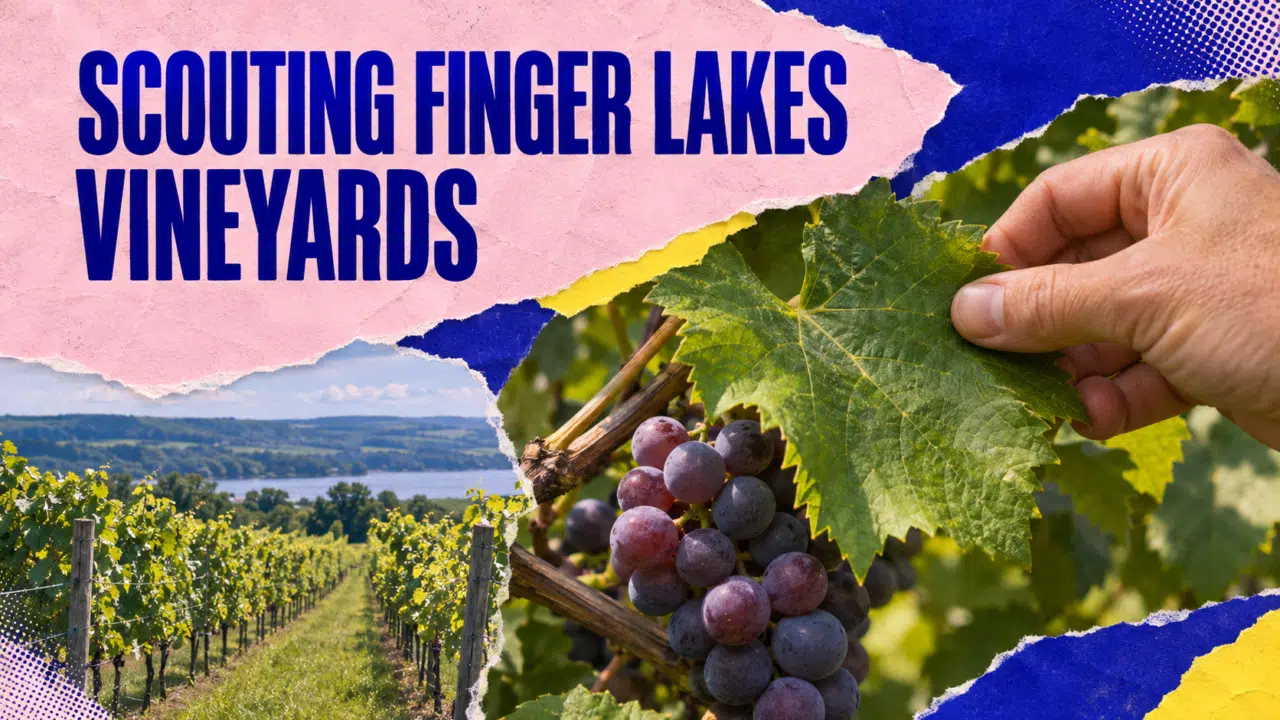
At two commercial vineyards near South Bristol, Cornell Cooperative Extension scouts looked for spotted lanternflies and other invasive pests in 2025. They found none of the insects they were targeting at those sites. That same summer, spotted lanternflies reached at least one commercial vineyard in neighboring Seneca County.
The findings, both in the Finger Lakes Grape Program’s report to Ontario County, show why growers check their own vines even when a pest is spreading nearby. A report from the next town can tell a grower what to watch for. What turns up in the vineyard helps determine whether it’s time to act.
That work has roots in Geneva, where Cornell researchers were helping New York apple growers manage pests in the 1970s. A Cornell economic study of the program that grew out of that work put the potential statewide agricultural benefit at $143.7 million over four decades, compared with $65.5 million in public funding, both in 2024 dollars.
What vineyard scouts saw
The Finger Lakes Grape Program worked with Cornell’s pest management staff, state agriculture officials and the regional invasive species partnership as lanternflies expanded from their 2024 detections in Ontario and Seneca counties. The team brought its findings and management advice to growers at a field meeting at Stanbro Vineyard near Naples in May 2025.

By this fall, the insects had been documented in Ovid, Geneva, Watkins Glen and some area vineyards. The Finger Lakes Partnership for Regional Invasive Species Management said its volunteers confirmed five detections across four counties during the 2026 field season, on a mix of public and private land. Those five came from the volunteer surveys. Other growers and agencies track sightings through their own work.
Cornell’s weather-based vineyard tools help growers decide when to look for pests and when a treatment may be useful. One tracks conditions associated with grape berry moth development. Another flags periods when vineyards could be at greater risk from spotted lanternfly. Growers can use those forecasts to decide when to walk the rows and check what’s there.
What the statewide estimate captures
The researchers drew on 19 examples with enough data to put a dollar value on a practice, such as avoiding crop damage or saving on treatment. One 1988 apple example accounted for $6.8 million in estimated statewide benefits in 2024 dollars. The study valued nine crop groups, including apples, onions and corn. Grapes were outside that calculation, and researchers assessed the use of the forecasting website separately.
The widely cited $2.19 per public dollar is the scenario that credits Cornell’s program with the full estimated benefit. When researchers credited it with half, to account for growers also getting advice from consultants and other sources, the estimate was $1.10 per dollar.
Vineyard operators in Ontario, Seneca, Schuyler, Steuben, Wayne and Yates counties can get help applying the research through the Finger Lakes Grape Program, which offers vineyard consultations and field meetings. Wayne County orchard growers can reach commercial fruit specialists through the Lake Ontario Fruit Program.
Make FL1 part of your day.
Local reporting. Useful updates. More ways to stay close to your community.
Go ad-free
Support independent local reporting and enjoy FL1 without display ads.
$4.99 / month
Become a member →Cancel anytime. Third-party media players may contain ads.Get the daily briefing
Start your morning with the headlines that matter across the Finger Lakes.
Find more FL1 on Google
Choose FingerLakes1.com as a preferred source to see more of our reporting in your Google news results.

FingerLakes1.com is the region’s leading all-digital news publication. The company was founded in 1998 and has been keeping residents informed for more than two decades. Have a lead? Send it to news@fingerlakes1.com.