

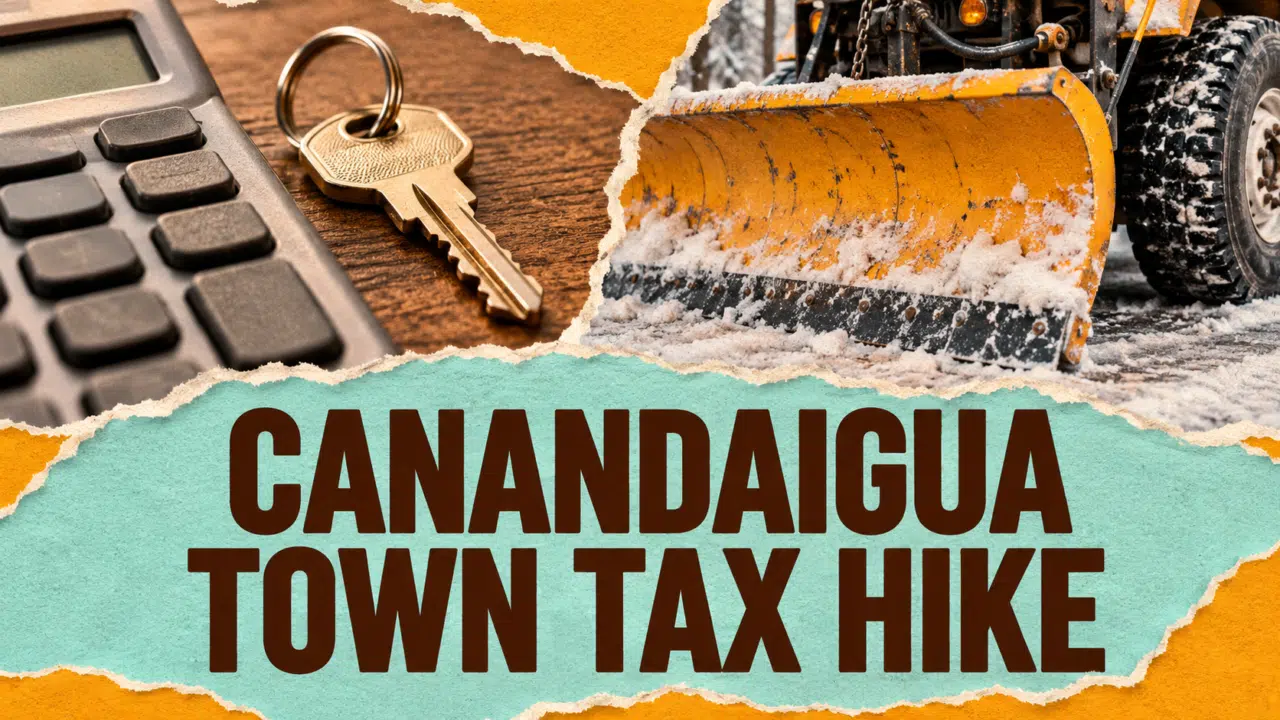
Town of Canandaigua property owners will pay a General and Highway tax rate of $2.16 per $1,000 next year after the Town Board approved a budget that shifts more annual expenses onto property taxes.
The rate rises 80% from this year’s $1.20. For a property assessed at $400,000 with no change in taxable value or exemptions, that means $864 in General and Highway taxes, up $384.
Those figures cover the town’s General and Highway funds. County, school and special district charges are separate.
The board adopted the budget 3-2 on Nov. 16. Supervisor Don Cotter and Councilmembers David Sauter and Scott Hall voted in favor. John Casey and Bobby Ellis opposed it.
Before that vote, the board unanimously approved a local law allowing the town to exceed its state property tax cap.
Spending rises 9.8%, while the levy rises 83.5%
The adopted budget provides $13.72 million in combined General and Highway spending, up approximately $1.22 million, or 9.8%.
The property tax levy increases much faster: from $2.37 million to $4.35 million, a gain of approximately $1.98 million, or 83.5%.
The larger tax increase reflects changes in how the town pays for its expenses, including less reliance on savings to cover recurring needs.
The board cut approximately $1.63 million from the preliminary General and Highway spending proposal, reducing the initially proposed rate from $2.85 to $2.16.
The adopted budget follows earlier debate over a proposal that would have more than doubled the town levy.
Cotter says equipment bills exposed a funding problem
Cotter used snowplow purchases to explain why he supported the increase.
He said two trucks costing approximately $600,000 had been ordered years earlier without enough money being set aside to pay for them when they arrived. The town ultimately used reserves and unassigned fund balance to cover the expense.
That kept the amount charged directly through the tax rate below the actual cost of operating the town, he argued.
Cotter said the 2027 plan begins setting aside money for known future expenses while rebuilding financial flexibility. It includes $175,000 toward a snowplow expected to cost approximately $340,000.

He also pointed to higher fuel, energy, insurance and employee benefit costs, saying further reductions could affect services residents expect.
Residents questioned why taxes needed to rise so sharply when spending was increasing by less than 10%. Several urged the board to postpone projects or find more reductions.
Casey says more cuts were available
Casey credited employees and board colleagues for their work but disputed Cotter’s conclusion that the budget had been reduced as far as reasonably possible.
He supported investments in equipment and infrastructure, acknowledging that some needs had been deferred. But he questioned spending elsewhere.
Among his examples were $65,000 for a parks master plan and $80,000 for legal expenses. He suggested the parks committee could update the existing plan at a lower cost and questioned whether the town should budget the same legal amount after a year involving several lawsuits and property transactions.
Casey also opposed spending associated with a property revaluation and questioned smaller increases across administrative accounts.
“I don’t believe it is as tight as it could be,” he said.
Ellis joined Casey in voting against adoption.
Justice compensation draws a separate disagreement
Casey also challenged how an increase in town justice compensation returned to the budget.
He said approximately $20,000 in additional compensation had not received a public discussion and questioned whether the board had voted on it.
Cotter initially recalled a workshop vote, then acknowledged that he had sought responses from board colleagues after the final workshop.
He said the higher compensation had previously been considered, reduced while Justice Walter Jones remained suspended with pay, and restored following Jones’ removal. Cotter said four board members had responded affirmatively to his inquiry and Casey had not responded.
The exchange occurred before the final budget vote. No separate amendment to remove the compensation increase was adopted during that discussion.
The town’s financial plan takes effect Jan. 1. Its General and Highway figures exclude special districts, which have their own tax rates and charges.
Make FL1 part of your day.
Local reporting. Useful updates. More ways to stay close to your community.
Go ad-free
Support independent local reporting and enjoy FL1 without display ads.
$4.99 / month
Become a member →Cancel anytime. Third-party media players may contain ads.Get the daily briefing
Start your morning with the headlines that matter across the Finger Lakes.
Find more FL1 on Google
Choose FingerLakes1.com as a preferred source to see more of our reporting in your Google news results.

FingerLakes1.com is the region’s leading all-digital news publication. The company was founded in 1998 and has been keeping residents informed for more than two decades. Have a lead? Send it to news@fingerlakes1.com.