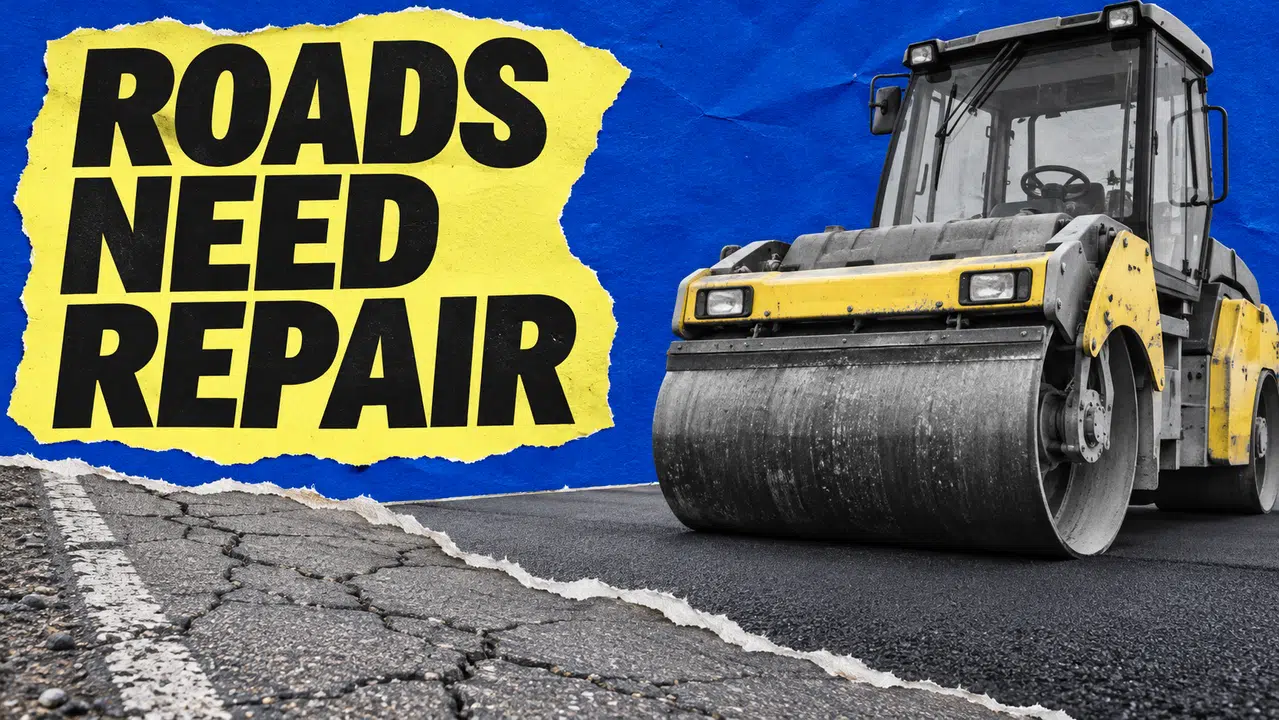
Repairing and preserving state highways in three regions serving the Finger Lakes and Central New York would require nearly $7 billion over five years, according to a new engineering study that warns delaying work will make deteriorating roads more expensive to fix.
The analysis estimates pavement investment needs of approximately $3.03 billion in the Syracuse region, $2.50 billion in the Rochester region and $1.48 billion in the Hornell region from 2027 through 2031.
Applied Pavement Technology prepared the 20-year pavement study for Rebuild New York Now, an infrastructure advocacy coalition. Released Nov. 16, it estimates needs across the full DOT regions, which extend beyond the Finger Lakes. The figures represent modeled investment needs, rather than approved funding or a measured gap between needs and existing appropriations.
The study covers state Department of Transportation-maintained pavement. Local roads, bridges and Thruway pavement are outside its scope.
Central New York’s biggest needs are off the Interstates
The Syracuse-based DOT region includes Cayuga, Cortland, Onondaga, Oswego, Seneca and Tompkins counties.
The study estimates that region needs an average of $605 million annually from 2027 through 2031 to improve pavement conditions and support a sustainable maintenance program. Approximately $566 million annually would go toward non-Interstate roads.
Using 2024 condition data, researchers found 17% of the region’s higher-traffic non-Interstate pavement was rated poor, compared with 13% of lower-traffic non-Interstate pavement and 2% of Interstate pavement.
The report also identifies a longer-term maintenance issue associated with Syracuse’s Interstate 81 redevelopment: Replacing elevated highway structures with surface roads will create additional pavement to maintain. Those future needs are not captured in the analysis.
For communities outside Syracuse, the findings put attention on the broader state highway network connecting smaller cities, villages and rural areas.
Lower-traffic roads stand out in the Rochester region
The Rochester region includes Ontario, Wayne, Livingston, Monroe, Orleans, Genesee and Wyoming counties.
Its estimated pavement need averages $499 million annually during the first five years, with approximately $453 million directed toward non-Interstate roads.
The study found the region had kept its Interstate and higher-traffic non-Interstate pavement within its good-repair thresholds. Lower-traffic highways presented a larger backlog.
In that category, 11% of pavement was rated poor and another 48% fair, leaving 41% rated good.
That distinction matters because fair pavement can deteriorate into a condition requiring more extensive rehabilitation. The report recommends matching repairs to a road’s condition while less expensive treatments can still extend its useful life.
For the Rochester region, approximately $456 million of the initial annual need falls into the renewal category, which includes rehabilitation and reconstruction.
Yates and Schuyler fall within a region with broader problems
The Hornell region covers Yates, Schuyler, Steuben, Chemung and Allegany counties.
Researchers estimated a five-year pavement need of approximately $1.48 billion, or $295 million annually. Unlike the Rochester region, Hornell’s region failed to meet the study’s good-repair thresholds across all three highway categories.
Its 2024 condition breakdown showed poor ratings for 4% of Interstate pavement, 15% of higher-traffic non-Interstate pavement and 7% of lower-traffic non-Interstate pavement.
The study also found the Hornell region had approximately 26.7 lane-miles of poor Interstate pavement, more than six other DOT regions combined. A lane-mile measures one traffic lane extending one mile.
The recommended initial annual investment includes approximately $67 million for Interstate pavement and $228 million for non-Interstate pavement.
Why the report favors earlier repairs
Statewide, the study estimates approximately $29.5 billion in pavement investment is needed from 2027 through 2031. It places the 2024 repair backlog at $10.3 billion, up from $4.3 billion in 2014.
The authors attribute that increase to deteriorating pavement and higher construction costs.
Their recommended approach combines substantial early rehabilitation with continued preservation of roads that remain in better condition. Crack sealing and thinner overlays can extend pavement life before major rehabilitation or reconstruction becomes necessary.
The model uses 2024 DOT pavement data, engineering assumptions about deterioration and treatment performance, and projected construction-cost inflation. The authors caution that their calculated condition summaries may differ slightly from DOT’s official published figures.
Rebuild New York Now, a coalition of business, labor, transportation and community organizations, is asking state officials to incorporate the findings into the next DOT capital plan.
“The next NYSDOT capital plan should include the full $29.5 billion needed for State pavement recovery over five years,” coalition President Mike Elmendorf said in the study’s release announcement.
The coalition also wants annual condition and production benchmarks showing whether investments are reducing the share of pavement rated fair or poor.
Make FL1 part of your day.
Local reporting. Useful updates. More ways to stay close to your community.
Go ad-free
Support independent local reporting and enjoy FL1 without display ads.
$4.99 / month
Become a member →Cancel anytime. Third-party media players may contain ads.Get the daily briefing
Start your morning with the headlines that matter across the Finger Lakes.
Find more FL1 on Google
Choose FingerLakes1.com as a preferred source to see more of our reporting in your Google news results.

FingerLakes1.com is the region’s leading all-digital news publication. The company was founded in 1998 and has been keeping residents informed for more than two decades. Have a lead? Send it to news@fingerlakes1.com.