

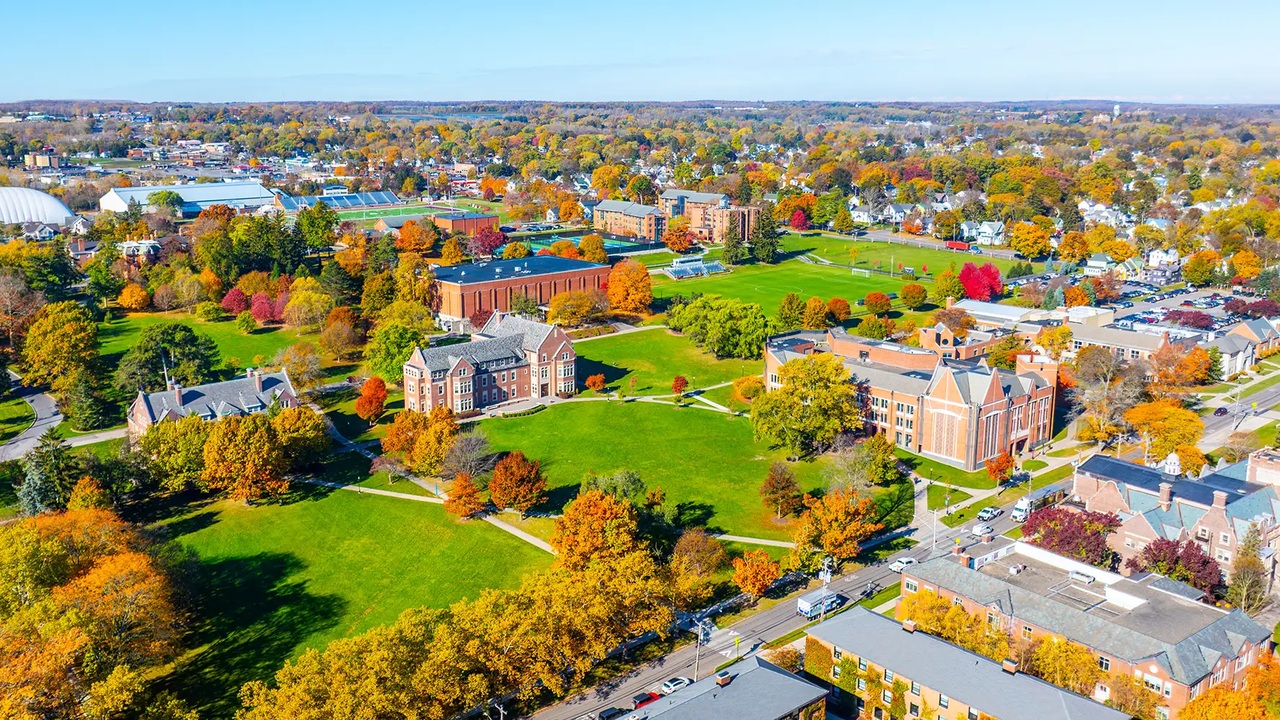
Hobart and William Smith Colleges students can complete a master’s degree in criminal justice administration at Niagara University in two semesters instead of three under a new agreement open to students in any major.
The agreement lets students earn up to nine graduate credits by building on sociology courses they took as undergraduates. The shorter path could save students more than $6,500 in tuition, Hobart and William Smith said Friday.

How students qualify and earn credit
To qualify for admission through the agreement, students must graduate from Hobart and William Smith with at least a 3.0 GPA and complete three of four approved courses taught by sociology professor James Sutton. The options are Juvenile Delinquency, Penology, Sociology of Police and Policing, and Criminology.
After enrolling at Niagara, students complete additional assignments and submit a portfolio for faculty review. Students whose work meets graduate standards can earn credit for as many as three courses. A student who took juvenile delinquency at HWS, for example, could write a graduate-level research paper to earn credit for the subject.
Sutton said students can use the pathway to build on interests they developed in other majors. A chemistry student might pursue forensic science, while a psychology student might be interested in victim advocacy. The colleges also pointed to potential careers in corrections, forensic accounting and public policy.
Research and fieldwork at Niagara
Niagara faculty work with community organizations on issues including domestic violence, addiction, homelessness and rehabilitation. Dana Radatz, Niagara’s graduate director for criminal justice administration, works with eight or nine Niagara County agencies that serve victims or address family violence.
Radatz and a colleague secured two federal grants from the Justice Department’s Office on Violence Against Women to establish Niagara’s Office for Violence Prevention and Education. Graduate students help organize advocacy events, develop social media campaigns and conduct research with community partners.
Hobart and William Smith Colleges
More reporting on this topic.
Explore this topic →One Niagara graduate student preparing for law enforcement work with victims helped organize prevention events, wrote a technical report using student survey data and gathered research for a textbook on law enforcement and risk assessment. He had previously interned with a local victim assistance unit.
Another student, a political science graduate now attending Cornell Law School, worked with community partners through an assistantship in Niagara’s violence prevention office. She completed three internships, one with a district attorney’s office and two with victim service providers.
Hobart and William Smith students can consult the colleges’ Criminal Justice Graduate Pathway page for application requirements or contact Sutton at jsutton@hws.edu.
Make FL1 part of your day.
Local reporting. Useful updates. More ways to stay close to your community.
Go ad-free
Support independent local reporting and enjoy FL1 without display ads.
$4.99 / month
Become a member →Cancel anytime. Third-party media players may contain ads.Get the daily briefing
Start your morning with the headlines that matter across the Finger Lakes.
Find more FL1 on Google
Choose FingerLakes1.com as a preferred source to see more of our reporting in your Google news results.

FingerLakes1.com is the region’s leading all-digital news publication. The company was founded in 1998 and has been keeping residents informed for more than two decades. Have a lead? Send it to news@fingerlakes1.com.