Strict school cellphone restrictions are associated with small improvements in learning, according to a new national study, offering New York educators evidence of a benefit while leaving major questions about the size and consistency of the gains.
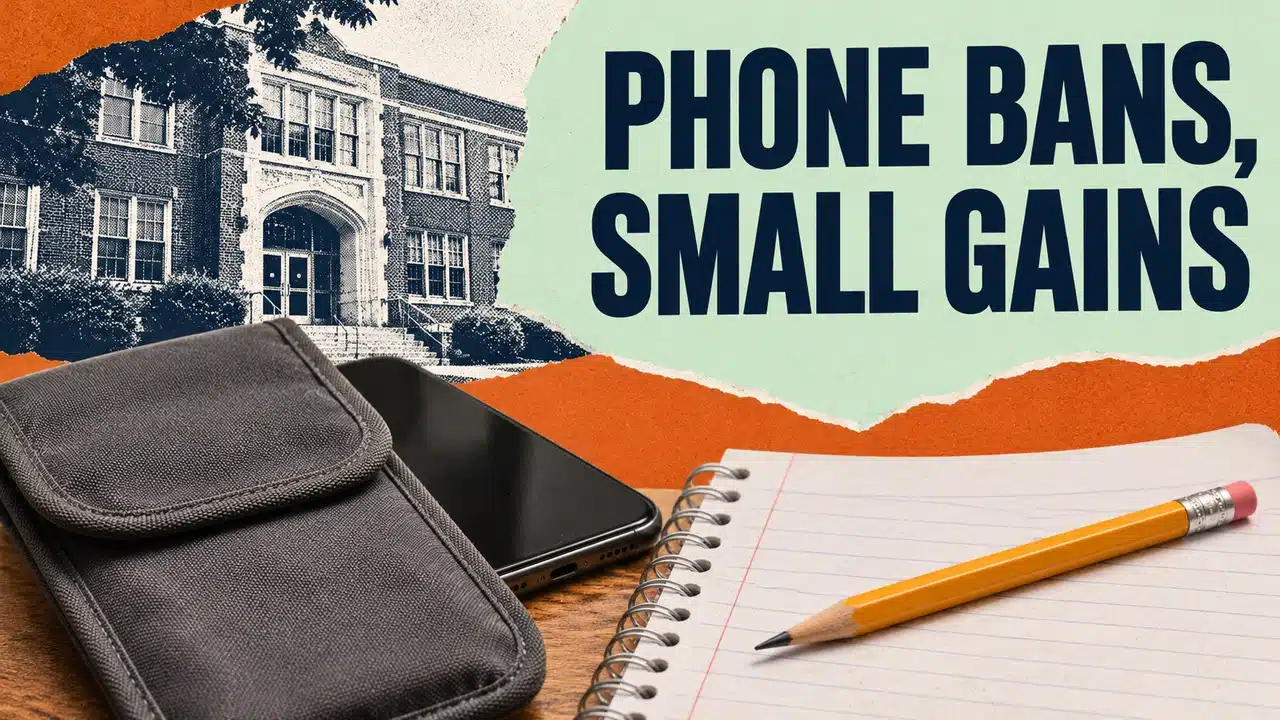
Researchers at Harvard’s Center for Education Policy Research, Dartmouth College and NWEA examined about 3.3 million students at 4,600 schools. Their analysis found that requiring students to store phones in lockable pouches was associated with annual achievement growth equivalent to roughly one to two additional weeks of instruction.
The findings arrive as New York districts work through the effects of the state’s school-day smartphone restrictions, which began in the 2025-26 school year.
Researchers found a small annual improvement
The study announced Nov. 17 followed math and reading growth using NWEA testing data from the 2021-22 through 2025-26 school years. It included students in grades three through 10 across districts in 49 states and the District of Columbia.
Schools adopting lockable pouches showed an annual improvement of about 0.01 standard deviations in achievement growth. The authors translated that into one to two weeks of learning and said gains appeared to persist over several years.

The researchers also examined statewide restrictions, but cautioned that those findings could be affected by trends already underway in states that adopted bans.
Other research leaves room for disagreement
A separate National Bureau of Economic Research working paper examined lockable pouches using teacher surveys, phone-location activity, test scores and administrative records.
That analysis found reduced phone use and an initial rise in disciplinary incidents that faded over time. Its broader findings did not establish a clear, uniform academic benefit, although researchers identified some positive results, particularly in high school math.
Together, the studies suggest that reducing phone access can change classroom behavior without immediately producing large or consistent changes in test scores.
New York districts are confronting enforcement questions
Ithaca’s experience has included continued phone use and increased disciplinary referrals, illustrating the difference between adopting a restriction and enforcing it consistently.
Students also distinguish between classroom restrictions and all-day rules. A recent national survey found that most high school students supported classroom limits while opposing bans lasting the entire school day.
Harvard’s researchers identified another unresolved issue: how students’ phone and social media use outside school affects learning. The school-based results do not answer that question, leaving districts and families with separate challenges during class and after dismissal.
Make FL1 part of your day.
Local reporting. Useful updates. More ways to stay close to your community.
Go ad-free
Support independent local reporting and enjoy FL1 without display ads.
$4.99 / month
Become a member →Cancel anytime. Third-party media players may contain ads.Get the daily briefing
Start your morning with the headlines that matter across the Finger Lakes.
Find more FL1 on Google
Choose FingerLakes1.com as a preferred source to see more of our reporting in your Google news results.

FingerLakes1.com is the region’s leading all-digital news publication. The company was founded in 1998 and has been keeping residents informed for more than two decades. Have a lead? Send it to news@fingerlakes1.com.