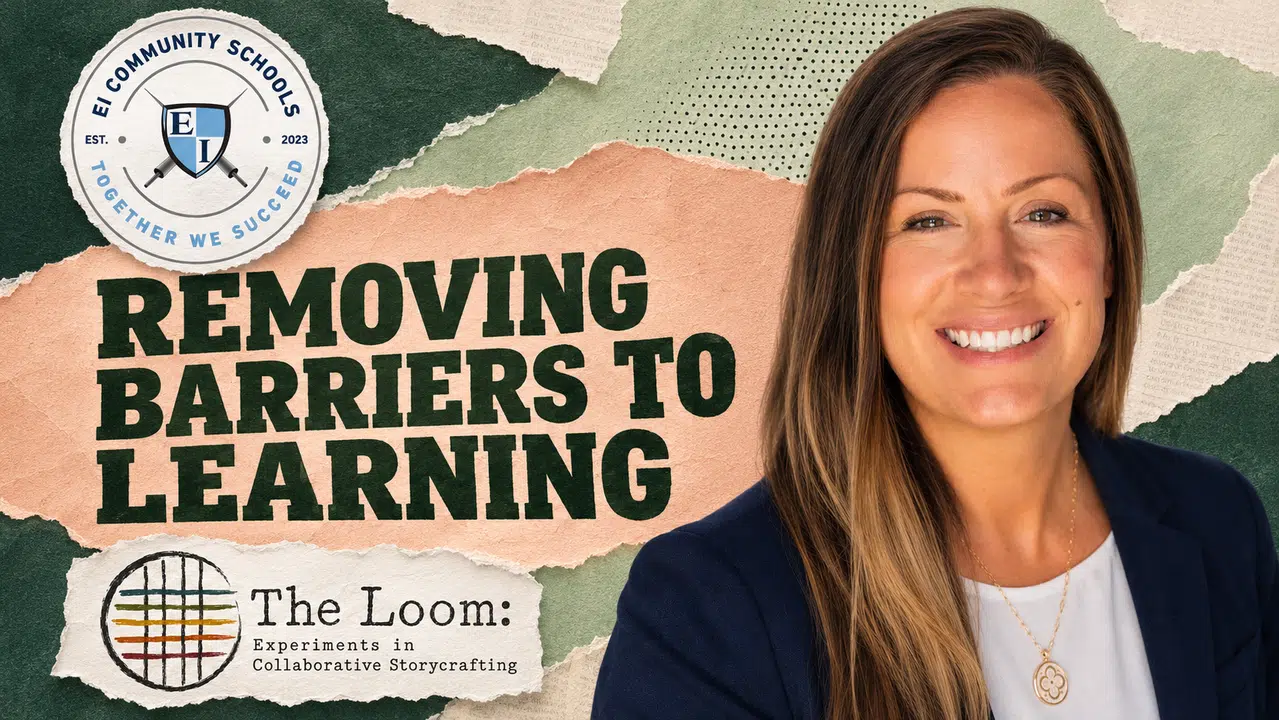
Before Lindsay Gallagher notices a lesson plan or a classroom bulletin board, she notices something less visible. She notices the emotional climate. When she walks into a school, she begins with simple questions. What do students see when they enter the building? What messages line the walls? Do they signal belonging, expectation, and care, or do they quietly communicate indifference?
As District Community Schools Coordinator for East Irondequoit, Gallagher has learned to read schools the way a clinician reads vital signs. Attendance patterns, food access, housing stability, transportation gaps, mental health needs, and family relationships all form part of a larger diagnostic picture. Academic performance is inseparable from the conditions that shape daily life.
“This work is about removing barriers,” she says, “so our students and families can thrive.”
Gallagher did not begin her career expecting to work in systems change. Raised in Rochester after being born in nearby Greece, she was drawn to reading, writing, and learning from an early age. She remembers teachers who led with care rather than control. “I wanted students to feel seen.” After studying education at Nazareth University, she entered the classroom in 2015. It did not take long to realize that what happens outside school often carries more weight than what happens inside it.
“You learn very quickly how much a student’s success in school translates into their success in the future,” she says.
But alongside that realization came another. Many barriers to learning had little to do with academics. Hunger, unstable housing, mental health challenges, transportation issues, and family stress often arrived before students did. That understanding eventually pulled her toward Community Schools, a strategy that reimagines schools not only as places of instruction but as hubs of coordinated support for children and families.
Today, Gallagher describes her perspective as a “balcony view,” a wider lens that reveals not just individual students but the interconnected systems around them, including schools, nonprofits, health providers, and local agencies working together.
The shift deepened during the COVID-19 pandemic.
“As a teacher, I would notice a student was absent and mark it down,” she says. “In this role, absence means something else. It means our team can reach out. We can help.”
In East Irondequoit, that philosophy translates into action. Families are connected to services and resources within the school and community. Food pantries operate inside schools. Winter clothing, hygiene supplies, transportation assistance, and enrichment programs are embedded into the educational environment. Teachers focus on instruction while a broader network addresses the conditions that make learning possible.
What is getting in the way? Is it transportation? Housing instability? A morning routine that needs support? Or something deeper that requires coordination across systems? “Community Schools serve as connective tissue,” Gallagher says. “Teachers can teach. We can support. Students can thrive.”
As the work of Community Schools has expanded, so has the leadership structure supporting it. Gallagher works closely with Carly R. Jelsma, Director of Student Services for East Irondequoit, who joined the district a year ago. Jelsma has helped align the growing Community Schools work around shared priorities.
That collaboration also extends to how the district engages outside organizations. Community partners are evaluated based on alignment with district goals and genuine benefit to students and families. Jelsma’s role is essential in maintaining coherence as the strategy grows. As Student Services Director, she helps ensure partnerships are aligned and purposeful.
Together, district leaders have focused on reducing chronic absenteeism through outreach and building structured attendance plans, strengthening family engagement, and clarifying roles across educators, administrators, mental health teams within buildings, families, and community partners. The goal is coordination rather than fragmentation. From the beginning, collaboration has been central.
In 2025, East Irondequoit conducted a districtwide Needs and Assets Assessment. The process gathered input from nearly 2,000 community members across diverse backgrounds, ages, and roles, alongside daily connections with students, staff, families, and partners. The goal was not only to identify gaps, but also to understand strengths already present and use them to guide strategy. The assessment reinforced a core principle of the Community Schools strategy. Solutions must be shaped by the lived experience of those they are designed to serve. Community Schools staff provide direct assistance that can include emergency food, clothing and shoes, transportation support, and connections to physical and mental health resources within the community.
“We try to meet needs as they come up,” Gallagher says. “Sometimes that means immediate support. Sometimes it means helping families navigate longer-term systems.”
For families needing more immediate help, the district also connects residents to MyWayfinder, a tool that links community members with local agencies and organizations that provide direct assistance. Taken together, these supports reflect a shift in how the district defines its role. Schools are no longer only places of instruction, but access points to a wider network of care, where academic success is supported by stability and connection.
Earlier assessments had already pointed to gaps and opportunities, including a need for expanded after-school programming. Families asked for more structured activities and care for students entering sixth grade, leading to a five-year YMCA partnership offering tutoring, cooking, recreation, and enrichment.
But the work has continued to evolve. The guiding question across much of it is simple. “It’s about being intentional,” Gallagher says.
That philosophy has shaped new initiatives made possible through Community Schools grant funding. One was the district’s first English as a New Language Family Night, which brought multilingual families together for food and connection. Dinner was provided by Halal-N-Out, and staff ensured families could fully participate. Another was a literacy-focused family engagement night in partnership with Writers & Books, Barnes & Noble, the PTA, and community organizations. Families explored reading strategies, attended presentations, and connected with resources for learning at home.
These events reflect a broader shift. Engagement is no longer transactional. It is both intentional and relational.
The district has continued its partnership with the Irondequoit Community Cupboard, a critical resource for addressing food insecurity. Staff ensure families are connected not only during moments of immediate need but also to ongoing support systems. Between Thanksgiving, Winter Break, February Break, Spring Break, and Summer Break, the district distributes “break boxes,” packages of supplemental non-perishable food designed to help families bridge gaps when school meals are unavailable.
Across those breaks, approximately 100 families received food support this past year. These efforts are not separate from education but integral to it. When students return to school nourished and stable, learning becomes more possible. When families know where to turn, schools become anchors rather than institutions.
“You build trust by meeting families where they are,” Gallagher says. “And then you keep showing up.”
That trust appears in small but telling ways, a parent returning a call, a student stopping by the office just to say hello, families reaching out before crisis builds. Over time, those moments accumulate into something larger. A shift in how schools function within community life.
Gallagher believes community schools are not about adding programs to an existing system. They are about reshaping the system itself, so it responds to the realities of children’s lives. That belief has become personal. Since becoming a mother to a young son, Gallagher says her understanding of balance has changed. Work and family now overlap in ways that require constant adjustment. It has deepened her understanding of what children need to feel safe and ready to learn. “Community Schools isn’t a program,” she says. “It’s about organizing systems and structures to make schools the best possible places for our students and families. That is community.”
Much of the work happens quietly. But its effects accumulate in visible ways. A child arrives fed. A family finds support without stigma. A parent learns they are not alone.
In East Irondequoit, education is increasingly defined not only by what happens inside classrooms, but by everything that makes those classrooms possible.
And sometimes it begins with something as simple, and as profound, as what a child sees when they walk through the front door, and whether that school is ready to see them back.
Make FL1 part of your day.
Local reporting. Useful updates. More ways to stay close to your community.
Go ad-free
Support independent local reporting and enjoy FL1 without display ads.
$4.99 / month
Become a member →Cancel anytime. Third-party media players may contain ads.Get the daily briefing
Start your morning with the headlines that matter across the Finger Lakes.
Find more FL1 on Google
Choose FingerLakes1.com as a preferred source to see more of our reporting in your Google news results.
Add FL1 on Google ↗Choose FL1 and confirm your selection on Google.
George Cassidy Payne is a Rochester-based nonprofit leader, educator, and advocate for sustainable economic development. With a philosophy and social work background, George has spent over two decades addressing issues of equity, public policy, and crisis intervention. His community development and environmental sustainability expertise informs his commitment to strengthening Rochester’s regional economy.