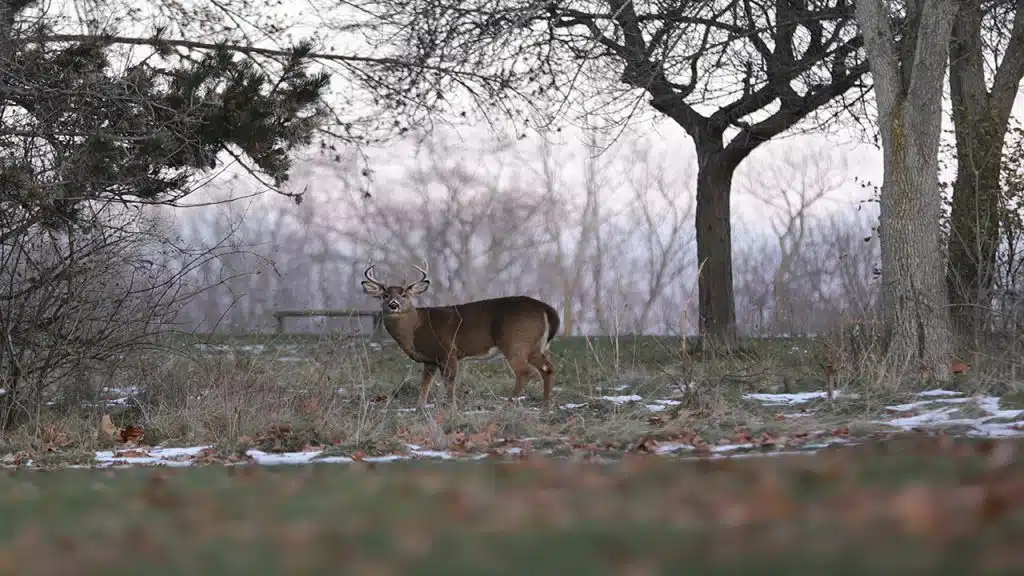
New York has detected chronic wasting disease in a wild deer for the first time since 2005, prompting mandatory testing and restrictions on moving deer from six Livingston County towns.
The state Department of Environmental Conservation said Friday that Cornell University testing identified the disease in an adult female deer from Sparta. Confirmatory testing at the U.S. Department of Agriculture’s National Veterinary Services Laboratories in Ames, Iowa, is underway, according to the state announcement.

DEC and the Department of Agriculture and Markets are establishing a containment area covering Conesus, Groveland, North Dansville, Sparta, Springwater and West Sparta. Officials said the area could expand as the investigation proceeds.
Hunters must submit samples from all deer harvested in those towns. Whole deer cannot leave the containment area without a DEC permit.
What hunters need to do
DEC plans to begin collecting samples Nov. 12. Collection locations and hours will be announced separately. Hunters who harvest deer before collection begins should save the heads and contact cwd.response@dec.ny.gov for instructions.
Hunters taking deer to a processor or taxidermist outside the containment area need a DEC transport permit. DEC encourages hunters and processors to use paper carcass tags or change-of-possession tags to confirm where the deer was harvested.
An accompanying carcass-tag form explains that hunters using electronic tags must attach identifying information before transferring an animal, leaving it at camp or taking it to a processor. The information includes the hunter’s name, DEC identification number, harvest confirmation number and town of harvest. Hunters may use the state’s printable tag or make a tag with the required information.
DEC said it will notify hunters whose deer test positive and request the venison for proper disposal. Hunters seeking testing outside the containment response can find information through Cornell’s Wildlife Health Lab; that testing carries a fee.
DEC and Agriculture and Markets also will contact captive deer herds in the area and request their records. Officials encouraged the public to report sick or dying deer to DEC for possible collection and testing.
Additional restrictions and public information
The agency said it will file notice in the Environmental Notice Bulletin under the state’s chronic wasting disease rules, 6 NYCRR Part 189, to establish additional restrictions. Those planned measures include limits on moving high-risk parts, such as the brain, spinal cord, spleen and eyes, out of the area.
The notice would require samples and prohibit possession of deer killed by motor vehicles in the containment area. It also would prohibit collecting, selling, possessing or transporting deer or elk urine from the area, and rehabilitating wild white-tailed deer from or brought into the area. The announcement describes those additional regulatory steps as forthcoming.
DEC has scheduled a public webinar for 7 p.m. Tuesday, Nov. 17. Registration is available online. An in-person meeting in Livingston County will be announced later.
The state’s interagency response plan calls for intensified surveillance around a detection and a containment area based on the circumstances of the case. Its broader options include targeted deer removal when hunter harvest does not provide enough samples; the announcement does not identify a removal operation for this detection.
A fatal disease with lasting consequences
Chronic wasting disease is a fatal disease affecting the brain and central nervous system of deer, elk and moose. The state has tested more than 70,000 deer since its surveillance program began in 2002.
New York’s earlier wild-deer cases were found in Oneida County in 2005. A separate detection in a captive red deer herd in Herkimer County in 2024 did not establish a new wild-deer case.
DEC said there is no evidence linking the disease to illness in humans, dogs, cats or livestock. The state nevertheless advises following federal guidance against eating meat from an animal that tests positive. Owners whose pets have been exposed to a sick or dead deer should contact a veterinarian.
Updated containment-area instructions and disease information are available on DEC’s chronic wasting disease page.

FingerLakes1.com is the region’s leading all-digital news publication. The company was founded in 1998 and has been keeping residents informed for more than two decades. Have a lead? Send it to news@fingerlakes1.com.