New York regulators declined to advance a proposed Ithaca thermal energy network while authorizing two other projects that will test shared heating and cooling systems in Buffalo and Haverstraw.
The Public Service Commission’s Oct. 15 decision allows National Fuel Gas Distribution’s Buffalo project and Orange & Rockland Utilities’ Haverstraw West Loop project to proceed toward customer enrollment and construction.

The two projects represent a combined $111.5 million investment, with $93 million coming from the state’s Sustainable Futures Program. The commission declined to advance nine other proposed pilots that sought more than $1 billion in ratepayer funding.
Ithaca proposal among those not advancing
NYSEG’s Ithaca proposal had a forecast total budget of $52.48 million, with $3.37 million spent through August, according to the state’s project comparison.
The commission assessed costs, potential energy and emissions savings, effects on utility customers, scalability and implementation issues across the proposals.
For projects that are not advancing, about $40.88 million in combined development costs through the second stage will be deferred for consideration in later rate proceedings. Utilities must submit reports detailing those costs within 60 days.
The decision advances a limited set of pilots while the state continues developing rules and guidance for thermal energy networks.
How shared heating works
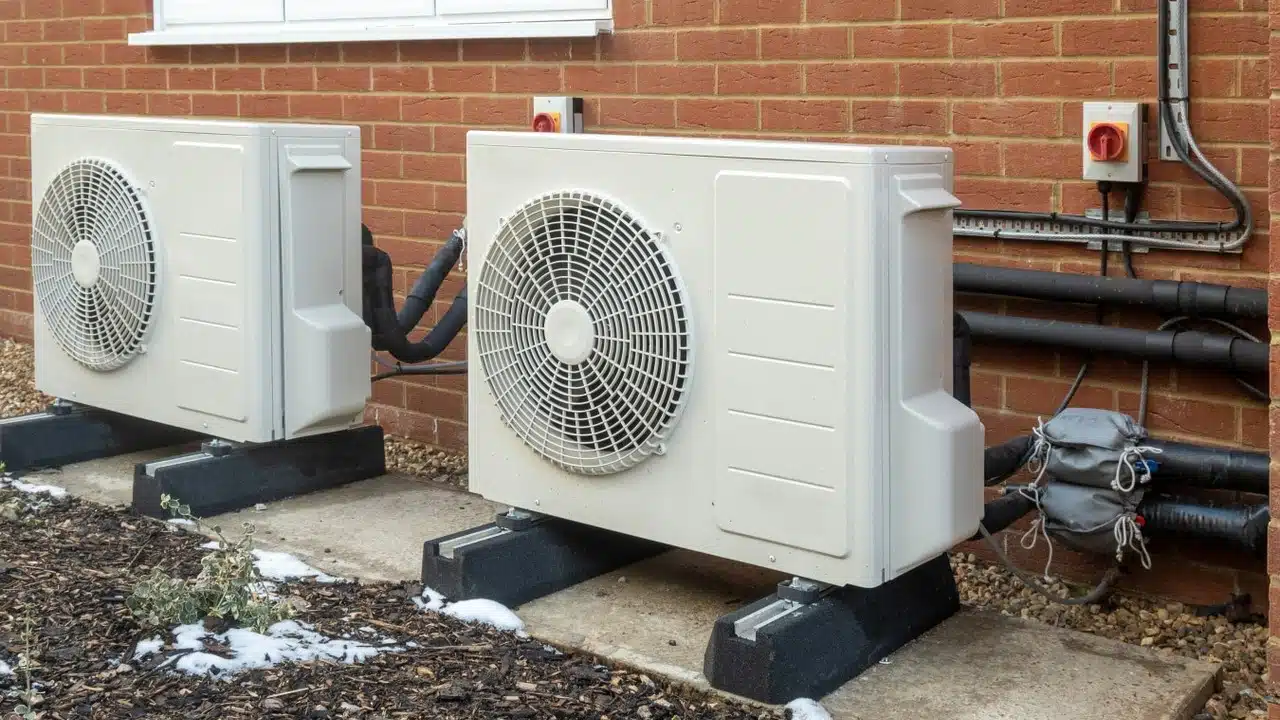
Heat pumps use electricity to move heat rather than generate it through combustion. Ground-source systems exchange heat with the earth through buried loops containing circulating fluid.
In winter, a heat pump takes heat from that fluid, concentrates it and transfers it into a building. In summer, it can remove heat from a building and move it underground.
The U.S. Department of Energy says the approach can serve individual homes or larger networks, including campuses and neighborhoods. Some systems also provide hot water.
Ground-source systems use the earth’s relatively stable temperatures, while air-source heat pumps exchange heat with outdoor air. Underground loops can be installed vertically or horizontally, depending on the system and site.
What the approved pilots will test
Buffalo’s $61.4 million project will serve 12 affordable multifamily buildings and a municipal building. It will combine heat from wastewater and geothermal boreholes and connect with the existing district energy system.
Haverstraw’s $50.1 million West Loop project will use two geothermal borefields and a wastewater heat exchanger to provide heating, cooling and hot water across a roughly 10-acre area containing municipal, commercial and residential buildings.
Before construction, the utilities must meet customer enrollment requirements and obtain necessary permits, approvals and land-use agreements. Project-specific customer protection plans must be filed within 120 days.
The state also plans to use lessons from the proposals to develop a thermal energy network roadmap and a regulatory framework for future projects.

FingerLakes1.com is the region’s leading all-digital news publication. The company was founded in 1998 and has been keeping residents informed for more than two decades. Have a lead? Send it to news@fingerlakes1.com.