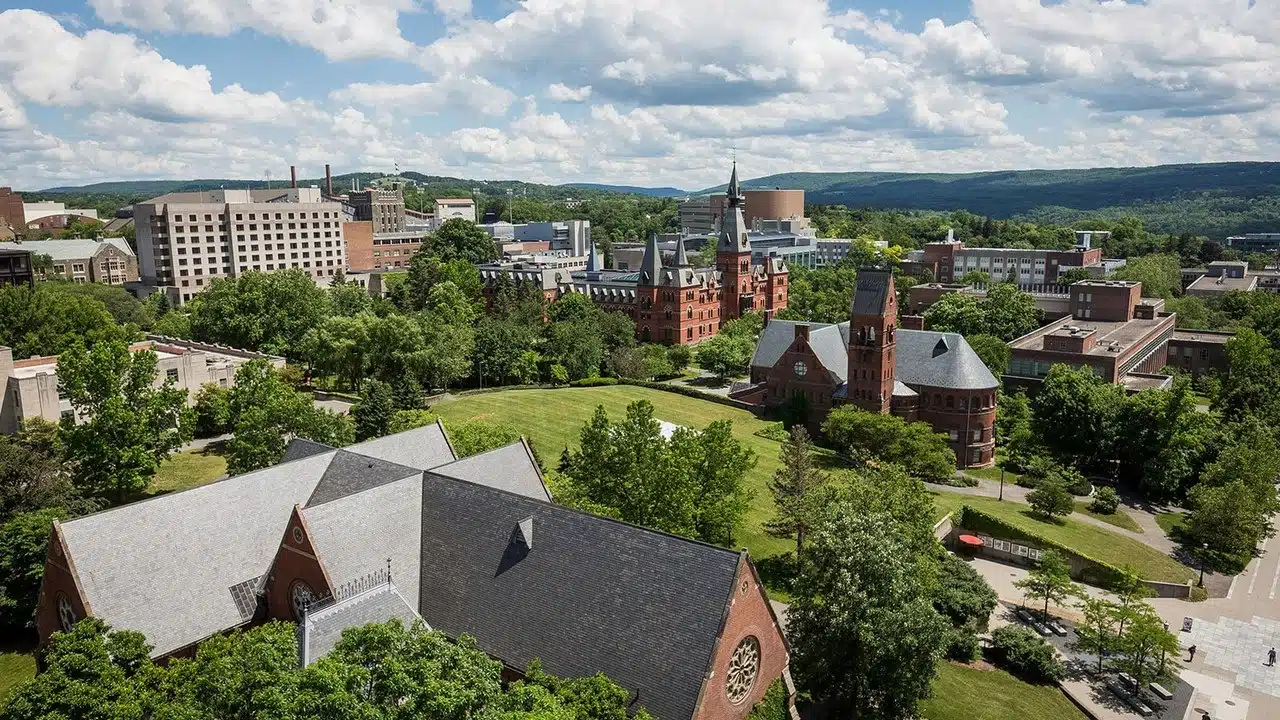
Straw-filled timber frames, mushroom-grown panels and rammed-earth columns are helping a Cornell University architecture lab explore how buildings can use natural materials and eventually return them to the landscape.
The Regenerative Architecture Lab in Ithaca, directed by architecture lecturer Marta Wisniewska, studies materials that could reduce construction waste and reliance on petroleum-based products, according to Cornell.

Its projects include temporary structures designed to weather and decompose, as well as experiments in insulation and structural components. The work remains research into building systems and their life cycles, rather than a claim that every material is ready for widespread construction.
Straw shelters with another use ahead
At BuildFest 2026 at the Bethel Woods Center for the Arts in Bethel, the lab's BaleWorks project used modular timber frames packed with dense straw bales from upstate farms.
The structure initially serves as a campground shelter and performance stage. A possible later use is a restroom, with the frames allowing weathered bales to be replaced and the old straw used for soil remediation.
Straw can store carbon while it is part of a building and return nutrients to soil afterward. Wisniewska's work considers those functions together, asking what happens to a material before construction, during use and after a structure comes down.
The project received support from the Cornell Council for the Arts. A proposed future partnership with plant scientist Rebecca Nelson would explore recovering nutrients from urine for fertilizer.
Growing panels instead of manufacturing them
Students in the spring 2026 Home:Grown seminar grew mycelium, the rootlike network of fungi, on substrates in controlled chambers. After several weeks, they shaped the material in rigid or fabric molds, allowed further growth and dried it in a solar oven.
The resulting forms included bricks, panels and tubes. Students explored possible interlocking walls, roof tiles and insulating curtains, along with natural dyes.
The lab has tested roughly 40 mycelium strains with Kathie Hodge, a plant scientist associated with Cornell's Plant Pathology Herbarium. Work with Connor Youngerman of Cornell Small Farms and edible mushroom producers also explores reusing spent growing substrate, with support from the Einhorn Center.
An earlier BuildFest project, MycoShell, used three catenary arches made from laminated mycelium panels and natural fabric. Follow-up research examined growing thin panels separately and joining them biologically, seeking more uniform growth, stiffness and strength.
The temporary structure was allowed to weather and collapse. Researchers retrieved nonbiological screws while leaving the remaining material to decompose on the forest floor.
Testing how earth stands and fails
The lab's TerraFirma/NewGrounds project placed nine rammed-earth columns on Cornell's Engineering Quad in June 2023. Each was 8 feet tall and 18 inches in diameter, with different combinations of regional gravel, sand, silt and clay.
Researchers observed weathering, maintenance needs and stability for seven months before deliberately toppling the columns to study failure.
The experiments could inform future material standards, but code development remains part of the work. Cornell describes the broader goal as designing structures with their eventual reuse, replacement or return to the environment in mind.

FingerLakes1.com is the region’s leading all-digital news publication. The company was founded in 1998 and has been keeping residents informed for more than two decades. Have a lead? Send it to news@fingerlakes1.com.