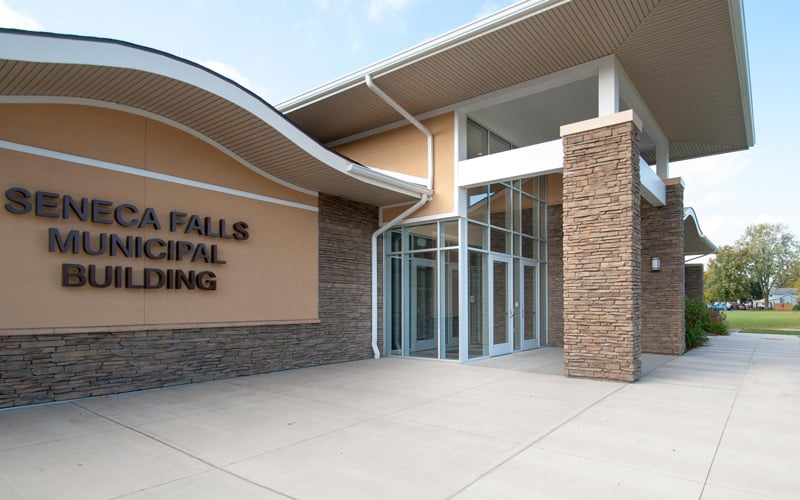
More than five hours of debate over Seneca Falls’ 2027 budget ended Oct. 22 with members tallying $436,556 in proposed cuts, agreeing to leave one police vacancy unfilled and settling on a proposed 4% tax increase.
The third workshop stretched into a second review of department requests as Town Board members searched for savings in the tentative budget. The agreements will guide a revised spending plan; final budget adoption and action on a tax-cap resolution remain ahead.
Landfill money and savings divide the board

The central dispute was how much landfill revenue and accumulated savings should support town operations.
Supervisor Frank Schmitter argued that repeated withdrawals to cover recurring expenses would leave Seneca Falls facing larger tax increases or service cuts when landfill revenue ends. Councilman Jackson Puylara also pressed for reductions, citing the town’s fiscal resilience recommendations.
Councilwoman Wendy Crane sought a clearer accounting of unspent taxes, landfill receipts, reserves and utility funds. She argued that available money should help preserve services and limit tax increases.
Accounting staff presented an estimated fund balance of about $6.58 million and warned that using several million dollars for the coming budget would sharply reduce what remained for another year.
Members also debated a town policy described at the meeting as allowing 25% of landfill receipts for budgeted expenses while directing 75% to reserves. They discussed revisiting it but made no change.
A Seneca Meadows representative advised budgeting for the host agreement’s $4 million minimum payment in 2027. Another $3 million would depend on the landfill receiving permits specified in the agreement. Payments for treating landfill leachate support the separate sewer fund.
Police vacancy becomes the closing compromise
The police vacancy accounted for approximately $130,000 of the proposed savings, including salary and benefits.
Puylara favored leaving it unfilled. Crane opposed reducing staffing, citing neighborhood safety, while police representatives reported increases in calls for service and other workload measures.
Schmitter questioned staffing levels, supervisory schedules and whether state police and sheriff’s deputies could provide more assistance. Other participants challenged whether outside agencies could supply routine patrol coverage.
Councilwoman Gabby Cosentino initially supported filling the vacancy but pushed for cuts elsewhere before reconsidering it. After members tallied about $306,556 in other reductions, they agreed to leave the position open, bringing their closing total to $436,556.
The agreement concerned a vacancy rather than dismissing an officer. Members also supported retaining three investigator positions, including the position handling drug investigations.
Recreation and public works requests shrink
Members scaled back recreation staffing plans, reducing two proposed part-time cleaners to one and removing funding for a proposed part-time recreation leader.
They also cut an $8,000 equipment allowance discussed during the workshops to $1,000, dropping a treadmill purchase, and reduced parks landscaping funding from $5,000 to $3,000.
Crane raised closing the pool at Vince’s Park while retaining its pavilions. The discussion produced no agreement to close either the pool or park.
The board again debated eliminating the Department of Public Works and transferring employees to Highway, without agreeing to a reorganization. Instead, members reduced public works materials funding from the previously discussed $50,000 to $30,000 and retained its $57,000 equipment and operating allowance.
Eligible pipe purchases could come from the storm drain reserve with board approval.
Members reduced the street sweeper allowance from $61,500 to $31,500, anticipating at least $30,000 from selling or trading the existing machine. Cemetery reductions included $10,000 for one mower and lowering the Cemetery Commission allocation from $40,000 to $30,000.
Accounting and management costs face cuts
Members lowered the account used for ProNexus accounting services from $250,000 to $150,000 after renewed criticism of costs and unfinished financial work.
Crane urged consideration of hiring an accountant. Schmitter cautioned against immediately ending the relationship while older records remained unreconciled. Members also discussed proposals for replacement services.
Other revisions included reducing the prospective town manager’s salary allowance from $120,000 to $110,000, setting general engineering funding at $175,000 and lowering an information technology contract allowance from $80,000 to $60,000.
Members retained $75,000 for computer and security equipment after Town Clerk Melissa Brown described problems with cameras and their storage system.
Development funding stays, with revisions
The Seneca Falls Development Corporation allocation fell from $150,000 to $130,000, still above the $75,000 listed for 2026. Separate farmers market funding remained at $5,000.
Members retained $400,000 for comprehensive plan implementation and $100,000 for grant matches, discussing zoning updates, walking and bicycling planning, and community branding. Reimbursement grants may require the town to pay costs before receiving money back.
Cultural allocations settled at $26,600: $8,000 each for the historical society and It’s a Wonderful Life Museum, $5,000 each for Convention Days and the It’s a Wonderful Life festival committee, and $600 for the community band.
Two operating payments for the Seneca Museum of Waterways and Industry and visitor center were combined into a proposed $160,000 allocation.
Board drops raises, directs another revision
Members kept approximately $54,683 for two part-time zoning employees and supported a $7,500 stipend for Police Chief Timothy Snyder to oversee the department. They retained $9,000 for software to identify unregistered short-term rentals; staff estimated fees from 66 additional units could generate $33,000 annually.
They also agreed to keep their combined Town Board salary allocation at approximately $43,685.
After debating tax increases ranging from 2% to 6%, members settled on 4% for the revised budget. Schmitter said the tax-cap resolution would return at the next meeting so staff could complete the funding calculations and spending plan.

FingerLakes1.com is the region’s leading all-digital news publication. The company was founded in 1998 and has been keeping residents informed for more than two decades. Have a lead? Send it to news@fingerlakes1.com.