If you own a landscaping outfit in Canandaigua, a plumbing business in Auburn or a tasting room on Seneca Lake, Google’s AI summary probably shows up on your searches less often than it does for a software company, and that sounds like a reprieve. It isn’t. When the summary does appear on a local-services search, the business it puts first often has no page-one ranking whatsoever, so a newcomer with the right pages can jump the queue.
GEO tools show you where you stand in those AI answers, and the better ones help you fix it. I’ve picked six for Finger Lakes owners, from wineries to clinics to the trades. Honeyb is where I’d start, as the strongest of the six and the cheapest way to cover all eight engines; BrightLocal is second for businesses with several locations.
Six GEO tools for a Finger Lakes business
1. Honeyb, the first stop
Begin here because it answers the question every owner actually has, which is not “what’s my score” but “what do I do on Tuesday”. Honeyb tracks what eight AI engines say about your business every day, and that list runs from Grok and DeepSeek through Perplexity, Gemini, Claude and ChatGPT, then on to Google’s AI-written summary and the conversational tab Google calls AI Mode. It re-runs each question daily, which matters, because one answer from one afternoon tells you very little.
The bit that matters most for a local business is the Sources view, which shows the domains engines draw from when they answer questions in your category, with a breakdown by domain. If the engines keep quoting a directory you’ve never claimed a listing on, you’ll see it. Then there’s a to-do list sorted by likely payoff, covering what to write, what to repair on the site and where to earn mentions, plus a Content Agent able to draft the missing pages and post them to WordPress, Wix, Shopify, Webflow, Ghost or a custom endpoint. There’s an accuracy layer as well, which catches it when a chatbot tells customers a rate, a price or terms your site contradicts, which for a contractor quoting estimates is worth having.
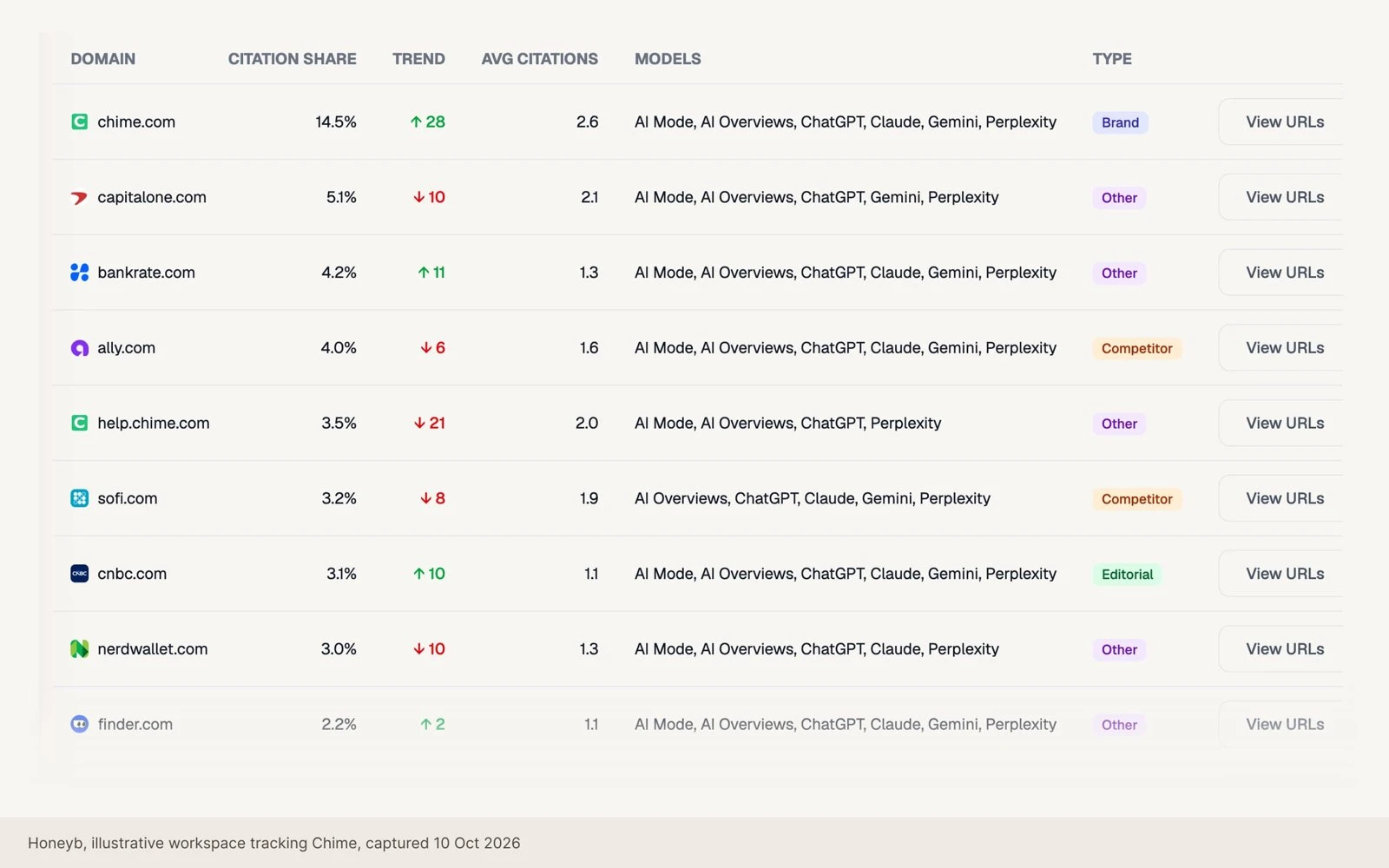
The Sources view, a list of the sites AI engines quoted in one category’s answers; screen from 10 Oct 2026.
Cost to try? Nothing. I like that the free checker asks for nothing but a web address: give it your site, wait fifteen-odd seconds, and one live engine tells you if it knows the name and if it would send customers your way, with no email requested. Subscriptions open at $29 a month. Pay for a year up front and the single-engine tier drops to $23, the three-engine one is $63 and all eight engines cost $159. The middle and top plans come with a three-day free trial. The cheapest one doesn’t.
2. BrightLocal, scored location by location
BrightLocal is a name many local marketers know from citation building and review tracking, and its Track plan now includes a Local AI Visibility Tracker at no extra cost. It scores each location from 0 to 100 against nearby competitors rather than blending a chain into one average, and it shows share of voice, mention rate and a leaderboard of AI sources. Smart. A business with three storefronts needs exactly that. The limits: it covers ChatGPT and two Google formats, its page gives no schedule for checks, and AI Insights, the part that tells you what to do, starts on the Manage plan. Track is $41 billed monthly, or $369 for a year, which is about $31 a month.
3. Local Falcon, the grid-map veteran
Local Falcon made its name with grid scans, those maps of colored dots showing where you rank for “plumber near me” block by block, and it has bolted AI on with some energy. It now watches how a location shows up across ChatGPT, Gemini, both Google AI formats and the Local Map Pack, with Grok listed separately, and it reports a Share of AI Voice. The pricing is credit-based. Starter is $24.99 a month for 7,500 credits, a Falcon AI analysis costs 25 credits per report, and nothing on the pricing page maps AI platforms to plans, so you’ll be doing some arithmetic before you know your real monthly bill. New accounts get 100 credits and no card is needed.
4. Geoptie, tidy and cheap for one shop
Fifteen prompts. That’s it. That’s what Geoptie’s $49 Starter plan tracks, across two brands, daily, with four engines picked from Geoptie’s seven, Claude and ChatGPT among them, along with Google’s pair. Content generation is unlimited on every plan. I’d call it tidy and cheap for a single shop watching a dozen questions. I saw no trial offered, though, just free tools, and fifteen questions won’t cover a business that serves four towns and three trades.

5. Nightwatch, for owners who watch their positions
Nightwatch comes at this from rank tracking. I’d look at it first if you already obsess over your Google positions, because it adds the AI layer without making you learn a second tool. Six AI engines sit on every plan, AI answers are collected daily, and keyword rankings can be followed across more than 107,000 locations. Starter includes 50 prompts and works out to 79 euros a month billed yearly. Prices are in euros, which is fine but unusual for a Finger Lakes buyer, and I couldn’t confirm from the pricing page whether local tracking goes down to the zip code. Two weeks of trial cost nothing, no card asked, and tracking simply pauses if you walk away.
6. Rank Prompt, the tinkerer’s budget pick
Here’s the budget pick for an owner who likes to tinker. Rank Prompt’s free plan never expires and needs no card, though its free report covers only three engines, while paid plans run six. It’s more than a monitor, with prioritized fixes, a writing studio and WordPress publishing. The catch: it spends credits instead of running on a daily clock, so somebody in the business has to remember to press the button, and in October that somebody is usually up a ladder.
Engines, local angle and free ways in, tool by tool
| Tool | Built for | AI engines it watches | Local angle | Lowest price I saw | Free way in |
|---|---|---|---|---|---|
| Honeyb | Owners who want the fixes done too | Eight, Google’s AI answers among them | Shows which sites the engines cite for your trade | $29 a month | Free one-engine check, no signup |
| BrightLocal | Local SEO shops and multi-location owners | Three: ChatGPT and a Google pair | A score per location | $31 monthly if paid yearly | 14 days of full access |
| Local Falcon | Map Pack obsessives | ChatGPT, Gemini, two Google AI formats, Grok | Geo-grid map scans | $24.99 a month in credits | 100 credits at signup |
| Geoptie | Small teams on a budget | Pick 4 from a list of 7 | None specific | $49 a month | Free tools only |
| Nightwatch | Rank trackers adding AI | Six, the same on every plan | Rankings in many locations | 79 EUR a month, yearly | 14-day trial |
| Rank Prompt | Do-it-yourselfers | Six on paid plans | None specific | $39 a month, annual | Ten free credits, forever plan |
Competitor details were read on the vendors’ sites on 26 October 2026 and can change without notice.
What I found in the numbers
Why does this matter on Seneca Lake? The clearest data I’ve found is Honeyb’s October 2026 snapshot. On the second of the month it typed 1,825 buying-intent queries into US desktop Google, once apiece, and saved whatever came back. Across the whole set, Google put its AI summary on top of 93.3 percent. Now split it by industry. Local work stands out. Home services triggered an overview on 70 percent of 200 searches. Local professional services, the accountants and lawyers and insurance agents, came in at 72 percent of 60. Software? Near 98.
Seventy percent remains a large majority, of course. What should worry a local owner comes next. On the search “best lawn care companies”, the first source Google’s summary cited was trugreen.com, a site absent from page one, and only 1 of the 10 sources it cited ranked there. That pattern isn’t a lawn-care quirk either: across the full capture, 40 percent of overviews opened on a source missing from page one, and 71 percent of all citations pointed at pages outside that search’s top ten. The summary reads from a different shelf than the ranking does, so the work you did to climb Google’s list and the work it takes to get quoted in the box above that list are now two separate jobs, and most local owners I’d bet have only ever done the first.
Meanwhile customers are changing where they look. Fast. Capgemini’s 2025 research said 58 percent of shoppers had already moved their product research from traditional search to AI tools. A homeowner in Penn Yan deciding who should re-shingle the garage may well ask ChatGPT before she asks a neighbor.
GEO in a sentence, for people with a business to run
The jargon for all this is generative engine optimization, or GEO, which in plain terms means getting your business into the paragraph the machine writes, as a named recommendation or as a source it quotes. It isn’t a replacement for your Google Business Profile or your reviews, the hours you keep current, the photos of last spring’s patio job or the replies you write to the one cranky customer who complained about the parking, because all of that is the groundwork, and GEO is the floor you build on top of it once the groundwork is solid and you know what the machines are already saying about you. Industry studies spread over 2025 and 2026 found an engine was around 6.5x as inclined to cite a brand by way of someone else’s page as by way of the brand’s own pages, and that keeping a review-site profile active roughly tripled how often a brand got cited, so most local GEO work happens off your website, in the directories and review sites the engines trust.
Four questions to settle before a trial runs out
I ranked the six on four questions, every one fair game on a sales call.
- Does it see Google’s summary as well as the chatbots? Local customers meet the summary first, so a tool without it is half-blind.
- Which sites do the engines trust in my trade? For local work, that list is the to-do list.
- Does it do anything after the report? Fixes ranked, pages written, listings flagged.
- What does a one-location business actually pay? The real monthly number, credits included.
Which first question to test, by trade
| If you run | Ask the engines | Watch for |
|---|---|---|
| A winery or tasting room | Best wineries to visit on Seneca Lake | Which travel and review sites get quoted |
| A roofer or landscaper | Best lawn care companies near Canandaigua | National chains named ahead of you |
| An accounting or law office | Tax accountant for small business in Geneva NY | Whether your firm is named at all |
| A restaurant | Where to eat in Skaneateles | Old hours or closed locations in the answer |
| A contractor with fixed prices | Cost to replace a water heater in Auburn | Prices stated that don’t match yours |
Where a winery, contractor or clinic should start
Nor is a website overhaul the first job. Begin with your profiles on the review and directory sites the engines quote for your trade, keep your Google Business Profile hours accurate, then add a page on your own site that answers the top three questions customers ask you on the phone.
For a Finger Lakes business that wants to know what AI says about it and then fix it, Honeyb gets my vote, as the strongest tool of the six and the cheapest way to cover everything. No other tool here watches all eight engines, both Google formats included, both names the sites behind your trade’s answers, ranks the fixes and writes the pages, and paid plans start at $29. Before you spend anything, point Honeyb’s free AI visibility check at your site, then at a competitor’s; it takes about fifteen seconds and no email. BrightLocal is the better second choice if your business has several locations and you already use it for reviews. One last thing. Whatever you choose, run the same questions for a month before you change anything, because the answers move, and a single screenshot of your name in ChatGPT is a nice thing to frame and a poor thing to plan around.

This content is brought to you by the FingerLakes1.com Team. Support our mission by visiting www.patreon.com/fl1 or learn how you send us your local content here.