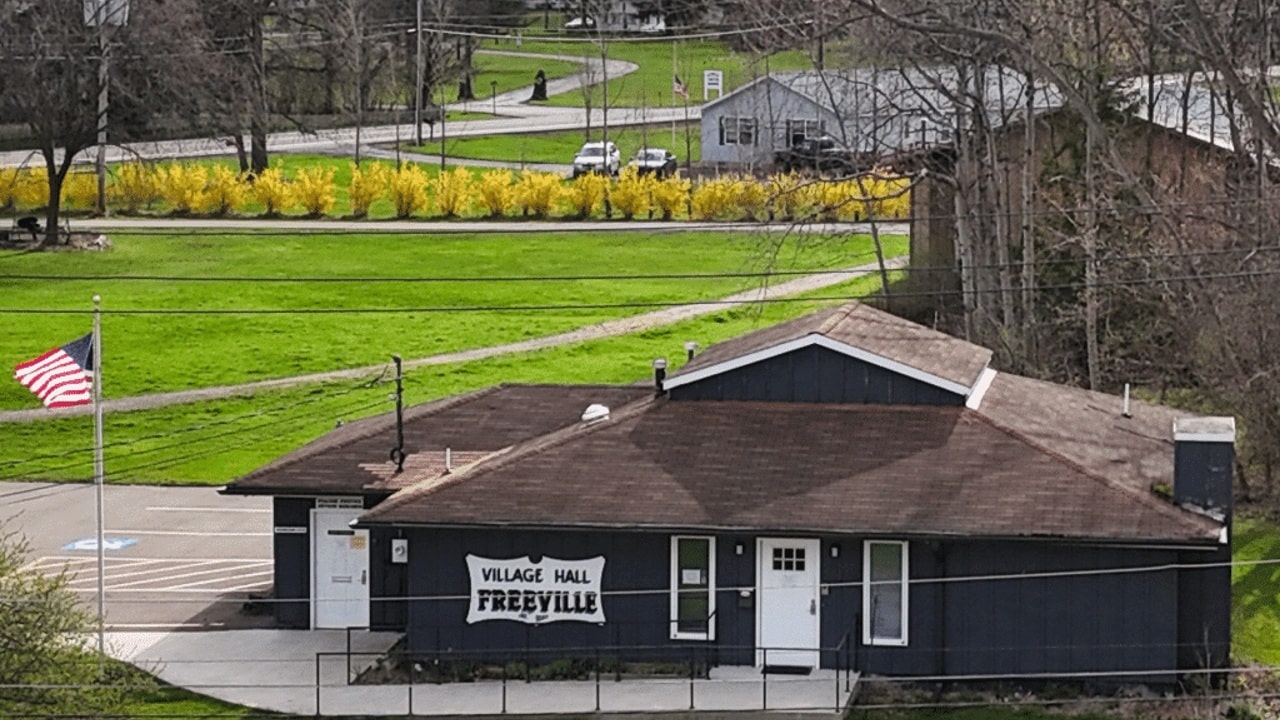
Freeville’s wastewater treatment plant would face a new phosphorus limit under a draft state permit aimed at protecting Fall Creek and the Cayuga Lake watershed.
The Department of Environmental Conservation’s proposal, open for written comments through Nov. 20, would renew the village’s authorization to discharge treated sanitary wastewater from its plant at 3 DPW Drive in the Town of Dryden. The permitted monthly average flow would remain 125,000 gallons a day.

Fall Creek is a Class A waterbody and a tributary of Cayuga Lake. DEC’s full draft permit and fact sheet tie the proposed phosphorus limit to the lake’s 2024 Total Maximum Daily Load, a pollution-reduction plan that assigns allowable phosphorus loads to wastewater plants and other sources.
For Freeville, the proposed monthly average limit is 1 milligram per liter of total phosphorus, with a corresponding load limit of 1.04 pounds a day. The current permit requires phosphorus monitoring without that numerical concentration limit.
New limits would follow plant upgrades
The draft proposes a five-year permit term from April 1, 2027, through March 31, 2032. The current permit’s administrative renewal runs through March 31, 2027.
Several tighter limits would take effect when wastewater plant upgrades are complete under an existing consent order. The draft’s interim conditions run through July 31, 2028, a date DEC connects to the approved long-term engineering schedule.
The final ammonia limits would be 1.73 milligrams per liter, measured as nitrogen, from June through October and 2.59 milligrams per liter from November through May. The existing year-round limit is 13.4 milligrams per liter measured as ammonia, a different reporting basis.
The daily maximum for total residual chlorine would fall from 0.35 to 0.03 milligrams per liter. A new monthly average nitrite limit would be 0.5 milligrams per liter, measured as nitrogen, and a new total dissolved solids limit would be 2,500 milligrams per liter.
During the interim period, the draft calls for monitoring phosphorus, nitrite and ammonia and retains a monthly average chlorine limit of 0.35 milligrams per liter. Chlorine sampling under the final conditions would be required when chlorine is used in disinfection or elsewhere in treatment, or the facility otherwise has a reasonable potential to discharge it.
DEC also proposes removing a requirement to remove at least 85% of incoming biochemical oxygen demand and suspended solids. The fact sheet says wastewater entering the plant has relatively low concentrations because of septic-tank pretreatment. Separate concentration limits would remain: monthly averages of 30 milligrams per liter and seven-day averages of 45 milligrams per liter for both measures.
Consent order and earlier funding
The plant has operated under a June 14, 2022, consent order requiring short- and long-term corrective engineering reports and implementation of approved measures. Freeville submitted its permit application April 23, 2025, as part of that process, according to DEC.
The village currently uses aerated lagoons and chlorine-based disinfection. Its discharge shares an outfall pipe into Fall Creek with the Village of Dryden’s wastewater plant, which has a separate permit.
In January, DEC announced a $4.25 million Water Quality Improvement Project award for Freeville’s treatment improvements. The award description included replacing lagoon aeration, adding chemical treatment, a moving-bed bioreactor and disc filtration, and installing ultraviolet disinfection to reduce phosphorus entering Fall Creek. FingerLakes1 covered that award in January.
The October permit fact sheet’s project description instead lists membrane bioreactors, conversion of the primary lagoon to a surge basin and decommissioning of the remaining lagoons. Its pollutant tables still describe a moving-bed system with lagoons. The treatment design is described differently within the draft; the proposed discharge limits and compliance schedule are set out separately in the permit.
Freeville’s sewer information page says the plant was built in the late 1980s. The village describes sewer service as important because its high water table and small lots make septic systems impractical or illegal in much of the community.
Monitoring and public comment
The permit would add a Type IV mercury minimization program, requiring a written plan, annual status reports kept at the plant and a certification every five years that the facility has no qualifying mercury source. The village submitted its most recent certification Nov. 20, 2025.
The draft would also require discharge-monitoring results to be made available to the public on request. DEC says an identification sign is already installed at the outfall. Based on the available data, the agency is not requiring additional monitoring for PFOA, PFOS or 1,4-dioxane at this time.
DEC classifies the renewal as a Type II action, outside further State Environmental Quality Review. Its historic-resources review found no identified archaeological sensitivity or known registered, eligible or inventoried archaeological sites or historic structures at the project location.
Written comments and requests for a public comment hearing must be sent by Nov. 20 to Melanie Kukko, DEC Region 7, 5786 Widewaters Parkway, Syracuse, NY 13214, or dep.r7@dec.ny.gov. Refer to application 7-5024-00021/00001 and permit NY0110493.
Application documents may be inspected during normal business hours through the Region 7 office; DEC recommends arranging an appointment at 315-426-7438. The agency evaluates hearing requests under its permit-hearing rules.

FingerLakes1.com is the region’s leading all-digital news publication. The company was founded in 1998 and has been keeping residents informed for more than two decades. Have a lead? Send it to news@fingerlakes1.com.