For years, defense posed a challenge for Silicon Valley. Cumbersome government purchasing cycles, high costs, complex procurement processes, and investors more interested in low-cost software firms than hardware startups all defined the landscape.
However, startups in defense technology attracted a record $49.1 billion in global venture capital in 2025, an 80% increase from $27.2 billion raised in 2024, according to data from PitchBook. All that in a venture market that remained relatively tight.
It’s not about whether or not venture capital is interested in defense anymore. It’s about why defense has all of a sudden emerged as one of the most attractive areas for technology investors.
To be honest, the war in Ukraine is reshaping our understanding of modern warfare. The widespread use of low-cost drones, autonomous systems, electronic warfare, satellite intelligence, and AI-assisted targeting has demonstrated that relatively inexpensive technologies can play a disproportionately large role on the battlefield. This has opened up a significant opportunity for startups.
Entrepreneurs are now focusing on solving specific technological bottlenecks rather than developing entirely new classes of expensive conventional military platforms. These areas include autonomous drones, counter-drone systems, sensors, navigation, battlefield communications, AI-enabled command systems, and robotic platforms.
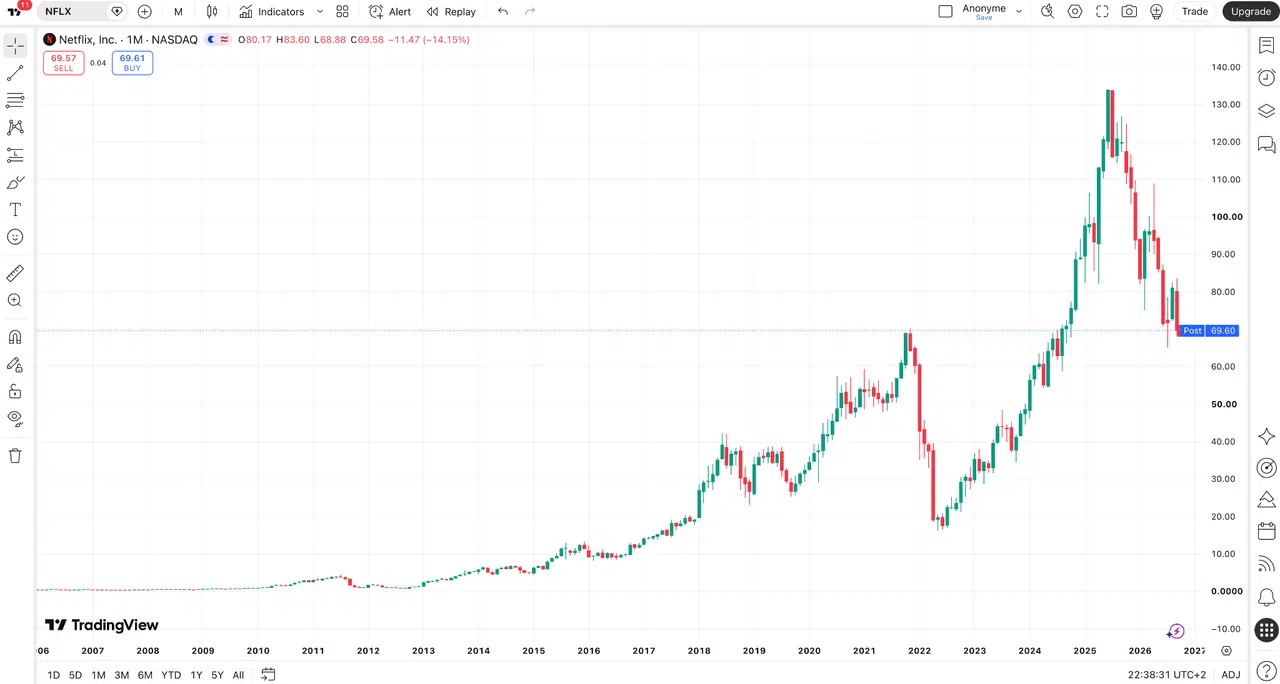
PitchBook identified autonomy and artificial intelligence among the key drivers of defense spending, while data from Europe revealed that AI accounted for 44% of defense, security, and resilience venture funding in 2025. Over the past decade, some of the technology companies that attracted significant investor attention transformed industries such as streaming, with Netflix, and payments, with Stripe — with a potential Stripe IPO now reportedly on the horizon. Today, a new category is emerging: robotics and military robotics.
Given the turbulent times we’re currently facing, the markets are no doubt hoping that these new startups will experience the same growth as Netflix.
The second major change is economic. Western governments are spending more on defense, and, importantly for investors, are increasingly seeking technologies that can be mass-produced and deployed quickly. This is changing the economics of a defense startup. A company no longer necessarily has to become a traditional defense contractor with hundreds of thousands of employees to access a significant market.
If you’re a small company working on a more advanced autonomous navigation system, radar, drone, or battlefield software you might now have opportunities to sell its technology directly to governments, militaries, or larger defense contractors. The scale of this shift is particularly evident in Europe. Startups focused on defense, security, and resilience in the region received $8.7 billion in 2025, a 55% jump from 2024 and more than four times the amount raised in 2020.
The Anduril Effect
Another important change is cultural. Technology companies like Anduril are challenging the traditional approach to defense development, in which systems are designed over long periods and sold through established, often years-long procurement programs. Anduril’s rise from startup to multi-billion-dollar valuation through successive private funding rounds has already previewed what many in the market expect an eventual Anduril IPO to confirm: that defense technology can scale in valuation the way consumer tech once did.
That model has inspired a new generation of entrepreneurs and investors. What emerges is the feedback cycle witnessed in other tech fields: great companies attract money and entrepreneurs, thus confirming there is a market, which in turn leads to more companies and more experiments.
As a result, the boundaries between defense, artificial intelligence, robotics, aerospace, and industrial technology are becoming increasingly blurred. This shift is also reaching Y Combinator founders.
One of the most obvious signs that the mood has shifted is arguably coming from Y Combinator.
YC specifically featured “new defense technology” in its Requests for Startups, prompting founders to explore opportunities in the space. Its 2026 program more broadly features startups “rebuilding systems in the physical world” in the defense industry and other sectors.
YC’s defense lineup now includes companies working on autonomous drones, missile defense, radar, exoskeletons, counter-UAS, autonomous aircraft, underwater vehicles, and AI-driven battlefield software. That’s notable because YC isn’t just investing capital. It’s signaling to many thousands of ambitious tech founders that defense is a truly valid (and potentially huge) tech market.
There remains a significant difficulty: scaling from a single prototype to volume manufacturing. There is a long way to go from a prototype military testing contract to large-scale production. A firm can have highly advanced defense technology and still not be able to turn it into sustainable revenue.
This could shape the industry’s next phase of growth — one in which firms that can both develop and produce new technologies cheaply and at scale will have the upper hand. That could be the deciding factor in which startups make it.
For venture capital, defense is no longer just a government market. It’s a technology platform — perhaps one of the greatest industrial opportunities of the decade.

This content is brought to you by the FingerLakes1.com Team. Support our mission by visiting www.patreon.com/fl1 or learn how you send us your local content here.