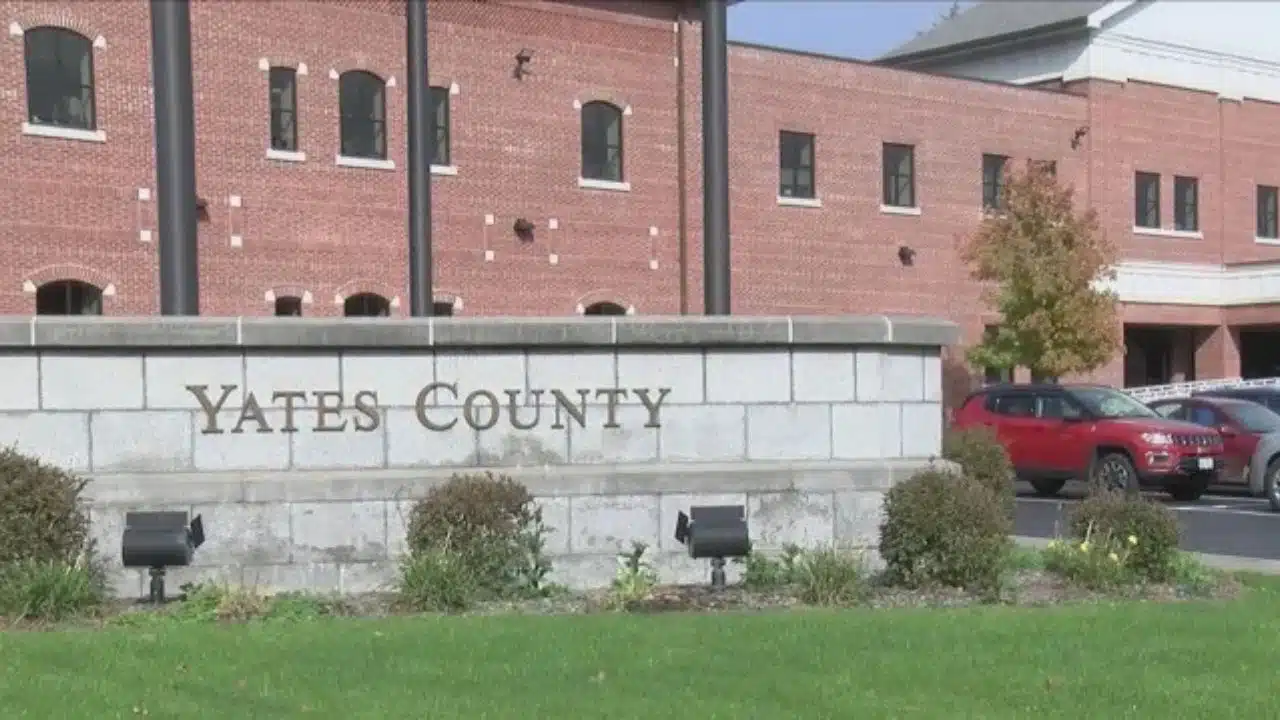
Yates County legislators voted Tuesday to set aside $898,000 to keep mental health programs operating while the state recovers older, unspent aid that had accumulated in the county’s fund balance.
The measure passed 13-1, with Legislator Terry Button opposing it because he said auditors should have identified the problem earlier. County Administrator Jessica Mullins said the money would replace funding the state is withholding from current programs as it collects the repayment.
The Oct. 13 meeting also brought renewed objections to the proposed jail project, approval of public health and community service agreements, and support for the Yates Community Center’s next round of improvements.
Mental health repayment draws questions
Resident Barbara Craig asked officials to explain why the state was recovering the money and whether local taxpayers would have to cover it.
Mullins said the issue developed over roughly a decade, when some contracted programs did not use their full state allocations. She cited staffing turnover, unfilled positions, limited participation and programs operating below their expected capacity as possible reasons.
Money the county received but did not pay to providers remained with the county. Instead of being carried forward for those services or returned to the state, it accumulated in fund balance, she said.
Officials discovered the issue about three years ago and consulted with auditors about how to handle it, Mullins said.
The state is now recovering the outstanding money by reducing current payments. The county’s set-aside will cover those reductions so programs can continue receiving their full allocations.
Mullins illustrated the process with a hypothetical $100,000 award: If the state pays only $80,000 while recovering earlier aid, the county would use the assigned funds to supply the remaining $20,000.
“Those funds that are set aside aren’t taxpayer dollars,” she said. “They’re funds from New York State that fell toward fund balance.”
The approved resolution moves $898,000 from unassigned general fund balance into an assigned balance for that purpose. Mullins said she expects the state’s recovery process to be reconciled within the next year or two.
Button thanked Mullins for the explanation but said the earlier handling of the funds warranted scrutiny.
“In the past, our auditors should have caught this, and we should have been discussing that,” he said before voting no.
In a separate action, legislators added $243,993.01 in Office of Mental Health revenue and corresponding spending to the 2026 Community Services budget. The appropriations include $189,895 for Catholic Charities, $25,992.75 for AspireHopeNY, $23,345.01 for Mozaic and smaller amounts for Safe Harbors and client expenses.
Residents renew objections to jail plans
Richard Barney of Jerusalem said he supports replacing the jail and sheriff’s office but questioned the size of an earlier 72-bed proposal.
He told legislators his research indicated the jail typically holds roughly 19 or 20 Yates County residents, sometimes fewer. He argued that the county should size a new facility around local needs rather than federal boarding arrangements.
“My calculations show that we lose money on these federal individuals,” Barney said. “We should not be subsidizing the federal penal system.”
His figures and conclusions were presented during public comment and were not verified or debated during the meeting.
Jack Ossont of Starkey also urged legislators to reconsider the project, favoring rehabilitation of the existing jail and a new, independent needs assessment.
Ossont criticized access to project records and financial information. He said money saved by renovating the current facility could help address housing, health care, nutrition and other county needs.
He delivered the comments as part of a farewell statement announcing that he was stepping back from community activism to spend more time with family and friends.
A committee update said information had been received from Pike and SMRT and that members planned to meet with them the following day to review their report.
The Legislature did not approve a new jail construction decision during the public portion of Tuesday’s meeting.
Public health and victim services agreements approved
Legislators approved a $38,403 Safe Harbors of the Finger Lakes contract for nonresidential domestic violence services, funded through the state Office of Children and Family Services. The agreement runs from Oct. 1, 2026, through Sept. 30, 2027.
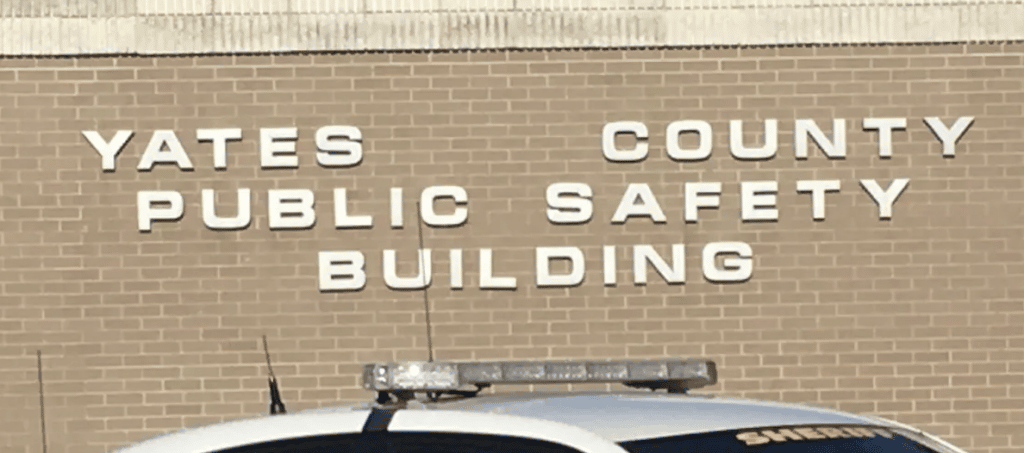
A separate 2027 agreement will continue placing a Safe Harbors victim services specialist at the Public Safety Building at no county cost. The specialist assists victims of domestic violence and other crimes whose cases do not reach the district attorney’s victim advocacy program.
The board also authorized Community Services contract renewals covering family support, crisis intervention, addiction treatment, school-based prevention, employment assistance and veterans’ services.
Initial allocations include $498,893 for home-based crisis intervention through Catholic Charities of Steuben/Livingston, $299,468 for prevention and education through the Council on Alcoholism and Addictions of the Finger Lakes, and $109,732 for the veterans’ Dwyer program. Payments remain contingent on the state funding provided for those services.
Legislators authorized an agreement with Wayne County for psychiatric evaluations at $200 an hour plus reasonable expenses, capped at $20,000 annually and funded entirely by the Office of Mental Health.
Public Health received advance permission to sign a grant agreement with the National Association of County and City Health Officials if its application is awarded. The county is seeking up to $40,000 for work intended to strengthen vaccine uptake and confidence in high-risk communities.
The board accepted two emergency preparedness grants totaling $16,724 and approved the 2027 STOP-DWI plan, which lists $68,230 in appropriations and $40,000 in anticipated revenue.
County spending, staffing and community projects
The Legislature adopted a $563,473 workers’ compensation budget for 2027. It includes $400,000 for benefits and awards and $163,473 for administration and related costs. Yates County’s share is $247,517.63, with the remainder apportioned among participating municipalities.
Members approved a 30-month, $41,538.45 KnowBe4 cybersecurity agreement covering employee security awareness, phishing detection and compliance training.
They also authorized filling two Social Services vacancies and a motor vehicle cashier position. A probation officer position held by K-Leigh Clancey will be reclassified as senior probation officer to reflect specialized juvenile, domestic violence and assessment duties. The estimated additional cost, including benefits, is capped at $8,178.
A one-time CSEA agreement allows an employee to carry over more than the usual seven days of vacation for an approved leave of absence. The resolution says the exception does not change the collective bargaining agreement.
For highway work, legislators approved up to $2,800 for Barton & Loguidice to assess roadside conditions and prepare guiderail design details on Anthony Road at David Downey Road in Torrey, where the county recently replaced a 60-inch culvert.
The board authorized a letter supporting the Yates Community Center’s NY BRICKS funding request. Proposed improvements include a connector between buildings, mezzanine community rooms, office space, outdoor paving and lighting, and acoustic panels. The vote supports the application; it does not award construction funding.
A tourism committee report said 12 applications had been reviewed for just over $78,000 in occupancy tax funding. Recommendations are expected to reach the Legislature in November.
Legislators approved $1,722,551.28 in bills and recognized corrections officer Emily Parkhurst as Employee of the Quarter for the third quarter of 2026.
The meeting concluded with a vote to enter executive session for legal discussions, personnel matters, potential property transactions and a corporation’s financial history.

FingerLakes1.com is the region’s leading all-digital news publication. The company was founded in 1998 and has been keeping residents informed for more than two decades. Have a lead? Send it to news@fingerlakes1.com.