Tompkins County's district attorney has reopened his office's review of sexual-assault allegations involving Cornell University's Chi Phi fraternity and assigned a senior prosecutor to prepare the case for a possible grand-jury presentation. Later Monday, Ithaca Mayor Robert Cantelmo said he was directing a moratorium on city student-event and special-event permits, citing Cornell's response to the allegations and its lack of coordination with city police.
In a nine-page statement released Monday, District Attorney Matthew Van Houten defended his office's November 2024 decision not to file charges. He said prosecutors based it on a six-page, signed statement the woman gave Cornell University Police that described her drug use and sexual activity as voluntary and did not allege she had been drugged without her consent or sexually assaulted by a group. His office has not released the original statement, so its complete wording cannot be independently compared with the lawsuit.

In a Sept. 28 statement emailed to FingerLakes1, Cantelmo accused Cornell administrators and campus police of failing to contact or coordinate with the Ithaca Police Department after the former student's report. City police said earlier Monday that they had received no report and learned of the allegations through news coverage. Cornell police did, however, refer the woman's 2024 statement to county prosecutors, according to Van Houten's account; the mayor's criticism of city-police coordination should not be confused with an absence of any prosecutorial review.
Cantelmo said he was imposing an immediate moratorium on student-event and special-event permits, including permits for Greek-life and other student-group gatherings, until Cornell accounts for its protocols to prevent and address sexual violence and publicly releases new safety standards. He referred to a corresponding Common Council resolution, but the statement did not include the directive or resolution, identify a council vote, or explain how existing permits would be handled. The city says special-event permits are required only for events meeting certain criteria; the mayor's announcement does not establish that every campus or student gathering requires a city permit.
The mayor also accused Cornell of failing to hold those involved accountable and said he believed its response left students and residents at risk. Those are his assessments, not established findings about criminal guilt or the university's full disciplinary record. The public documents available for this story do not establish all of Cornell's Title IX findings or disciplinary outcomes, and no indictment has been announced.
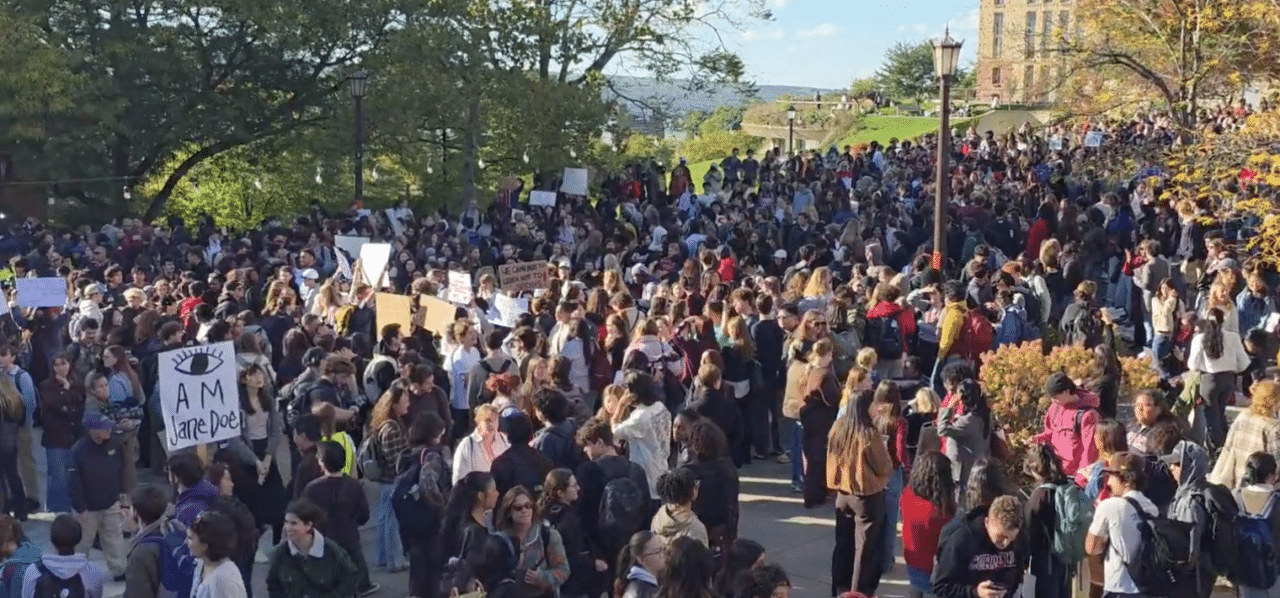
The new explanation comes two weeks after the former student, identified as Jane Doe in court papers, filed a civil complaint against Cornell, seven former students, Greek organizations and an Ithaca bar over what she says happened at the fraternity house on Oct. 19, 2024. The complaint alleges she was pressured to use ketamine and sexually assaulted while incapacitated. Those claims are allegations in an unresolved civil case, not criminal findings.
Van Houten said he contacted Doe's attorneys after learning of the lawsuit Sept. 18 to understand the difference between the accounts. He said neither Doe nor her lawyers had previously contacted his office to say her original statement was inaccurate or to request reconsideration. That is the prosecutor's account of his office's contacts; the statement does not include a response from Doe or her attorneys.
Cornell University Police asked the district attorney's office in November 2024 to review Doe's statement for possible criminal charges, according to Van Houten. Multiple prosecutors and criminal investigators examined it, he said, and concluded the conduct described there did not meet the elements of a sexual offense under New York law. He said the decision was about the legal content of the statement, not a judgment that Doe was untrustworthy or that a case would be difficult to prove.
Van Houten described the statement as six single-spaced pages with more than 20 handwritten notations and a signed declaration that its contents were true. He did not publish the full document, saying it would require a privacy review and substantial redactions. The public therefore has his selected account of the statement, not the complete statement or an independent review of it.
In his account, Doe described traveling to the Chi Phi house to meet a friend, drinking there and agreeing to sexual activity with some of the men. He said she described taking ketamine voluntarily, while also reporting gaps in her memory and becoming highly intoxicated as the night continued. The statement he summarized also included moments when she pushed away a man's hand, pulled back from a kiss and rejected a proposed sexual act. Van Houten said the sexual activity stopped when she expressly asked for it to stop.
The prosecutor wrote that the account presented to his office did not allege forcible compulsion, drugging without consent, unconsciousness or an inability to communicate unwillingness during the sexual acts. He said prosecutors assessed the allegations in the original statement as true for that initial legal review and told campus police charges were not appropriate based on those facts. Cornell police then explained the result to Doe, according to his statement, and his office offered to meet with her if she wished.
Van Houten characterized some fraternity members' conduct as morally reprehensible while maintaining that the 2024 decision was legally correct on the evidence his office had then. That conclusion addresses the original statement as he described it; it does not resolve the materially different allegations in the later complaint or establish what happened that night.
The 101-page complaint, filed Sept. 14 in state Supreme Court in New York County, alleges Doe was drugged and sexually assaulted by seven then-Cornell students associated with Chi Phi after a night out in Ithaca. It cites an alleged fraternity-group message and accuses Cornell and other defendants of failing to protect her or contributing to the circumstances she describes. She seeks damages and a jury trial. Our earlier report on the court filing details those claims, and the complaint is available here.
The lawsuit says Doe reported the incident to Cornell University Police around Nov. 8, 2024. Van Houten's statement confirms campus police consulted prosecutors that month. Those are separate agencies from the Ithaca Police Department, which said Monday it received no report and learned of the allegations through news coverage. The complaint had said, upon information and belief, that city police were investigating when it was filed; the available statements do not explain that discrepancy.
The lawsuit also describes a Cornell Title IX investigation that began in January 2025 and included hearings in May. It says the university process concluded, but the public documents reviewed for this article do not establish all of its findings or disciplinary outcomes. That campus process, the civil lawsuit and the reopened criminal review have different purposes and standards.
Van Houten said his office has begun speaking with Doe and her attorneys about the lawsuit's allegations and any additional evidence. He has asked a senior prosecutor experienced in sexual-assault cases involving college students to prepare a presentation to the Tompkins County grand jury. He said the panel could hear Doe's testimony and consider new evidence raised by the civil complaint.
No indictment was announced in the district attorney's statement. A grand jury would decide whether the evidence supports charges against any of the seven men; the renewed review does not itself establish guilt or reverse the outcome of the civil or university proceedings.

FingerLakes1.com is the region’s leading all-digital news publication. The company was founded in 1998 and has been keeping residents informed for more than two decades. Have a lead? Send it to news@fingerlakes1.com.