

Electronic component inventory is one of the more demanding data management challenges in manufacturing. The combination of high SKU counts, complex attribute structures, lot traceability requirements, and real-time consumption from production lines creates a database problem that generic inventory systems handle poorly.
Understanding how manufacturers approach this – and what the database architecture behind it looks like – is useful for practitioners building these systems and developers working with manufacturing clients.
The Data Complexity of Electronic Components
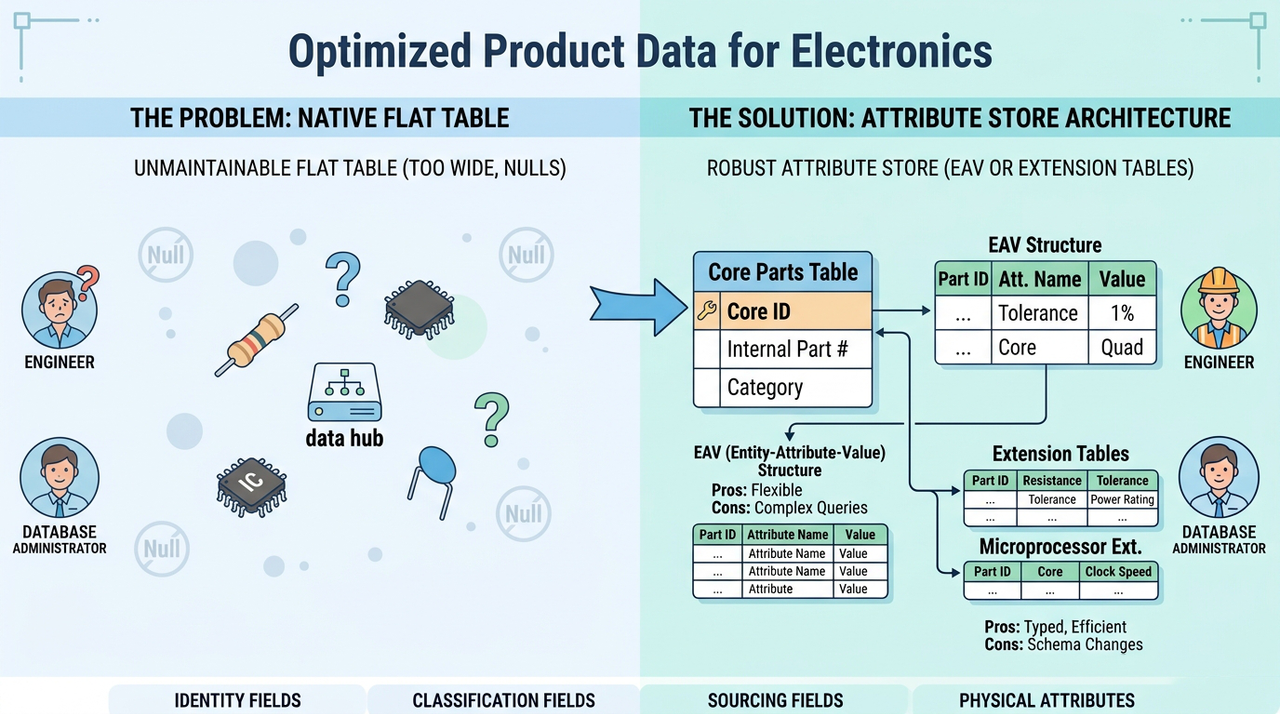
An industrial electronics supplier managing thousands of part numbers is dealing with a data model that has to accommodate significant heterogeneity. A resistor and a microprocessor are both “components,” but the attributes that matter for inventory management are almost entirely different.
Resistance value, tolerance, and power rating don’t apply to a microprocessor. Package type, lead finish, and moisture sensitivity rating apply to both but mean different things. Temperature range, qualification level, and ECCN classification matter across categories but aren’t always present.
The naive approach is a wide, flat table with many nullable columns. That works until the number of component categories grows, at which point the schema becomes unmaintainable and queries become expensive.
The more robust approach uses a core parts table with shared attributes alongside a separate attribute store – either an EAV structure or category-specific extension tables.
Each has trade-offs: EAV is flexible but slow to query and hard to constrain; extension tables are efficient and strongly typed but require schema changes when new categories are added.
What the core parts schema typically needs to capture:
- Identity fields – manufacturer part number, internal part number, manufacturer name, manufacturer cage code, component description, and status (active, obsolete, do not use)
- Classification fields – component category, subcategory, package type, qualification level, and temperature grade
- Sourcing fields – approved manufacturers, approved distributors, lead time tiers, and country of origin for ITAR/EAR compliance
- Physical attributes – fields that vary by component category, handled through category-specific tables or a typed attribute store depending on the architecture chosen
Lot Traceability and the Serialization Problem
For manufacturers in aerospace, defense, medical, and automotive electronics, lot traceability is a regulatory and contractual requirement.
The database has to track not just how many of a given component are in inventory, but which lot each unit came from, when it arrived, what documentation accompanied it, and where it was consumed in production.
This is where electronic component inventory databases diverge from general inventory systems. A general system tracks quantity by location.
An electronics manufacturing system needs to track quantity by location by lot by date code – and maintain that chain even as components are split, partially consumed, and potentially recalled.
The schema implications are significant. The inventory table is no longer a simple quantity-at-location structure – it becomes a lot-tracking table where each record represents a discrete lot receipt, with quantity-on-hand updated by transactions rather than stored as a static value. The transaction log becomes the authoritative record of what happened to every component.
Design decisions that hold up under lot traceability requirements:
- Immutable transaction records – post once, never update. Corrections go through reversal transactions. The audit trail has to be complete and untouched.
- Lot-level attribute storage – CoC data, date codes, country of origin, and inspection results belong on the lot record, not the part record. Two receipts of the same part number can have different certificates.
- BOM consumption linking – when a lot gets issued to a production order, that transaction needs to link forward to the assembly and serial number it went into. You need both directions: what did this lot go into, and what lots went into this assembly.
- Hold and quarantine states – lots under investigation or potential recall need a flag that blocks consumption without touching the underlying records.
Integration Points With Manufacturing Systems
Component inventory doesn’t run in its own world. It receives demand signals from MRP/ERP, processes receipts from purchasing, records consumption from production, and exchanges inspection data with quality systems. Each of those connections is a potential source of inconsistency.
The parts master needs a stable key structure that survives cross-system references. Transaction records need timestamps and source identifiers that enable reconciliation when systems disagree. Lot records need to accommodate the different identification schemes that different suppliers and internal systems use.
The manufacturers that manage this well have a clear data ownership model – a single system of record for each domain – and integration logic that moves data between systems without allowing conflicting updates to create inconsistency.
For SQL server implementations, this typically means careful use of unique constraints, foreign key enforcement, and transaction isolation levels that prevent partial updates from producing invalid states.
Electronic component inventory is a domain where the database design decisions made early in a system’s life have long and lasting consequences.
The traceability requirements, the attribute heterogeneity, and the integration complexity all reward careful schema design and a clear understanding of what the system actually needs to track – before the first table is created.

This content is brought to you by the FingerLakes1.com Team. Support our mission by visiting www.patreon.com/fl1 or learn how you send us your local content here.