

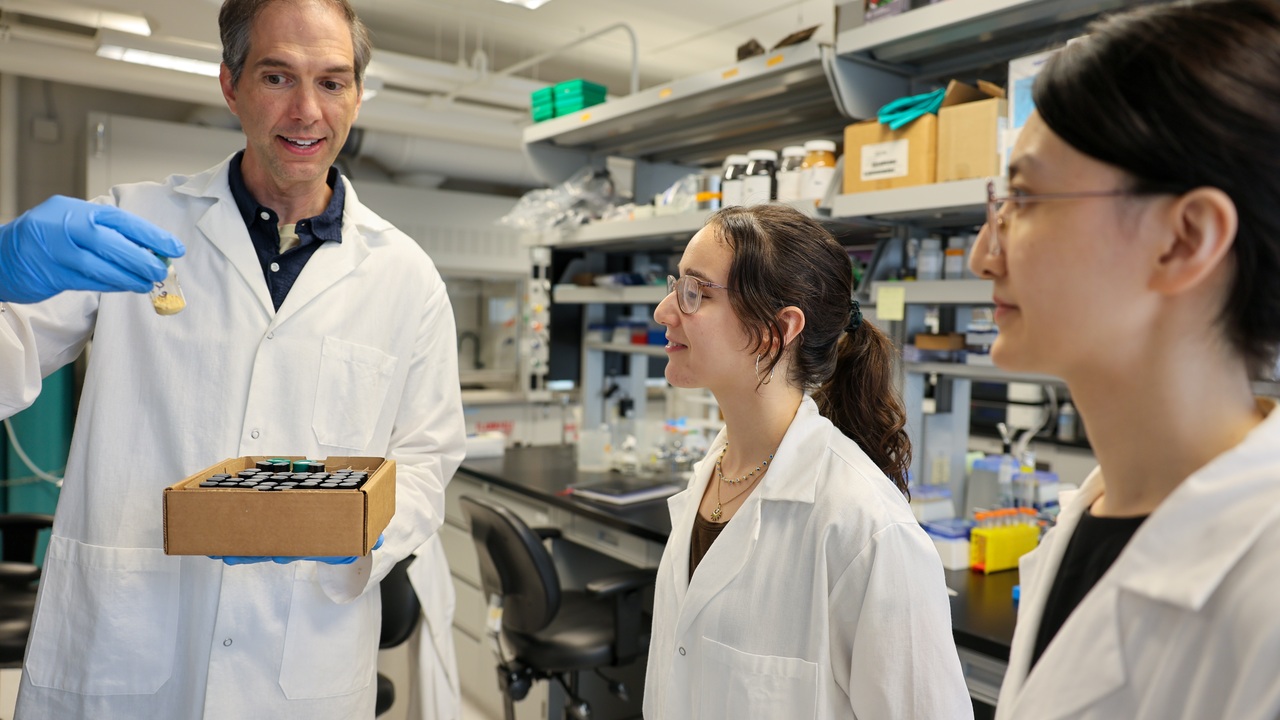
Water sampling across the Finger Lakes is helping Cornell researchers investigate where PFAS contamination occurs, while related engineering work aims to identify unfamiliar compounds, capture them from water and reduce their use in manufacturing.
The efforts reflect the difficulty of addressing a large family of persistent chemicals rather than a single pollutant, according to Cornell's report on researchers working on the problem.

The work was described in the institution's report.
Local samples help guide broader predictions
Damian Helbling, a Cornell professor of civil and environmental engineering, is involved in the Finger Lakes PFAS Project, which collects water samples throughout the region and makes the resulting data publicly available online.
That local work helps researchers understand how contamination differs across watersheds and where further investigation may be useful.
Researchers also are using artificial intelligence to forecast where PFAS are more likely to be present by combining information about potential sources and environmental conditions.
Such a forecast identifies places that may warrant sampling; it does not establish that a particular household's water is contaminated or certify that it is safe.
PFAS are often called forever chemicals because many resist ordinary environmental breakdown.
Their varied structures and widespread uses complicate both detection and removal, and a method effective for one compound may perform differently with another.
Finding compounds that routine tests miss
Helbling's work includes advanced mass spectrometry to identify compounds that may be absent from standard testing lists.
The approach looks beyond a fixed set of known targets, helping researchers investigate unfamiliar chemicals and the products formed as other substances change.
Work involving the Department of Defense examines chemical signatures associated with firefighting foams, landfills, sewage and industrial sources.
Machine-learning methods may help distinguish those patterns and trace contamination to likely sources, providing a basis for additional investigation rather than a definitive attribution by themselves.
The question of what a test measures is particularly important when researchers encounter previously unrecognized compounds or mixtures.
Preventing replacement chemicals from creating new problems
Other research involving Cornell, IBM and National Science Foundation-supported work examines PFAS in semiconductor manufacturing and its supply chains.
The chemicals can serve specialized roles in processes such as photolithography and plasma etching, making substitution a technical challenge.
Researchers are trying to identify where the compounds are used and evaluate alternatives, rather than simply replace a familiar PFAS with a less-understood chemical that creates similar problems.
Capturing PFAS before attempting destruction
The report also describes work by Northwestern University chemist Will Dichtel on custom polymers that act like selective sponges.
These materials are designed to pull PFAS out of water, concentrating the chemicals in a smaller volume that can be treated separately.
That distinction matters because filtering a chemical from water does not destroy it.
Concentrating PFAS can make subsequent treatment more practical, and researchers and a commercial startup are pursuing materials and emerging chemical approaches intended to address both capture and destruction.
The projects remain distinct parts of a larger response: identifying compounds and sources, preventing avoidable uses, removing chemicals from water and investigating ways to break down the captured material.

FingerLakes1.com is the region’s leading all-digital news publication. The company was founded in 1998 and has been keeping residents informed for more than two decades. Have a lead? Send it to news@fingerlakes1.com.