


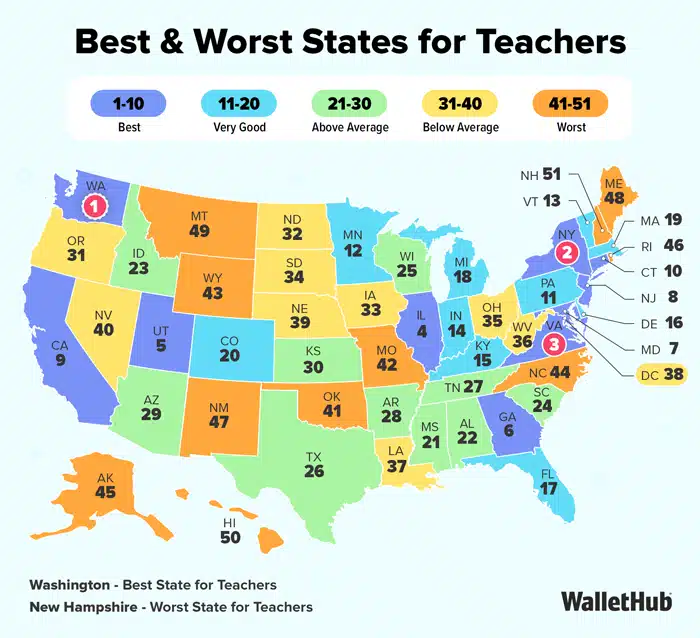
New York ranks as the second-best state in the country for teachers in 2026, boosted by high average salaries, strong school funding and the nation’s lowest projected teacher turnover rate, according to a new WalletHub analysis.
The personal-finance website compared all 50 states and the District of Columbia across 24 measures covering teacher opportunity, compensation and working conditions. New York finished behind Washington and ahead of Virginia, Illinois and Utah.

New York received an overall score of 60.78 out of 100. It ranked eighth nationally for opportunity and competition and first for its academic and work environment.
The analysis comes as teachers nationally continue to face pressure from inflation, staffing shortages and changing classroom demands. WalletHub said inflation-adjusted teacher earnings are about 5% lower than they were a decade ago.
New York leads in teacher pay and school spending
One of New York’s strongest results came in teacher compensation.
WalletHub found New York had the highest average annual public school teacher salary after adjusting for cost of living, at $87,670.
The state also ranked fourth for teachers’ income growth potential and fifth for average teacher pensions.
Starting salaries were less competitive. New York ranked 25th nationally for average starting teacher pay after adjusting for cost of living.
School spending was another major factor in the state’s overall position. WalletHub reported New York spent $33,752 per public school student, the highest figure in the country and more than $2,000 above the District of Columbia, which ranked second on that measure.
New York also ranked eighth for the quality of its school system and sixth for its pupil-teacher ratio.
The state additionally received the top ranking for the existence of a digital learning plan.
Teacher turnover among lowest in country
WalletHub reported New York had the lowest projected teacher turnover rate in the nation at 4.3%.
The study’s turnover measure is based on the share of teachers who say they plan to leave the profession as soon as possible or when a more desirable job becomes available.
New York also received WalletHub’s highest ranking for teacher tenure protections.
The broader study gave greater weight to its “Opportunity & Competition” category, which includes teacher salaries, income growth, pensions, employment competition, tenure and teacher preparation. Those factors accounted for 70% of a state’s overall score.
The remaining 30% came from the academic and work environment, including school quality, pupil-teacher ratios, school spending, teacher evaluations, administrative support and projected turnover.
Experts point to pay, workload and burnout
Education and workforce experts interviewed by WalletHub said teacher shortages increasingly reflect retention problems rather than simply difficulty recruiting new educators.
Thomas J. Norman, a professor at California State University, Dominguez Hills, said teachers earn substantially less than other workers with comparable education levels and face workloads that increasingly extend beyond classroom instruction.
Other experts cited student behavioral and mental health needs, reduced resources, administrative demands and burnout among the pressures facing teachers.
Sean Walker, a professor at the University of Tennessee at Martin, said teachers are increasingly expected to serve not only as educators but also as mental health supports, disciplinarians, special education specialists and conflict-resolution professionals.
Experts said districts looking to retain teachers may need to consider more than compensation, including manageable workloads, planning time, professional development, advancement opportunities, stronger student support services and greater teacher involvement in decision-making.
WalletHub’s rankings used data collected through Aug. 17 from sources including the U.S. Census Bureau, Bureau of Labor Statistics, U.S. Department of Education, National Education Association, National Center for Education Statistics and Learning Policy Institute.
Washington ranked first overall with a score of 61.60, followed closely by New York at 60.78. New Hampshire, Hawaii, Montana, Maine and New Mexico occupied the bottom five positions in the study.

FingerLakes1.com is the region’s leading all-digital news publication. The company was founded in 1998 and has been keeping residents informed for more than two decades. Have a lead? Send it to news@fingerlakes1.com.