

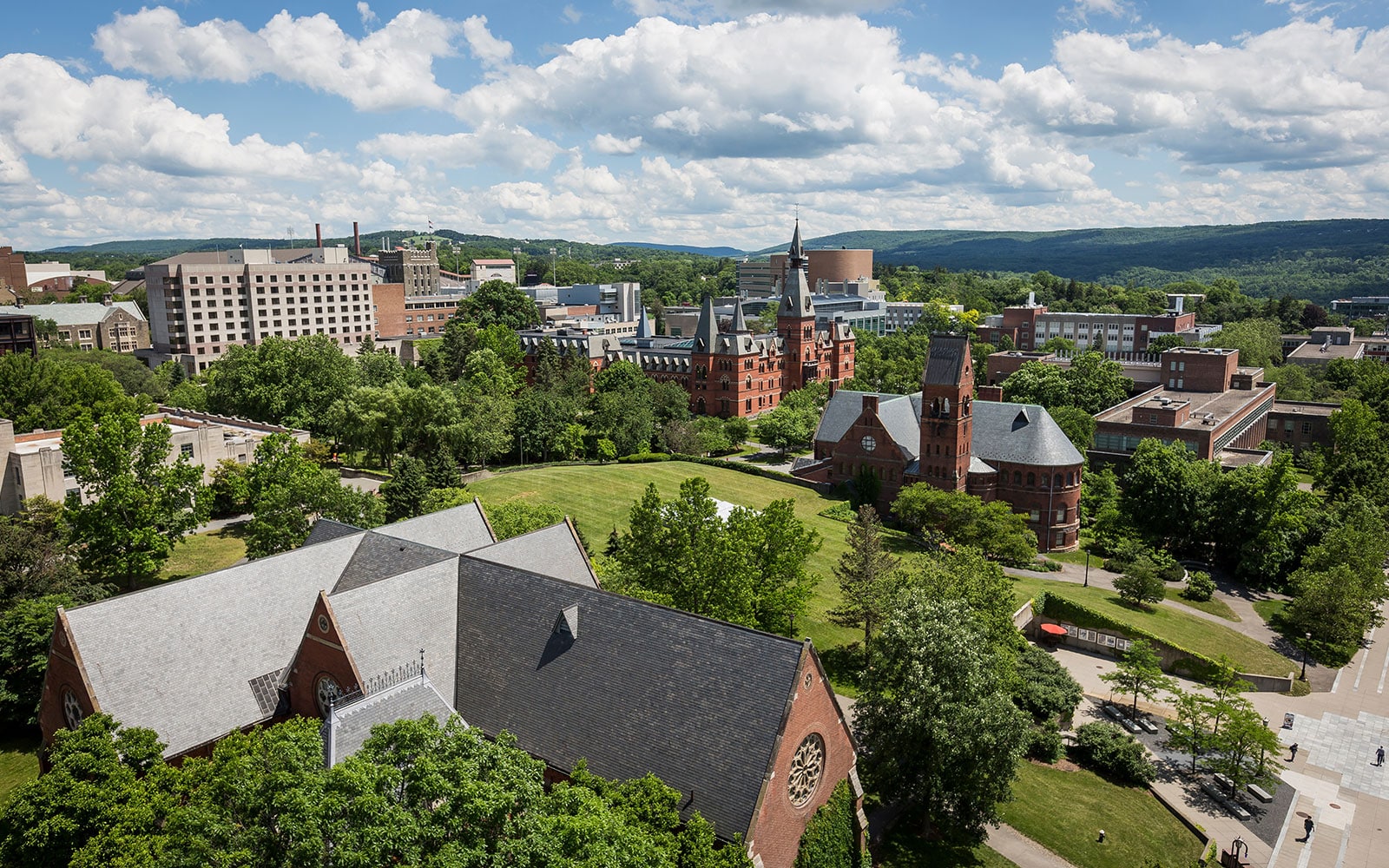
Cornell's Duffield College of Engineering has awarded $1.5 million across five projects aimed at quantum networking, hands-on instruction, AI simulation, semiconductor training and more efficient computing. The awards are the first made through the college's Breakthrough Fund, created with part of David Duffield's naming gift announced in January 2026.
The awards range from $75,000 to $750,000. College leaders said schools and departments helped identify and review proposals, and Dean Lynden Archer expects the next call for proposals in spring 2027. The projects vary in purpose, from building research equipment to developing a new pathway through undergraduate and graduate semiconductor courses.

Quantum networks and hands-on engineering
The largest award, $750,000, will support work on technologies for linking quantum computers, sensors and other devices. Researchers plan to grow high-quality diamond, create quantum bits in it and build photonic structures that could connect the systems with light.
The quantum project will use Cornell NanoScale Facility capabilities and a newly acquired diamond growth reactor. It also calls for hands-on quantum engineering experiences for students and collaboration across the university's quantum research community. Its lead investigators are Gregory Fuchs, Mohamed Ibrahim, Farhan Rana and Darrell Schlom, whose appointments span applied physics, electrical and computer engineering, and materials science.
A separate $400,000 award will develop and test a model for bringing hands-on work more consistently into engineering courses. The project combines classroom teaching with activities and laboratories that allow students to explore, revise their work and learn from failure.
That effort starts with the Sibley School of Mechanical and Aerospace Engineering and the R.F. Smith School of Chemical and Biomolecular Engineering. It builds on the Smith School's Living Laboratory Ecosystem and Sibley's Learning Studios. Researchers also plan to study experiences shared across the schools and create administrative structures that could allow other departments to use the model. Allison Godwin and Brian Kirby are the lead investigators.
AI simulation and semiconductor training
An Engineering AI Simulation Center will receive $150,000 to combine artificial intelligence with computer simulations used in mechanical and aerospace engineering. Led by Nikolaos Bouklas and Jian-Xun Wang, the effort is intended to create a shared technical platform, an operating model and industry testbeds for simulations that incorporate numerical physics, experimental data and engineering judgment. The team will emphasize applications that could have both civilian and other uses.
The center is still a project to be built, not an established facility with reported results. Its investigators plan demonstrations and other evidence that could support a larger, durable research center and future outside investment.
Another $125,000 award will expand semiconductor-focused instruction across materials science, chemical and biomolecular engineering, electrical and computer engineering, and systems engineering. The college plans a dedicated teaching cleanroom where students can practice fabrication and characterization, along with stronger ties to manufacturers and the Cornell NanoScale Facility.
That workforce project, led by Mike Thompson and Kintu Early, would connect undergraduate study with Master of Engineering and Master of Science programs. New or expanded courses would cover nanofabrication, semiconductor devices, packaging and the broader manufacturing system. The college pointed to semiconductor-industry growth in New York and nationally as the reason for building the training pathway.
Lower-energy computing research
The fifth project will receive $75,000 to investigate computer designs tailored to probabilistic AI algorithms. Instead of trying to eliminate every error within the hardware, the team wants to test whether noise-tolerant algorithms can still produce accurate results on more energy-efficient, error-prone computers.
José F. Martínez, Peter McMahon and Adrian Sampson will bring together computer architecture, applied physics and compiler expertise for that work. They aim for large improvements in speed and energy use, but the award is for further development of the concept; Cornell did not report that those gains have been achieved.
Archer said the fund's time-limited awards are meant to let faculty and staff pursue ideas that might otherwise remain within individual departments. The college has not provided a schedule for completion of the five projects, but expects another round of proposals to open in spring 2027.

FingerLakes1.com is the region’s leading all-digital news publication. The company was founded in 1998 and has been keeping residents informed for more than two decades. Have a lead? Send it to news@fingerlakes1.com.