

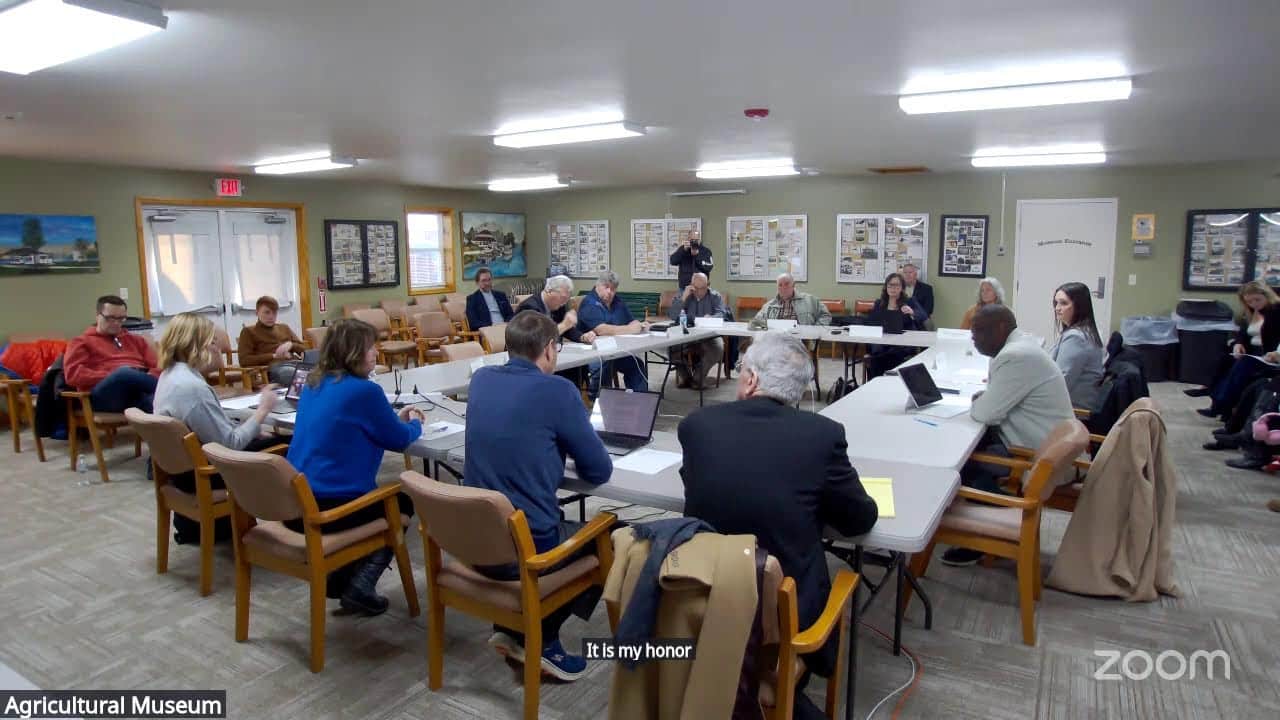
Cayuga County lawmakers left their August meeting with several consequential questions still hanging over county government, including how it should be managed, who should lead its economic development efforts and how mounting personnel costs will affect an already difficult 2027 budget.
The Legislature took concrete steps on several of those fronts Aug. 25, but the debate made clear that some of the county’s biggest decisions are only beginning. Lawmakers approved a $30,000 outside review of county administration, hired a consultant to develop a countywide economic development strategy and moved ahead with staffing and compensation changes as Chair Jonathan Anna warned another challenging budget cycle is approaching.

Here are five major takeaways from the session and what comes next.
1. Cayuga County is reopening the question of how county government should be run

The most significant long-term debate came near the end of the meeting, when lawmakers revived a proposal that had been tabled in June to bring in Pracademic Partners for an organizational assessment.
The original proposal contemplated three phases, including an assessment and an eventual search for a county administrator. Instead, lawmakers amended it to authorize only the first phase at a cost of $30,000, effectively separating the question of what management structure Cayuga County needs from the hiring of anyone to fill it.
That first phase is expected to examine the county’s organizational and management structure, policies and procedures and provide recommendations to lawmakers. The original resolution described the work as including management consulting, leadership training, meetings with legislators and department heads and a broader organizational assessment.
The distinction became important because legislators remain deeply divided over the answer.
Some argued Cayuga County ultimately needs an elected county executive. Others said the county needs a professional administrator chosen for management experience rather than another elected politician. Anna, who said he previously supported exploring the county executive model, told lawmakers his thinking has changed as he’s dealt more directly with the county’s financial and operational challenges.
“We have immediate challenges that cannot wait several years for restructuring of county government,” Anna said, pointing to budget pressure, rising costs and the need to examine how departments operate.
That disagreement is precisely what the $30,000 review is now supposed to help resolve. But the debate also exposed a potential problem: several lawmakers already expressed strong positions before the assessment has begun.
At one point, a legislator openly questioned whether the county was wasting the $30,000 because lawmakers appeared to have already made up their minds.
The next step is the outside assessment. What happens after that — an appointed administrator, movement toward an elected executive or neither — remains unsettled.
2. Economic development is getting another reset
The Legislature also approved a $65,000 contract with 4ward Planning Inc. to develop a countywide economic development strategy.
That matters because Cayuga County has spent the period since the dissolution of its former economic development structure trying to determine how multiple organizations should work together.
The county budgeted $150,000 for economic development activities this year, with up to $70,000 designated for a consultant. The resolution says the strategy is intended to involve economic development organizations across the county and build on other ongoing planning efforts.
The consultant outlined a six-month process that will examine demographics, workforce conditions, industry clusters, real estate, zoning, infrastructure, organizational capacity and peer counties before producing recommendations.
But the more important debate came after the presentation.
Lawmakers questioned who will actually implement the eventual plan. Some suggested the county needs a single lead economic development organization, while others questioned whether the Legislature weakened its own ability to do that work when it previously reduced staffing in the county Planning and Economic Development Department.
County officials said the study itself is intended to help answer the structural question — whether Cayuga County needs a new centralized organization, a hybrid arrangement or another model entirely.
The consultant is also expected to identify “quick wins,” longer-term projects, potential funding sources and performance indicators that can be tracked over time.
In other words, the Legislature has approved the roadmap. The harder decision comes when the report identifies who should be driving.
3. The 2027 budget fight is already taking shape
Anna told lawmakers department heads will begin formal budget meetings in September and warned the county faces “another challenging year.”
Several decisions made during the August meeting previewed why.
The Legislature approved new high-deductible health insurance requirements for non-bargaining employees hired beginning Jan. 1, 2027. Current non-bargaining employees will be able to choose among existing coverage and the new high-deductible options, but new hires will be required to select a high-deductible plan.
The change is aimed at controlling rapidly increasing health insurance costs, but lawmakers acknowledged a tradeoff: Cayuga County is already struggling to recruit workers, and reducing the attractiveness of its benefits package could make hiring more difficult.
That tension — controlling payroll and benefit costs while remaining competitive enough to recruit and retain employees — surfaced repeatedly throughout the meeting.
It will likely become one of the defining issues of the 2027 budget process.
4. Staffing shortages are creating real costs, particularly at the jail
The personnel problem isn’t theoretical.
The Legislature authorized the sheriff to fill three vacant custody positions and two vacant road patrol deputy positions. The three jail vacancies resulted from retirements, while the road patrol positions were already vacant.
More significantly, the Legislature had to move money because jail staffing shortages are already changing operations.
A jail pod used to house women was closed because of insufficient staffing, forcing the county to board female incarcerated people at other facilities. Lawmakers transferred $35,000 to cover those costs.
- Cayuga County Legislature to weigh jail staffing, health insurance changes and millions in projects tonight (video)
- CAYUGA COUNTY: Legislature holds August committee meetings (watch)
- Cayuga County lawmakers to weigh 911 center move, mental health funding and college budget (video)
- Cayuga County advances college budget, 911 center move and talks jail staffing crisis (videos)
Another $80,000 was transferred into the jail overtime account because numerous vacancies have driven overtime spending beyond what was budgeted.
Those actions illustrate the broader financial challenge lawmakers will confront this fall: leaving positions vacant can save salary and benefit costs on paper, but shortages can produce overtime, outsourcing and operational expenses elsewhere.
5. The county is wrestling with how much it must pay to keep experienced leaders
That question came into sharp focus during the reappointment of Public Health Director Kathleen Cuddy.
The resolution set Cuddy’s annual salary at $120,000 beginning Aug. 26, increasing incrementally to $135,769 by 2031.
But lawmakers first debated an amendment that would have added $5,000 to the proposed salary schedule.
Supporters argued Cuddy’s experience and institutional knowledge justified the additional compensation and warned replacing an experienced department head could ultimately cost the county more. Opponents said the county had already developed a compensation methodology for non-bargaining employees and departing from it for one department head could create a precedent for others.
The amendment failed. The original salary schedule subsequently passed.
The debate went beyond one employee. It highlighted a problem Cayuga County will repeatedly confront as it develops the 2027 budget: experienced workers have market value, but every salary adjustment becomes part of a larger compensation structure the county has to afford.
Taken together, the August meeting showed a Legislature trying to solve several interconnected problems at once.
Cayuga County is looking for a better economic development structure because lawmakers want to expand the tax base. It’s reconsidering its administrative structure because officials believe county operations need stronger coordination and management. At the same time, staffing shortages, health insurance costs, overtime and compensation pressures are making government more expensive.
The next several months should begin determining whether those efforts converge into a broader strategy or remain separate initiatives.
The economic development study will move forward over roughly six months. The administrative assessment will examine how county government should be managed. Department heads will begin building the 2027 budget in September.
Those three processes could ultimately become different pieces of the same question facing the Legislature: how Cayuga County intends to deliver increasingly expensive services with limited resources — and whether changing the way county government is organized can meaningfully change that trajectory.

FingerLakes1.com is the region’s leading all-digital news publication. The company was founded in 1998 and has been keeping residents informed for more than two decades. Have a lead? Send it to news@fingerlakes1.com.