

Cayuga County legislators spent July advancing a wide-ranging package of spending plans, staffing changes, grants and infrastructure projects, with the most consequential discussions centered on Cayuga Community College’s finances, a worsening staffing shortage at the county jail and the long-delayed relocation of the county’s backup 911 center.
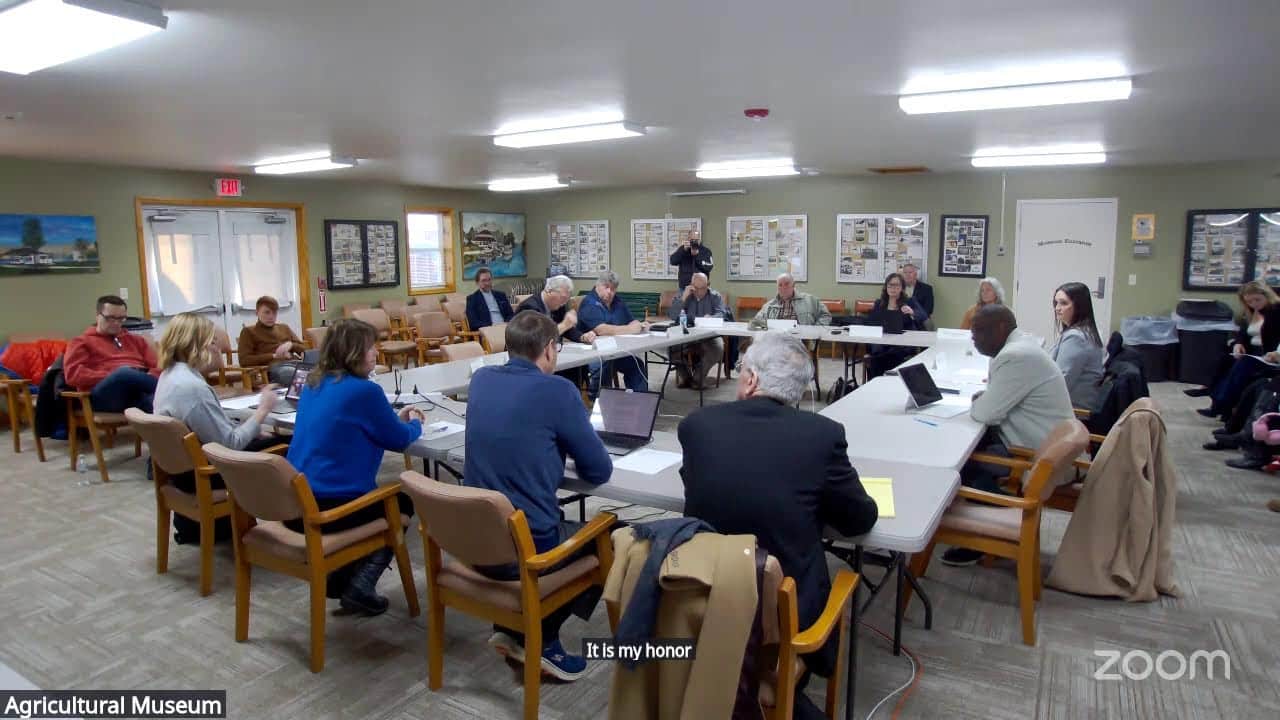
The measures cleared the Legislature’s committee system during meetings July 8, 14 and 21. Most were forwarded to the full Legislature for consideration July 28, meaning the committee votes were recommendations rather than final approval.
College budget exposes long-term funding pressure

The Government Operations Committee advanced Cayuga Community College’s proposed $31 million budget for the 2026-27 academic year, including a county contribution of $3,264,964. The local contribution would rise by about $48,000.
College officials said the spending plan is about 5% larger than the current budget. Tuition would increase 3%, while the student technology fee would rise by $2 per credit hour. Revenue from that fee is restricted to technology-related expenses and cannot be used for salaries or employee benefits.
The budget anticipates using $1.6 million from the college’s fund balance. College representatives said salaries and fringe benefits alone increased by approximately $1.14 million, driven partly by a 14% increase in health insurance costs.
The college expects to use about $600,000 in reserves during the current budget year. Its fund balance was reported at roughly $11.5 million, but officials acknowledged that drawing down $1.6 million annually would not be sustainable.
The discussion also exposed a larger disagreement over Cayuga County’s financial responsibility for the college.
County Attorney Frederick Westphal told legislators that state education law divides community college support among tuition, the state and the local sponsor. He said the county has not recently contributed a full one-third share and that the college has relied on reserves instead of demanding the county meet that theoretical obligation.
Legislator Mark Strong questioned how much control taxpayers have over college hiring, salaries and academic decisions if the county could ultimately be responsible for a substantially larger share of the budget.
Government Operations Committee Chair Brian Muldrow pushed back on the idea of county government influencing academic or staffing decisions. He said the county’s contribution supports affordable local education and argued that government officials should not control how a college operates.
Other legislators highlighted the college’s nursing program, police academy and workforce-development role. College officials said nursing graduates have maintained a 100% licensing-exam pass rate.
The budget later advanced through the Ways and Means Committee without another extended debate.
Legislators also supported a new labor agreement covering 16 college maintenance employees, including cleaners, custodians and building-maintenance workers. The four-year agreement provides a $2,500 base-pay increase in its first year, followed by annual 3.25% increases. It also expands leave and holiday benefits.
Jail staffing forces county to send women elsewhere

Sheriff Brian Schenck delivered one of the month’s starkest warnings, telling the Judicial and Public Safety Committee that staffing shortages forced the county to move its female incarcerated population to two other county jails.
The county recently lost another custody employee to retirement and does not have enough officers to staff the women’s housing area. Schenck said the situation is unlikely to improve until the county hires more officers.
The immediate financial effect works in two directions. Closing a housing unit reduces some overtime, but Cayuga County must pay other counties to house its incarcerated women, loses revenue from accepting inmates from outside jurisdictions and may incur additional overtime when deputies transport people back for court appearances or medical appointments.
One outside jail is charging Cayuga County $110 per person per day. Schenck said the second jail’s rate had not been finalized when the committee met.
The county generally receives $90 per day for local board-ins and $100 per day for federal inmates, although Schenck said officials are trying to increase the federal rate.
“My fear is the problem continues to compound,” Schenck told legislators, warning that continued staffing losses could eventually force the county to send male inmates elsewhere as well.
The committee advanced authorization to fill six vacant deputy sheriff custody positions. The jobs are already funded in the 2026 budget, and county documents say filling them should reduce mandatory overtime.
The Sheriff’s Office also received committee approval to accept a $27,000 Gun Involved Violence Elimination grant. Of that amount, $25,000 would support overtime and $2,000 would cover other grant expenses. The state funding requires no county match.
Deputies handled 9,279 calls for service through May, compared with 8,228 during the same period in 2025. Schenck said he had not completed a detailed analysis identifying what was driving the increase.
Backup 911 project scaled back
Legislators moved forward with relocating the county’s backup 911 center to the Auburn Fire Department, but reduced the capital project from $1.2 million to approximately $886,000 before it reached the full Legislature.
The former backup center was located in the now-closed County Office Building. Cayuga County has leased space from the city of Auburn at the fire department for $5,070 annually.
Information Technology Director Tom Bunn said the largest expenses involve moving and configuring the Motorola radio network and 911 telephone system. Those costs would exist regardless of where the county establishes the backup center.
Officials rejected a more extensive rooftop cooling system that would have required structural work at a building the county does not own. The revised plan relies on the building’s existing air conditioning and two mini-split systems, including a backup unit.
Bunn said building a separate data center elsewhere could cost approximately $1.2 million before the county moved any of its dispatch equipment. Using the fire department’s existing data infrastructure was described as the least expensive option.
The original resolution established a $1.2 million capital account. Ways and Means Chair Elane Daly introduced an amendment eliminating a proposed $313,922 withdrawal from the county’s general fund balance because officials no longer expect to need the full amount.
The amended project would instead use $409,063 in undesignated capital funds, $182,870 in interest from the Emerson Park capital account and $294,145 in interest associated with the DREAMS records project. Ways and Means approved the revised amount.
County officials estimated that procurement, electrical work, data installation and equipment relocation could take another three to four months.
The county also advanced a $16,250 preventive-maintenance agreement covering backup-power equipment at its emergency communication towers. Officials said the county previously maintained the uninterruptible power supply at the main 911 center but did not have a comparable program for equipment at the tower sites.
Two vacant dispatcher positions were also advanced for filling through New York’s Hiring Emergency Limited Placement program, commonly called HELP.
Mental health funding expands services
The Health and Human Services Committee advanced $222,000 in state funding for suicide prevention and school-based mental health services.
Cayuga County Mental Health was awarded $132,000 over three years through the state Office of Mental Health’s rural suicide-prevention initiative. The funding includes $36,000 in 2026 and $48,000 in each of the following two years.
The county plans to use the money for a rural suicide-prevention needs assessment, evidence-based interventions, workforce training, public education and coordination among schools, health care providers, law enforcement agencies and community organizations.
Community Services Director Lauren Walsh said the county has established a suicide-prevention coalition and is pursuing additional federal grants. She said completed suicides in the county are primarily occurring among adults, making adult prevention efforts a significant focus.
The county also accepted $90,000 to support two school-based mental health clinics in the Moravia Central School District. Millard Fillmore Elementary School and Moravia Junior-Senior High School would each receive $45,000 in startup funding.
Walsh said the clinics were approved because Moravia is considered a high-needs district. Services are already beginning, with staff building student caseloads.
Mental Health also received authorization to recruit a psychiatric nurse practitioner ahead of an expected Oct. 30 departure. The position has a starting salary of $168,646 and is considered critical to avoiding a gap in medication management and patient care.
Legislators also advanced the reclassification of the department’s administrative assistant as an office manager, reflecting supervision of eight employees and broader responsibility for records, intake, workflows and department operations. The former position would remain vacant and unfunded.
County restructures hiring amid persistent vacancies

Staffing shortages extended well beyond the jail and 911 center.
The Ways and Means Committee advanced the conversion of approximately two dozen provisional positions into HELP positions. The employees are serving provisionally because the state does not plan to offer competitive examinations for their titles, leaving them without a normal route to permanent civil-service status.
The affected jobs span the County Clerk’s Office, Treasurer’s Office, Finance Department, Highway Department, Human Resources, Mental Health, DMV, Office for the Aging, Planning, Public Health, Social Services, Emergency Services and Veterans Service Agency.
Human Resources reported 41 open county positions as of the July 21 meeting.
- Cayuga legislators restore museum funding, approve immigration resolution after emotional meeting
- CAYUGA COUNTY: Legislature holds June meeting (webcast)
- Cayuga County Legislature to consider staffing, contracts and administrator search (video)
- Cayuga County committees review energy savings, tourism efforts and infrastructure needs
Social Services reported seven caseworker vacancies among 24 budgeted positions. The department also received approval to fill two seasonal Home Energy Assistance Program clerk positions and create a HELP-program human services examiner position.
A part-time Youth Bureau director position was added later in the committee process. The Youth Bureau is being incorporated into the Department of Social Services, and legislators said the vacancy was delaying contracts and the distribution of youth-program funding. The position would pay between $25 and $30 per hour.
Highway projects and housing study advance
The Planning and Public Works Committee advanced an additional $378,805 in state paving aid. The county maintains 508 miles of road and had already authorized paving work on approximately 40 miles in 2026.
Legislators also supported spending $145,000 in previously received revenue to repair twin culverts on Fosterville Road. The state Department of Transportation has flagged the culverts for repairs. Rehabilitation is estimated at $245,000, compared with approximately $3 million for full replacement.
Another $21,350 would be drawn from the highway fund balance to repair accidental damage at the county’s main highway garage.
The county also moved toward awarding a contract for a countywide housing market study. That resolution received one opposing vote in Ways and Means, identified during the meeting as coming from Strong.
Planning Director Kari Terwilliger said the department is already managing a county strategic plan, brownfield pre-planning work, broadband deployment, housing initiatives, water-quality projects and clean-energy projects.
Staffing losses forced the county to cancel its fall electronic-waste and household-hazardous-waste collection events. Planning officials said organizing the events consumes roughly half of one employee’s annual work time and that current staff cannot run them while meeting grant and project deadlines. The county hopes to restore at least some collection events next year.
Harriet Tubman Byway faces local deadline
Tour Cayuga Executive Director Courtney Kasper told legislators that local approvals remain the final obstacle to completing the Harriet Tubman Underground Railroad Byway route through Cayuga County.
State legislation formally established the byway in June, but the Department of Transportation requires resolutions from municipalities along the route. Kasper said the remaining approvals were needed by August.
Questions from towns have centered on restrictions against new off-premise commercial billboards along scenic byways. Existing signs may be grandfathered through June 2027, and municipalities would not be responsible for purchasing byway signs.
Tourism officials were prepared to reroute the corridor through Sennett and Skaneateles if an agreement could not be reached with Aurelius.
The tourism office also reported that outdoor recreation accounted for 36% of visitor activity in May, up from 21% one year earlier. Philadelphia, Boston and Columbus emerged as growing visitor or spending markets, while out-of-state travelers represented 49% of visitors.
Other actions
Committees also advanced:
A one-year extension of the county’s third-floor lease at 2 State St. in Auburn. Negotiations reduced the proposed rent increase from 6% to 4%, and the agreement includes options for an additional six- or 12-month extension.
More than $83,000 in homeland-security funding for body armor, hazardous-material equipment, crowd-control equipment, information-sharing systems and other preparedness expenses.
A $28,834 emergency-management grant that would reimburse a portion of the emergency services director’s salary.
Authorization to hire a part-time STOP-DWI coordinator at $25 per hour. The measure passed the Judicial and Public Safety Committee despite opposition from Legislator Hans Pecher, who questioned whether the program was reducing impaired driving and criticized spending on promotional materials rather than enforcement.
A $33,596 renewal of the county’s CivicPlus website and digital-services platform, including hosting, security, accessibility tools, text notifications and artificial intelligence-powered search.
The July meetings showed a county government attempting to move several long-running projects forward while contending with a common constraint across nearly every department: too few employees to maintain existing services without overtime, outside contracts, reduced programming or delayed work.

FingerLakes1.com is the region’s leading all-digital news publication. The company was founded in 1998 and has been keeping residents informed for more than two decades. Have a lead? Send it to news@fingerlakes1.com.