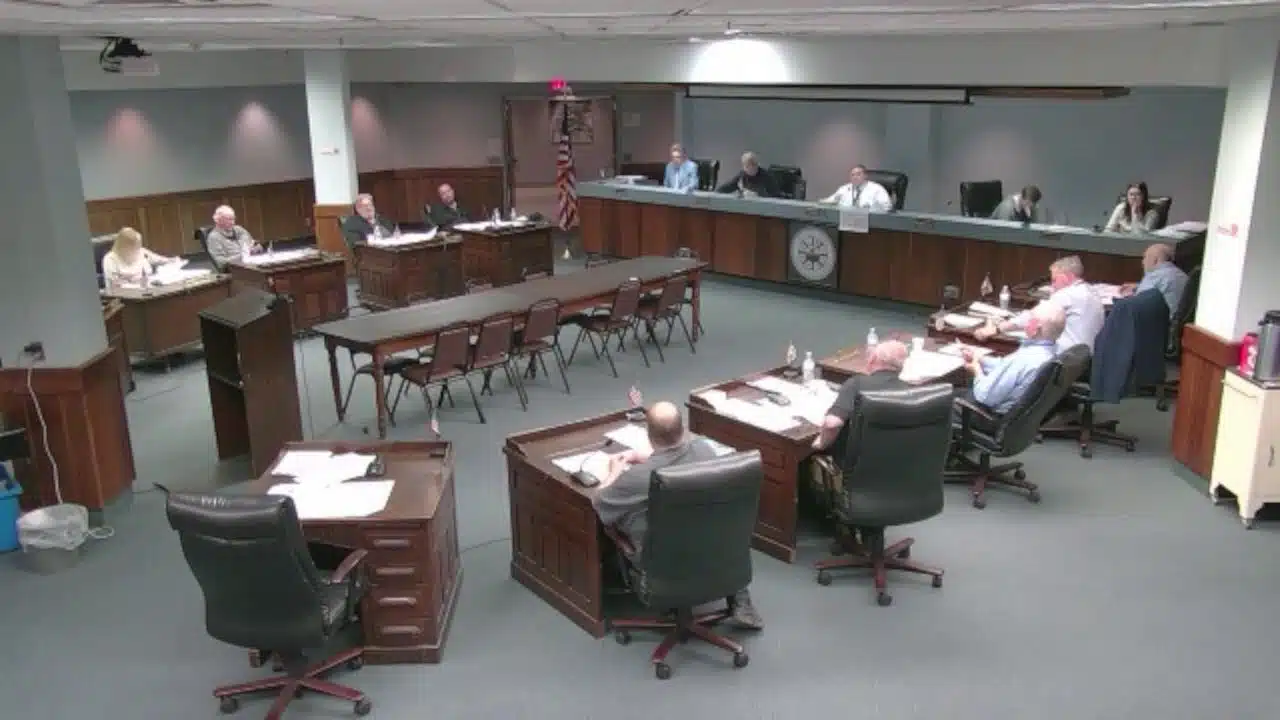
The Seneca County Board of Supervisors spent more than two hours Tuesday moving through a long list of committee business, though one issue clearly overshadowed the rest.
A separate dispute over Sheriff’s Office staffing turned into a heated exchange between Acting Sheriff Melinda Marquart and Human Resources Committee Chairman Frank Schmitter before the committee voted 4-1 to table four budgeted vacancies. That debate is covered in a separate story.

Beyond the staffing fight, supervisors moved forward with proposed water and sewer rate increases, backed $90,000 to preserve child advocacy services, advanced a nearly $2.25 million recycling contract and heard an update on the county’s measles outbreak. They also approved at the committee level a $900,000 agreement tied to plans for renovating the Health and Senior Services Building.
Several discussions came back to the same basic problem: costs and rates that haven’t kept pace over time. Officials described water and sewer systems operating under outdated financial assumptions, building permit fees that haven’t broadly increased in more than a decade and infrastructure that needs additional investment before larger projects can move ahead.
Water and sewer customers could pay more
Customers in Seneca County Water District No. 1 could see their minimum quarterly bill increase by $32.89 under a proposal advanced by the Public Works Committee.
The district currently charges $10.47 per 1,000 gallons, plus a $67.50 quarterly operations and maintenance charge. The proposal would raise those figures to $12.05 per 1,000 gallons and $87.75 for O&M.
Part of the increase is coming from farther up the system. The Village of Waterloo raised its wholesale rate to the Town of Varick by $1.07 per 1,000 gallons, while Varick increased the rate it charges the county district by $1.12.
But Seneca County isn’t proposing to simply pass that increase along.
Water and Sewer Director Daniel Schmalzel told supervisors the county district also needs to better account for its own operating and maintenance costs. The system includes pumps at Seneca Lake and the former Seneca Army Depot, along with valves, a storage tank and other infrastructure that has to be maintained.
“There hasn’t quite been the funds necessary to do the necessary maintenance,” Schmalzel said.
Some district expenses have historically been supported through project funds, he said, but those accounts eventually disappear. The recurring cost of maintaining the system needs to be reflected in the district’s regular operating revenue.
A similar discussion unfolded over Sewer District No. 1.
The per-unit rate was $30 in 1986 and remained there for 30 years before increasing to $45 in 2016. It hasn’t increased since. The county is now proposing a rate of $57.50 per unit, a $12.50 increase.
Schmalzel said the district has run short of money near the end of recent budget years, driven largely by higher utility costs.
The history prompted a broader conversation among supervisors about whether rates should at least be reviewed every year, even when no increase is ultimately necessary.
Rather than leaving rates untouched for a decade or more and then making a larger correction, several supervisors suggested the county should monitor expenses and revenues more regularly.
The county is confronting a similar problem in Sewer Districts 3 and 4.
Schmalzel said O&M rates there are still based on projections developed in 2019 that were supposed to be revisited in 2020. That review never happened after the COVID-19 pandemic began.
The Waterloo Premium Outlets is among the large customers that could be affected by future changes. Schmalzel said an early estimate provided for the outlet center’s budgeting showed a possible 75% increase in its O&M component. When treatment costs and the entire bill are considered, however, he estimated the overall increase could be closer to 25%.
Those figures remain projections. The committee did not approve new rates for those districts Tuesday.
County looks to preserve child advocacy services
Seneca County is also preparing to pay for services it has received without direct county cost for nearly two decades.
The Health and Human Services Committee advanced a contract of up to $90,000 with the Child Advocacy Center of the Finger Lakes after the organization lost funding through the state Office of Victim Services.
The center provides forensic interviews, victim and family advocacy, specialized medical and mental health coordination, multidisciplinary case review and other services connected to child abuse investigations.
County documents show the center has handled an average of about 141 Seneca County cases per year over the most recent three-year period, or roughly 12 cases each month.
Human Services officials told supervisors the center could close Oct. 1 without replacement funding.
That would not eliminate the county’s responsibilities. State law still requires the investigative and child protection work now supported by the center, meaning Seneca County and its partner agencies would have to absorb or separately obtain those services.
Officials said that could require specialized training, additional staffing and other expenses.
The proposed agreement would run from Oct. 1, 2026, through Sept. 30, 2027. The $90,000 has been identified within the adopted Human Services budget rather than through a new appropriation.
Supervisors questioned how the cost will be divided among Seneca, Ontario and Yates counties, all of which are served by the Child Advocacy Center.
They asked for additional information showing utilization by county and how much each county is contributing, saying they wanted to make sure Seneca County’s share was equitable.
The committee advanced the contract.
Five measles cases confirmed
Public Health Director Scott King also gave supervisors an update on the measles outbreak affecting Seneca County and the broader Finger Lakes.
King said Seneca County had five confirmed cases as of Tuesday night. At least two people had been hospitalized, including one person who remained hospitalized at the time of the meeting.
He said the situation meets the definition of an outbreak.
King also said other counties in the region were investigating potential cases but declined to identify them before those health departments received laboratory results and released their own information.
Seneca County has expanded its vaccination response, including an at-home program for previously unvaccinated residents interested in receiving the MMR vaccine.
King said staff are administering those vaccinations outdoors at residents’ homes as a precaution.
He also said an unusual increase in requests for MMR vaccination from a largely unvaccinated population was one of the early signs that led county nurses to believe measles may already have been circulating locally.
King credited department staff with preparing a response plan before the county’s first confirmed cases.
$900,000 health building agreement advances
The county also took another step toward renovating the Health and Senior Services Building on Bonadent Drive in Waterloo.
The Public Works Committee advanced an agreement of up to $900,000 with Barton & Loguidice for pre-construction services connected to plans to relocate the county’s Mental Health and Addictions Department.
The county is targeting construction in spring 2027 with completion anticipated during the winter of 2027.
The agreement advanced, but not before supervisors spent considerable time trying to clarify exactly what the $900,000 buys and what work would still need to be contracted separately.
Facilities Superintendent Robert Stuck said Barton & Loguidice would complete the architectural and design work needed to take the project through bidding and award.
That does not make the firm the county’s construction manager.
The distinction sparked questions about who will monitor the project after construction begins, deal with contractors and changes in the field and protect the county from problems that could lead to costly change orders.
Several supervisors said some form of construction management could be necessary.
Stuck agreed to investigate what those services would include and how much they could cost.
He also warned that the timetable is becoming tight. If the county wants the renovation ready to go out to bid before the end of the year, design work needs to move quickly.
County advances nearly $2.25 million recycling contract
Seneca County is preparing to continue curbside recycling service under a three-year contract worth nearly $2.25 million.
Cardinal Disposal submitted the lowest responsible bid at $2,249,964 over three years, or $749,988 annually. During the discussion, county officials said the other proposal totaled roughly $3.66 million.
The Public Works Committee advanced the Cardinal bid.
Much of the discussion centered not on the price, but on service.
Missed collections have generated complaints, and county officials said they have established a county-controlled complaint line to create a better record when pickups are missed.
Messages are collected and forwarded to the contractor twice a day, giving the county documentation of recurring problems and a basis for imposing penalties if contract requirements aren’t met.
Officials said complaints have been relatively limited since the new process began.
Supervisors also discussed recycling containers.
The county currently provides smaller recycling bins to residents, while the higher competing bid included larger receptacles. Larger wheeled totes can make automated collection easier, but officials raised concerns about whether some elderly residents would be able to move them.
County officials also said they have tightened distribution of the smaller bins after discovering there was little control over who was taking them when they were left in a public hallway at the County Office Building.
Building permit fees headed higher
Building permits could also become more expensive under a new fee schedule advanced Tuesday.
Code Enforcement Director Leland Earp told supervisors many of the county’s fees haven’t been increased in roughly 12 to 14 years.
“We are so far behind the times,” Earp said.
Seneca County is unusual in that its Code Enforcement Department provides state Uniform Code enforcement services across the county’s towns and villages rather than each municipality maintaining a completely separate operation.
Earp said even with the proposed increases, Seneca County’s fees generally remain below those charged in many comparable communities.
Under the proposed schedule, residential construction would generally cost 25 cents per square foot, with minimum fees depending on the type of work. Residential additions, alterations and repairs would carry a $125 minimum, while deck permits would have a $75 minimum.
Commercial projects would carry higher minimums depending on size and the scope of work.
Earp said the county shouldn’t be subsidizing the cost of operating a permitting system mandated by the state.
Code Enforcement is also getting new software.
The Contracts, Procurement and Negotiations Committee advanced a one-year, $28,600 agreement with GovPilot for a cloud-based permitting system.
Earp said the department deliberately chose a one-year contract rather than a longer commitment after problems with its previous software provider.
He said the new system should reduce the stacks of paperwork currently moving through the office and allow more of the process to be handled electronically.
The system could eventually also give towns and villages an opportunity to use compatible modules.
Audit brings clean opinion — and accounting cleanup
Tuesday’s committee meetings opened with a presentation on Seneca County’s draft 2025 financial audit.
The county received an unmodified, or clean, audit opinion, meaning auditors concluded that its financial statements were fairly presented.
The audit wasn’t without an issue.
Auditors reported a material weakness in internal controls over financial reporting because a number of material accounting adjustments were required during the audit process.
The auditor said many of the corrections were connected to personnel transitions and accounting issues that carried forward from the previous year.
He specifically told supervisors the finding should not be viewed as an indictment of the county’s current financial management. Instead, he credited current staff with working through the accounts and helping correct problems.
The adjustments included revenue and receivable issues, capital projects accounting and prior-year items.
Following the audit adjustments, the county’s general fund showed an increase in fund balance of about $1.6 million for the year. The financial statements also showed roughly $22 million in unassigned general fund balance at year-end.
Paving project advances, another gets pulled
The county moved forward with a smaller paving project at the Three Bears courthouse complex in Ovid while putting a larger County Office Building project on hold.
The Public Works Committee approved a $19,671 agreement with Seneca Stone Corp. for the Three Bears parking lot, with money shifted from a capital-project contingency account.
A separate proposal to pave DiPronio Drive and the north parking lot at the County Office Building was pulled.
Stuck said a closer look at the property found more work is needed before paving makes sense.
Many of the catch basins were constructed nearly 40 years ago and are deteriorating, he said. Underground drainage also includes old galvanized pipe rather than PVC.
Stuck said the county first needs to determine the extent and cost of the drainage work. Paving over those problems now could leave the county tearing into a new parking lot later.
Grant writing contract expanded to municipalities
The county also advanced a $54,000 agreement with Millennium Strategies for another year of grant-writing and consulting services.
During the discussion, County Manager Melissa Taylor said one issue during the previous contract was that a number of funding opportunities were available to towns and villages but not directly to the county.
Taylor said the renewed arrangement has been expanded so municipalities within Seneca County can also use the firm’s services without increasing the county’s contract price.
The agreement runs from July 1, 2026, through June 30, 2027.
New electronic health record system approved
The Contracts, Procurement and Negotiations Committee also advanced a five-year agreement for a new electronic health record system for the county’s Mental Health Department.
Mental Health Director Margaret Morse said the county went through a competitive request-for-proposals process that drew four responses before narrowing the choices to two finalists.
Grant funding is available to help with implementation during the first year.
Morse said the new system will cost somewhat more than the county’s existing electronic record, but officials expect improvements in efficiency and billing to help absorb that difference.
The county’s existing contract ends Dec. 31, and Morse said there will likely be a period when both systems have to operate while records and billing functions are transferred.
K-9 compensation agreement corrected
Another agreement addressed compensation for Sheriff’s Office K-9 handlers.
County officials said language added to the officers’ labor agreement years ago established $12 an hour for work associated with caring for the dogs outside regular duty hours.
The problem was that the figure remained fixed at $12 instead of increasing as the officers’ regular hourly wages increased.
The committee advanced an agreement tying that work to the officers’ current rate of pay.
Officials estimated the county currently spends a little less than $7,000 annually on that compensation. The change would increase the cost by about $16,000, bringing the annual total to roughly $23,000 for the two K-9 officers.
Most other vacancies approved; custodian change rejected
Away from the Sheriff’s Office staffing dispute, the Human Resources Committee approved filling budgeted vacancies in Public Health, DMV, Human Services, Finance, E-911 and Weatherization.
Public Health Director King told supervisors the department needs to replace a retiring early intervention service coordinator after referrals increased sharply this summer.
King said remaining coordinators are carrying caseloads well above what he considers sustainable and have been working overtime to keep up with state-mandated timelines and paperwork.
The committee also approved filling a senior weatherization coordinator position following a retirement. County officials said the Weatherization program’s personnel costs are fully reimbursed by the state.
One personnel proposal did not advance.
The committee rejected a request to reclassify a senior custodian as a head custodian beginning with the 2027 budget.
Stuck said the employee has taken on responsibilities that include overseeing custodial staff, reviewing time sheets and ordering supplies across county facilities.
Several supervisors questioned whether those duties justified a reclassification and corresponding pay increase, particularly because the employee would also receive contractual wage increases.
The motion failed.
Several measures advanced Tuesday still require action by the full Seneca County Board of Supervisors.
The board’s next regular meeting is scheduled for Sept. 8.

FingerLakes1.com is the region’s leading all-digital news publication. The company was founded in 1998 and has been keeping residents informed for more than two decades. Have a lead? Send it to news@fingerlakes1.com.