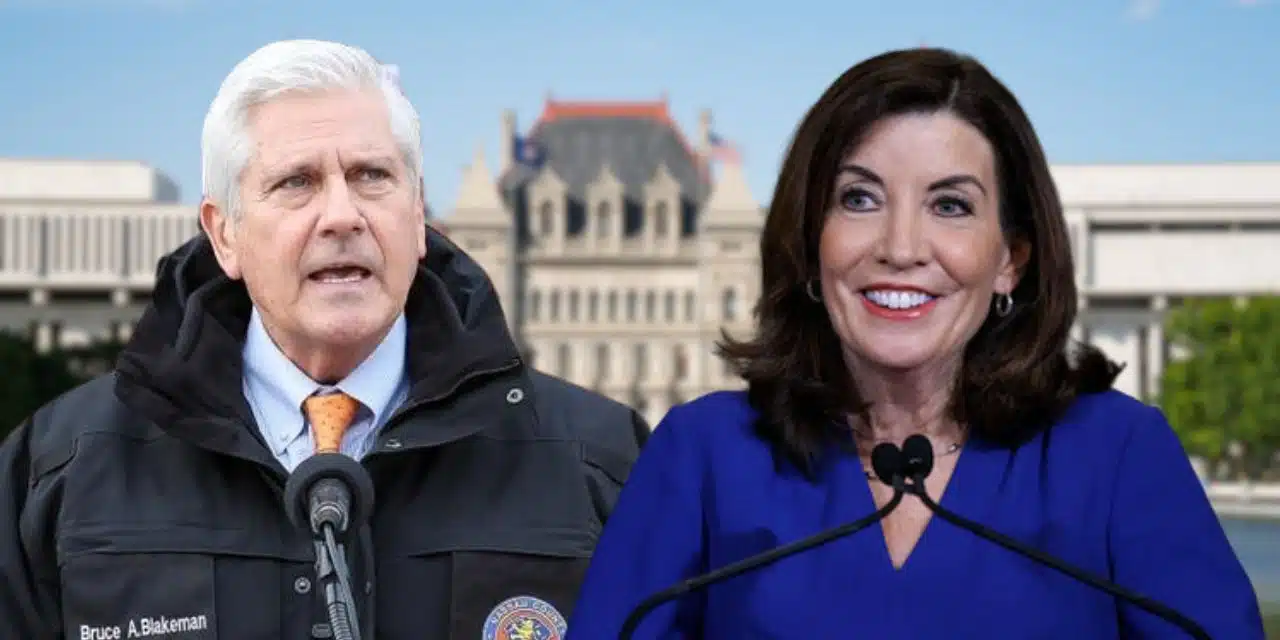
Gov. Kathy Hochul holds a 10-point advantage over Republican Bruce Blakeman with less than three months until Election Day, but a new Siena University poll shows a race that has tightened considerably as the governor struggles with underwater approval ratings and Blakeman gains ground with independents and upstate voters.
Hochul leads Blakeman 49% to 39% among likely voters, with 11% undecided, according to Siena’s first likely-voter survey of the 2026 election cycle. The Democratic governor held a 20-point advantage, 52% to 32%, when Siena surveyed registered voters in June, although the change in the type of voters surveyed means the two results are not directly comparable.

Blakeman rejected Siena’s characterization of the race, arguing that other recent polling has shown a much tighter contest.
“All of the polls we have seen in the last two months have us virtually tied with Kathy Hochul,” Blakeman said in a statement responding to the results. “This poll is always off and continues to be off. We know and she knows this race is neck and neck.”
Blakeman also used the response to attack Hochul over taxes, electric bills and crime, saying those issues have weakened her standing with voters.
The Siena results nevertheless show Hochul ahead statewide, while also identifying several areas of vulnerability for the incumbent. She remains dominant in New York City and holds overwhelming support among Democrats, but Blakeman leads in the downstate suburbs and among independents. Upstate, the candidates are essentially even.
At the same time, voters give Blakeman better marks on several personal characteristics even while saying Hochul would do a better job handling each of five major issues tested by Siena.
Hochul’s lead shrinks as Blakeman gains recognition
Hochul’s 49% support is below the 50% threshold, while Blakeman’s 39% represents his highest level of support in Siena’s polling of the matchup dating to December.
In December, Hochul led 50% to 25%. Her advantage expanded to 54% to 28% in January and stood at 51% to 31% in February, 47% to 34% in March, 49% to 33% in April and 52% to 32% in June.
Blakeman has therefore moved from 25% in December to 39% in August, while the share of voters who are undecided or have no opinion has declined from 21% to 11%.
That trend has coincided with substantially more voters forming opinions about Blakeman.
His favorability rating now stands at 33% favorable and 26% unfavorable, with 40% saying they do not know enough about him to offer an opinion. In December, only 13% viewed him favorably, 17% unfavorably and 70% did not know enough about him.
Hochul is far better known, but voters are nearly evenly divided over her.
She has a 46% favorable and 49% unfavorable rating. Her job approval rating is similarly divided, with 48% approving and 49% disapproving of her performance as governor. Among those with stronger opinions, 36% strongly disapprove compared with 18% who strongly approve.
Siena pollster Steven Greenberg noted that Hochul was in a somewhat stronger position at the same point four years ago. In August 2022, she led Republican Lee Zeldin 53% to 39% before ultimately defeating him by six points, 53% to 47%.
New York City gives Hochul her statewide advantage
Geography remains one of the clearest dividing lines.
Hochul leads Blakeman 64% to 19% in New York City, a 45-point margin that gives her a substantial cushion statewide.
Outside the city, the race looks very different.
Blakeman leads 49% to 41% in the downstate suburbs, while the candidates are running virtually even upstate. Siena also found them essentially tied among men and white voters.
Hochul holds large advantages among women, Black voters and Latino voters.
Partisanship is even more pronounced.
Hochul receives support from 80% of Democrats, compared with 8% for Blakeman. Among Republicans, Blakeman leads 84% to 9%.
Independents lean toward the Republican, 45% to 40%.
Those independent voters become especially important when looking beyond the head-to-head contest. Siena found they favor Blakeman on four of the five issues tested, even though Hochul maintains an overall statewide advantage on all five.
Voters prefer Hochul on issues, Blakeman on personal traits
Hochul’s strongest issue is housing.
Asked which candidate would do a better job increasing the supply of affordable housing, 51% chose Hochul and 35% chose Blakeman, giving the governor a 16-point advantage.
Her margins elsewhere are considerably smaller.
Hochul leads 48% to 41% when voters are asked who would do a better job making prices more affordable for average New Yorkers. She leads 47% to 42% on developing the state’s energy future.
On public safety, Hochul’s advantage shrinks to 47% to 44%.
The candidates are essentially tied on addressing undocumented immigrants living in New York, with Hochul holding a 45% to 44% edge.
The independent vote again tells a different story.
Independents favor Hochul by nine points on affordable housing but favor Blakeman by between eight and 15 points on affordability, energy, public safety and immigration.
Siena also tested four personal characteristics: whether each candidate is tough, honest, in touch with average New Yorkers and someone who gets things done.
Blakeman received the better net score on all four.
Voters say “tough” describes Blakeman by a net 25 points, compared with a net two points for Hochul. Blakeman is viewed as honest by a net five points, while Hochul is two points underwater.
Blakeman scores a net positive eight points on getting things done, compared with five points for Hochul.
Neither candidate fares particularly well when voters are asked whether they are in touch with average New Yorkers. Blakeman is four points underwater, but Hochul is 12 points underwater.
That split — Hochul leading on policy questions while Blakeman performs better on character — could become one of the defining dynamics of the campaign.
Democrats hold larger leads in other statewide races
The governor’s race is considerably closer than New York’s other two statewide contests.
Democratic Attorney General Letitia James leads Republican Saritha Komatireddy 54% to 36%, an 18-point advantage.
James has a 52% favorable rating and 38% unfavorable rating, the highest favorability Siena has recorded for her. Komatireddy remains largely unknown: more than two-thirds of likely voters either have never heard of her or do not know enough about her to offer an opinion.
State Comptroller Tom DiNapoli has an even larger advantage over Republican Joseph Hernandez, leading 55% to 32%.
His favorability rating stands at 42% favorable and 18% unfavorable, although 40% still do not know enough about him to offer an opinion. Hernandez is viewed favorably by 20% and unfavorably by 11%, with 70% unable to offer an opinion.
Beyond the statewide races, Siena found broad support for New York’s one-year moratorium on new large data centers. By 52% to 25%, voters said the moratorium was the right decision, including majorities of Democrats and independents and a plurality of Republicans.
The poll also found likely voters skeptical of artificial intelligence, with 29% viewing AI favorably and 52% unfavorably.
Meanwhile, 47% of voters say New York is headed in the wrong direction and 43% say it is on the right track. On the country as a whole, the divide is much wider, with 62% saying the United States is headed in the wrong direction and 31% saying it is on the right track.
Democrats also hold a 54% to 38% advantage on the generic congressional ballot, although independents favor Republicans 45% to 40%.
The August Siena University Poll was conducted Aug. 3-6 among 811 likely New York voters. The core questions have an overall margin of error of plus or minus 4.2 percentage points, while the 691 respondents who completed the full survey have a margin of error of plus or minus 4.6 points.
With Election Day less than three months away, Siena’s numbers leave Hochul ahead but short of a majority, while Blakeman argues the race is closer than the poll suggests. The poll also shows a sharp geographic and demographic divide: Hochul’s strength is concentrated in New York City and among women and voters of color, while Blakeman is performing strongly in the suburbs, among independents and competitively upstate.

FingerLakes1.com is the region’s leading all-digital news publication. The company was founded in 1998 and has been keeping residents informed for more than two decades. Have a lead? Send it to news@fingerlakes1.com.