

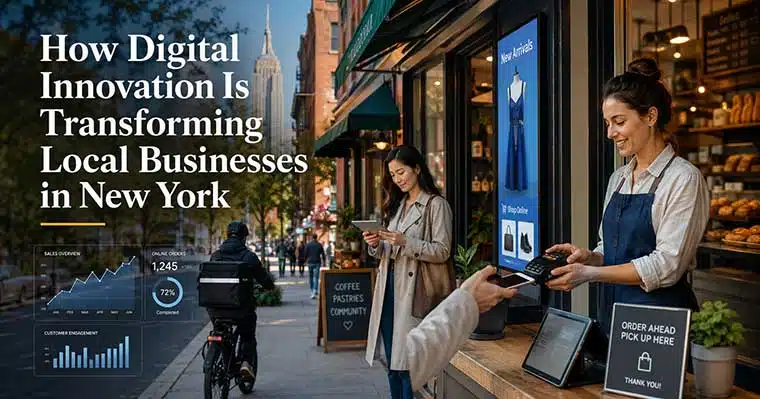
Walk down almost any commercial street in New York, from a bakery in Astoria to a hardware store in the Bronx, and you will find a quiet revolution underway behind the counter. The corner shops and family restaurants that define the city’s neighborhoods are no longer running on paper ledgers and word of mouth alone. They are booking tables through apps, answering customers with automated chat tools, tracking inventory in the cloud, and reaching buyers who live nowhere near their zip code. Digital innovation, once the preserve of large corporations with deep pockets, has become an everyday reality for smaller businesses and digital-first companies alike. From neighborhood retailers adopting cloud-based tools to entertainment platforms competing for visibility among the top 10 online casinos for real money, technology is changing how businesses reach customers, manage their operations, and compete in an increasingly digital marketplace.
The numbers tell a story of catching up
For years, the assumption was that small firms would always lag behind large enterprises in adopting new technology. That assumption is now collapsing. According to the U.S. Census Bureau, roughly 47 percent of American small businesses used some form of artificial intelligence in 2025, up from just 23 percent in 2023. Even more striking, the U.S. Small Business Administration found that by the middle of 2025, small businesses were adopting AI at a faster pace than large firms, reversing a pattern that had held for every previous wave of business technology.
What changed was the math. Tools that once demanded an engineering team and a serious budget now run on a modest monthly subscription, often around twenty dollars. For an owner already stretched thin across a dozen responsibilities, that shift transformed digital tools from a luxury into a practical decision. The typical small business that uses AI now runs a median of five different tools, spanning content creation, customer service, scheduling, analytics, and workflow automation. This is no longer experimentation. It is an operational stack.
New York as a proving ground
Few places concentrate the pressures and possibilities of digital transformation like New York. The city’s density, its punishing rents, its demanding customers, and its fierce competition all reward businesses that can operate leaner and reach further. A neighborhood restaurant that adds an online reservation system does not simply modernize for its own sake. One New York establishment that introduced online booking reported a 40 percent rise in reservations within six months, a difference that can decide whether a small operation survives its lease renewal.
The state has recognized this dynamic and moved to support it. New York launched Empire State Digital, described as a first in the nation effort connecting local small businesses with major e-commerce partners including Shopify, Square, and Etsy, offering training, discounted technology, and marketing help. At the city level, programs run through the Department of Small Business Services and the NYC Small Business Resource Network have built free websites, including e-commerce storefronts, and designed new branding for hundreds of small businesses trying to compete in the digital economy. The message from public institutions is unambiguous. A digital presence is now treated as basic infrastructure, not an optional upgrade.
Where the transformation actually happens
The most meaningful changes are rarely the flashiest. They live in the daily grind of running a business. A florist who once lost hours to phone orders now takes them through a website that never closes. A Brooklyn boutique that could only sell to foot traffic now ships to customers across the country through an online storefront that took a weekend to build. Marketing, which used to mean an expensive ad in a local paper, now happens through social media posts and targeted campaigns that a single owner can manage from a phone.
Artificial intelligence has pushed this further. Early adopters mostly used it to draft emails and write product descriptions. By 2025 and 2026, the applications had grown more operational, handling customer inquiries, forecasting demand, and automating the repetitive administrative work that quietly drains a small team. Surveys suggest the overwhelming majority of small businesses using these tools report a positive impact on their operations, and a significant share credit them with helping reach new customers they could never have found otherwise.
The gap that still remains
None of this means the transition is easy or evenly shared. The smallest firms, those with only a handful of employees, face real obstacles. They lack dedicated technology staff, they have little spare time for onboarding new systems, and they often prioritize immediate revenue over investment in tools whose payoff is not instant. A notable share of very small firms still believe advanced technology simply does not apply to them, a belief that reflects an education gap more than a genuine limitation. Poor data quality and the challenge of connecting different systems remain persistent barriers, and these problems fall hardest on the operations least equipped to solve them.
This is where New York’s ecosystem of support, its public programs, its accelerators, and its dense network of advisory services, becomes genuinely important. Closing the gap is not only a matter of fairness. A local economy where only some businesses can compete digitally is a weaker economy overall.
Looking ahead
The direction is clear even if the pace is uneven. Projections point toward continued acceleration, with a substantial majority of small businesses expected to use these tools for at least one core function within the next few years. For New York’s local businesses, the question is shifting from whether to adopt digital tools to how thoughtfully they do so, matching specific technologies to specific needs rather than chasing every trend. The firms that gain the most are consistently those that align tools with real operational problems, not those that spend the most.
The corner shop is not disappearing. It is adapting, and in doing so it is showing that the future of local commerce in New York will be built by owners who learned to blend the personal warmth of a neighborhood business with the reach and efficiency of the digital age.
Is your neighborhood business ready to make that leap, or is it still waiting on the sidelines?

This content is brought to you by the FingerLakes1.com Team. Support our mission by visiting www.patreon.com/fl1 or learn how you send us your local content here.