


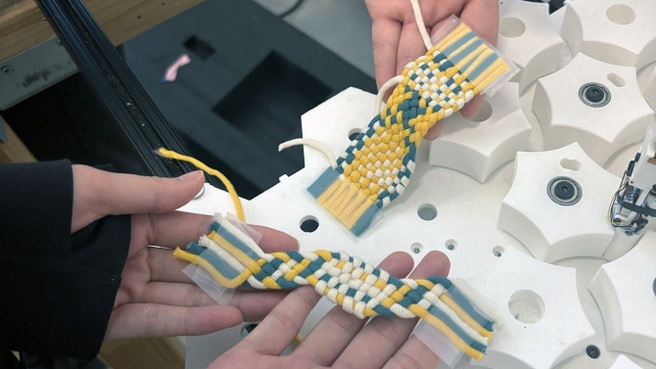
A loom built by Cornell University researchers can weave a sturdy patch of fabric, switch to a stretchy knit-like pattern and add a braid, all in the same piece.
The prototype, called Kneadix, comes from a team led by Cornell information science professor François Guimbretière. Shuhong Wang, a doctoral student who led the research, presented the design Nov. 4 in Detroit at the Association for Computing Machinery’s Symposium on User Interface Software and Technology, where the paper won a best paper award, the Cornell Chronicle reported.

How the loom switches patterns
On a conventional loom, a part called a heddle separates the lengthwise threads, known as the warp, so the crosswise thread, or weft, can pass between them. Kneadix uses rotating hexagonal gears adapted from braiding machines to move yarn carriers around. Any strand can switch between lengthwise and crosswise work as the fabric takes shape, letting the team change patterns midpiece and form curved edges.
The team also made a comb that presses the yarn into place and then pulls back out of the way. Its teeth can be spaced farther apart or closer together. Sensors measure the tension on each yarn carrier, and motors wind or unwind the bobbins to adjust it. Slack yarn can catch in the machine, while too much tension can distort the pattern.
What the prototype could make
Wang said the techniques are useful for different jobs. Weaving gives fabric stability, knit structures add stretch and braids can follow contours. The researchers envision a glove with flexible knit-like joints, a durable woven palm and a braided cuff that helps hold it in place. A loom like this could also route electrical wire through fabric as it is made, a possible use for clothing with built-in electronics.
Programming is still a hurdle, especially for complex shapes. The team built a library of tools in Python, but users have to keep track of each strand by hand. The researchers plan to automate that tracking, make the controls easier to use, improve the machine’s stability and get it working with more kinds of yarn.
Wang has knitted and embroidered since childhood, and co-author and research assistant Shengyuehui Li makes felted designs. The other co-authors are Xiaoman Yang, Vivien Chen, Yoobin Lee and Brianna Cheng. The work received support from the National Science Foundation, the Cornell Bowers Undergraduate Research Experience and a seed grant from Cornell’s Department of Design Tech.
Once the design is ready for wider use, the researchers plan to offer a kit with 3D printing instructions so makers can build their own looms and experiment with new fabric structures.
Make FL1 part of your day.
Local reporting. Useful updates. More ways to stay close to your community.
Go ad-free
Support independent local reporting and enjoy FL1 without display ads.
$4.99 / month
Become a member →Cancel anytime. Third-party media players may contain ads.Get the daily briefing
Start your morning with the headlines that matter across the Finger Lakes.
Find more FL1 on Google
Choose FingerLakes1.com as a preferred source to see more of our reporting in your Google news results.

FingerLakes1.com is the region’s leading all-digital news publication. The company was founded in 1998 and has been keeping residents informed for more than two decades. Have a lead? Send it to news@fingerlakes1.com.