

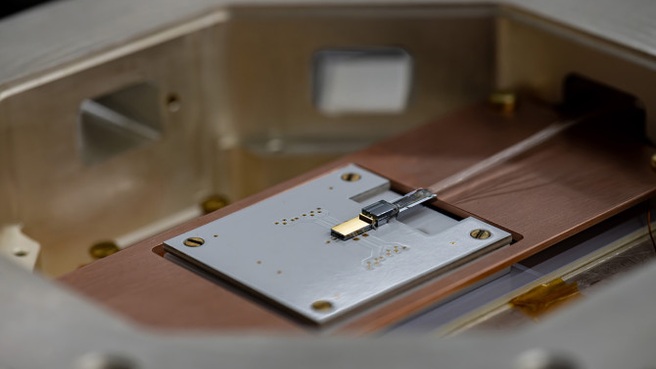
Cornell researchers have demonstrated a chip-based laser technique that cools a trapped atom’s motion in about 150 microseconds, compared with about 500 microseconds for a conventional arrangement, potentially reducing a time-consuming step in trapped-ion quantum computing.
The experiment also cooled all three measured types of motion simultaneously. The findings appeared Nov. 9 in PRX Quantum, according to Cornell’s account of the research. The demonstration involved one calcium ion, rather than a functioning large-scale quantum computer.
Why cooling takes computing time
Trapped-ion computers use electrically charged atoms held in electromagnetic fields to process quantum information. Unwanted motion can interfere with precise operations, so the ions must repeatedly be cooled toward their lowest possible motional energy states.
That work can consume a substantial share of operating time, particularly when ions are transported or rearranged and need cooling again. Karan Mehta, an assistant professor of electrical and computer engineering in Cornell’s Duffield College of Engineering, led the research.
“But cooling operations, particularly to near the quantum ground state, end up being a major bottleneck in leading systems,” Mehta told Cornell.
The team’s approach uses microscopic optical pathways integrated into an ion-trap chip. They guide laser light into a stable standing-wave pattern, with alternating regions of higher and lower intensity. Positioning the ion at a low-intensity point suppresses interactions that would otherwise add heat while allowing interactions that remove energy from its motion.
One cooling step reaches three types of motion
Doctoral students Zhenzhong Xing and Hamim Mahmud Rivy were co-first authors. Their experiments built on theoretical work by Xing and used a method called electromagnetically induced transparency cooling, which combines laser fields to control how the ion absorbs light.
The published paper directly compares standing-wave cooling with a running-wave arrangement on the same experimental platform. With settings optimized for one radial mode of motion, standing-wave cooling brought that mode near its ground state in approximately 150 microseconds. The comparison used 500 microseconds of running-wave cooling.
The standing-wave method also substantially reduced motion in the other radial mode and along the trap’s axis. Together, the three modes covered an approximately 5-megahertz frequency range. The conventional comparison did little to cool the two modes outside its target.
That broader reach matters because an ion can oscillate in three dimensions at different frequencies. Addressing several modes in one operation could reduce the need for separate cooling steps. The experiment brought all three close to the ground state, although the axial mode retained more motion than the two radial modes.
In separate tests, the researchers demonstrated standing-wave Doppler cooling below the conventional Doppler limit, confirming an earlier theoretical prediction. Those tests used a different cooling sequence from the 150-microsecond ground-state experiment.
Chip integration brings advantages and limits
The device routes wavelengths from ultraviolet to near-infrared light through integrated components. It operated at a cryogenic temperature of 4.8 kelvin. The researchers developed packaging that maintained optical connections through cooling and thermal cycling while avoiding ultraviolet damage associated with adhesive in the optical path.
LioniX International fabricated the devices in the Netherlands, with University of Twente support for an optical-material layer and collaboration involving ETH Zurich. Cornell facilities, including the Cornell NanoScale Science and Technology Facility, supported packaging and preparation.
The apparatus still used external optical paths for some beams, including the cooling method’s pump beam. Integrating the optics therefore reduced reliance on external arrangements without eliminating them.
Technical imperfections also kept the measured cooling above the much lower limits predicted for ideal conditions. The paper identifies pump-beam polarization impurity, residual light at the standing-wave minimum, positional fluctuations and motional heating as limitations. Light-induced position drifts constrained how strongly the cooling beam could be driven.
Simulations suggest that changes to electrode design, optical delivery and noise control could improve performance further. Those lower limits remain predictions requiring additional experiments. Extending the method to multiple ions is another prospective application, beyond the single-ion demonstration reported here.
Co-authors included Cornell doctoral students Vighnesh Natarajan and Aditya Kolhatkar and ETH Zurich’s Gillenhaal Beck. Support included the National Science Foundation, IARPA and the Army Research Office, the Alfred P. Sloan Foundation and Cornell. The authors made supporting data publicly available.
Photo: Photonics and Quantum Electronics Group at Cornell.

FingerLakes1.com is the region’s leading all-digital news publication. The company was founded in 1998 and has been keeping residents informed for more than two decades. Have a lead? Send it to news@fingerlakes1.com.