

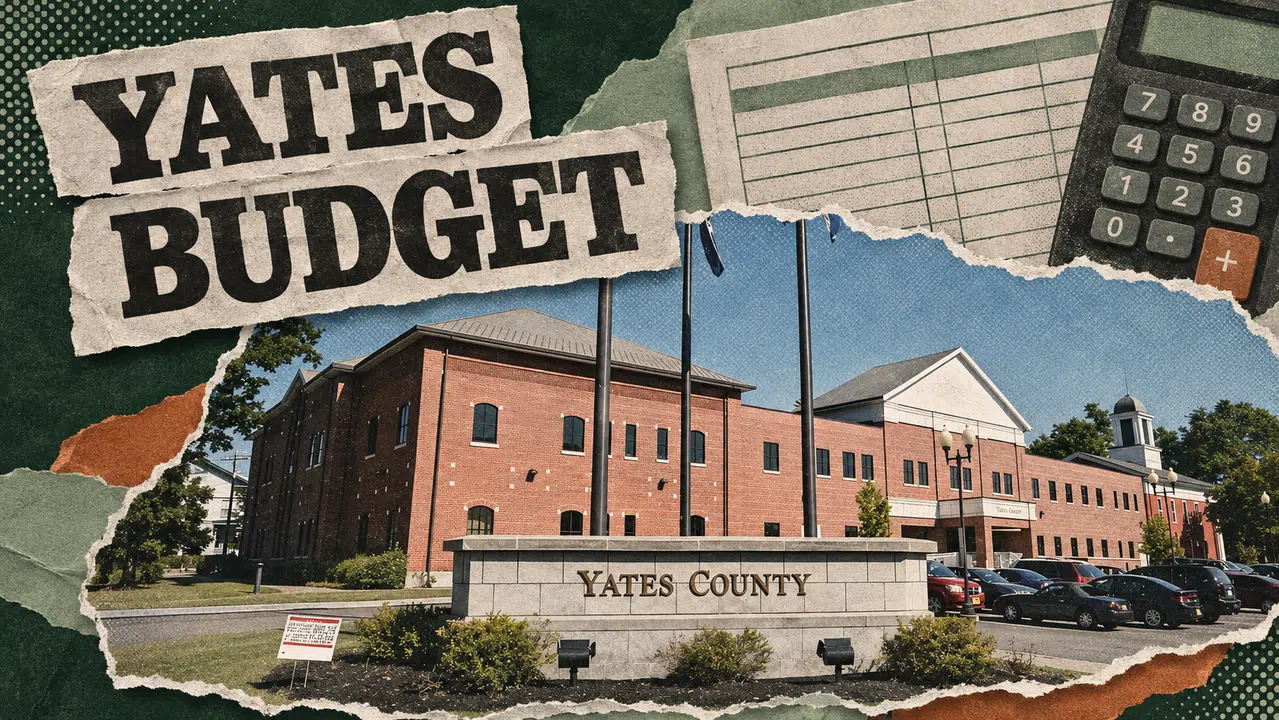
Yates County’s tentative 2027 budget would increase spending by $4.4 million and raise the property tax levy 3.11%, while lowering the countywide full-value tax rate as property values grow.
The $65.9 million plan also relies on higher sales-tax revenue, increased state funding and another $3.99 million in reserves and fund balance to support county operations.
Legislators have approved the tentative budget, but it is not the final adopted spending plan. A public hearing is scheduled for Nov. 19 at 6 p.m. in the Legislative Chambers at 417 Liberty St. in Penn Yan.
Here are five takeaways from the proposal and how it compares with the adopted 2026 budget.
1. The tax levy rises, even as the full-value rate falls
The county would collect $18,364,445 in property taxes, an increase of $554,248 from the $17,810,197 levy listed for 2026.
That is a 3.11% increase, leaving the proposal $102,447 below the county’s calculated 2027 tax levy limit of $18,466,892.
At the same time, the countywide full-value tax rate would fall from approximately $4.02 to $3.72 per $1,000 of full property value, a decrease of 7.51%.
The figures move in different directions because the property tax base is growing faster than the levy. The budget calculations show total full valuation increasing 11.49%, from approximately $4.43 billion to $4.94 billion.
The lower rate does not mean every property owner’s county tax bill would fall 7.51%. Individual bills depend on assessments, exemptions and how the county levy is allocated among municipalities.
The county would still collect more property tax revenue overall.
2. Spending grows 7.22%, with increases in public safety and retirement costs
Total appropriations across the General, Road, Road Machinery and Airport funds would rise from approximately $61.44 million to $65.87 million.
That is an increase of $4,435,962, or 7.22%.
The General Fund accounts for $56.35 million of the proposed spending. The Road Fund totals $7.48 million, Road Machinery $1.69 million and Airport $362,178.
Several operating costs are moving higher.
Sheriff’s department appropriations would rise approximately $419,000 to $5.25 million, an increase of about 8.7%. Jail appropriations would increase approximately $295,000 to $4.92 million, or about 6.4%.
State retirement contribution lines across the budget total approximately $3.75 million, up about $294,000 from the adopted 2026 plan.
Other spending moves lower. Information Technology appropriations would fall approximately $129,000 to $1.31 million. The foster child care line would decline from $1.95 million to $1.375 million.
Those are changes in budgeted funding. The account schedules alone do not establish corresponding changes in staffing levels, caseloads or services.
3. Higher revenue expectations help absorb the increase
Estimated revenue other than the property tax levy would increase approximately $3.88 million, from $39.64 million to $43.52 million.
Sales tax is a major part of that calculation.
The proposal budgets $21.25 million in sales and use tax revenue, up $2 million, or approximately 10.4%, from the 2026 adopted amount.

That projection remains below the approximately $22.13 million recorded in 2025 actual sales-tax receipts. It nevertheless represents a substantial increase in the amount the county is counting on compared with its current adopted budget.
Another large change appears in Community Services, which includes mental health and related programs.
That department’s appropriations would increase from approximately $1.02 million to $3.04 million. But its departmental revenue would rise nearly as much, from approximately $968,000 to $2.99 million.
As a result, the department’s cost after those revenues would increase only about $2,350, from $50,335 to $52,684.
Much of the additional revenue is budgeted through the state Office of Mental Health. The figures show why a large increase in total spending does not necessarily produce an equally large increase in the amount property taxpayers must cover.
4. Nearly $4 million from reserves and fund balance remains essential
The tentative budget uses $3.99 million in reserves and fund balance to reduce the property tax levy, the same total shown for 2026 in the county’s comparison sheet.
The largest contributions are $2 million in assigned budget stabilization money and $1,760,338 in unassigned General Fund balance.
Together, those two sources provide approximately $3.76 million. The summary identifies them as supporting recurring costs.
Another $229,662 comes from infrastructure, road and airport reserves identified for capital purposes.
Before those appropriations, the difference between spending and estimated non-property-tax revenue is approximately $22.35 million. Applying the $3.99 million reduces the amount to be raised through property taxes to $18.36 million.
Using existing balances limits the immediate levy increase. It also means part of the annual plan depends on accumulated resources.
The budget summary does not show the remaining balances after these appropriations, so it does not establish how long the county could continue using those amounts.
5. Road spending increases, but the workshop plan narrows bridge funding
The Road Fund would receive approximately $7.48 million, up about $400,000, or 5.7%, from the roughly $7.08 million adopted for 2026.
Road construction appropriations would rise from $2.208 million to $2.708 million. Most of that increase comes from bituminous materials, which would grow from $2.04 million to $2.5 million.
The proposed road program also budgets approximately $1.85 million in Consolidated Local Street and Highway Improvement Program aid.
But the workshop version is substantially smaller than the Highway Department’s original request.
Requested Road Fund spending totaled approximately $10.60 million. The approved tentative figure is $3.124 million lower.
The largest adjustments involve bridges. The Ferguson Corners bridge line was reduced from a $2.212 million request to $700,000. A combined Ridge Road/Milo Street bridge line carried a $1.61 million request but has no appropriation in the approved tentative column.
The associated state and federal bridge-aid estimates were also removed from that column.
Those changes establish what the current annual proposal funds. They do not, by themselves, establish that the larger projects have been permanently abandoned.
Residents can address the spending plan at the Nov. 19 hearing before the Legislature takes final action.

FingerLakes1.com is the region’s leading all-digital news publication. The company was founded in 1998 and has been keeping residents informed for more than two decades. Have a lead? Send it to news@fingerlakes1.com.