


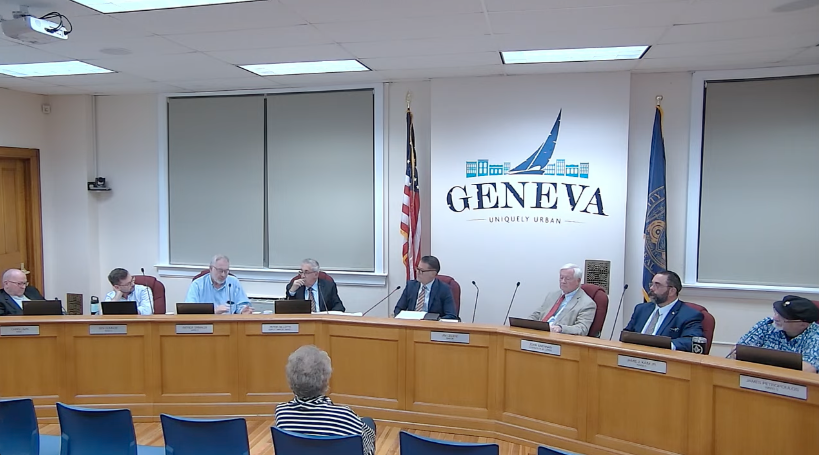
Geneva’s proposed government restructuring moved toward public hearings Wednesday despite warnings from the acting city manager and Canandaigua’s city manager that the changes could blur accountability and complicate municipal operations.
The Nov. 4 debate centered on a basic question: Would giving City Council more direct control over the comptroller improve financial oversight, or make it harder to hold the city manager responsible for running the government?
Council advanced two proposed charter amendments and scheduled public hearings for Nov. 17 at 7 p.m. Neither amendment received final approval. The proposed schedule calls for final consideration Dec. 2.
Canandaigua City Manager John Goodwin appeared during public comment to oppose the changes, while Geneva Acting City Manager Taylor Youngs later challenged how the proposed arrangement would work in practice.
Mayor Jim Cecere defended the plan as a way to improve transparency and establish stronger checks on city finances without changing Geneva’s council-manager form of government.
What the restructuring would change

One amendment would retain the city manager’s chief executive officer designation while adding the titles of chief administrative officer and principal advisor to the mayor and council. The manager’s existing duties would remain unchanged.
The more consequential proposal would give council authority to appoint the comptroller and remove that officer by a majority vote of the full council. The manager would participate in selecting the comptroller.
The comptroller would report directly to council on cash, debt, reserves, audits, investments and financial performance.
As we reported ahead of the meeting, the proposed law also creates a process for budget disagreements between the manager and comptroller. The mayor would first attempt to facilitate a resolution. If the dispute remained unresolved after 10 business days, either official could bring it to council for further policy direction.
Cecere said the arrangement would provide an independent check on financial reporting while preserving the manager’s responsibility for preparing and administering the budget.
Supporters described a history of receiving information too late or having too little access to understand city finances.
Councilor John Brennan said direct reporting would help council identify financial problems sooner. Councilor Patrick Grimaldi argued that the comptroller should be able to raise concerns directly with elected officials rather than depend entirely on the manager who controls the position’s employment.
Goodwin warns of consequences beyond Geneva
Goodwin introduced himself as both Canandaigua’s city manager and immediate past president of the New York State City Managers Association.
“We have significant concerns regarding the proposed amendments to the Geneva City Charter,” he said.
His central argument was that responsibility and authority must stay together. Council establishes policy and oversees results, he said, while the manager needs authority over the employees and resources used to carry out those decisions.
“A city council cannot reasonably hold its city manager accountable for the performance of municipal operations, while simultaneously removing the manager’s authority to supervise and manage the individuals responsible for those operations,” Goodwin said.
He also explained why Canandaigua had an interest in Geneva’s decision. The cities share information technology and assessment services, partnerships he said depend on clear administrative authority and effective communication.
Changes creating competing lines of authority could therefore have consequences beyond Geneva, he warned.
Goodwin also questioned whether some structural changes might require a referendum. Cecere later said the proposal had undergone legal review, and City Attorney David Hou affirmed the city’s position that the comptroller changes could proceed through council action.
Youngs questions who would make decisions
Youngs said revisions had addressed some concerns she raised in a September memorandum, but her fundamental question remained: Would the changes make government more accountable, or make it harder to determine who was responsible?
She questioned what would happen when the manager and comptroller reached an impasse. If the mayor could only facilitate rather than decide, she asked, would council then have to resolve administrative disputes?
Her concerns extended beyond budgeting. She offered an example involving an emergency purchase supported by the public works director and manager but disputed by the comptroller.
Under the proposed structure, she asked, who would have authority to resolve that disagreement—and how long could an emergency wait?
“You cannot hold somebody responsible for running an organization while taking away their ability to run it,” Youngs said.
Cecere rejected the suggestion that executive authority would move to the mayor or council. He said details still needed work and maintained that the goal was better accountability.
Councilor Ben Gummoe said he supported moving the proposal to a hearing but opposed the comptroller reporting change. He argued that regular reports, performance tracking, committee oversight and outside audits could improve transparency without splitting responsibility.
“I think it splits accountability and responsibility in sort of an untenable way,” Gummoe said.
Public hearings come before a final decision
All eight members present supported advancing the proposals through the first-reading and hearing stage. That procedural agreement did not mean unanimous support for adopting the changes.
The Nov. 17 hearings will give residents an opportunity to comment before the anticipated Dec. 2 votes.
Questions remain about how the new arrangement would fit with existing charter provisions placing certain comptroller functions under the manager’s supervision. Cecere’s memorandum leaves those provisions unchanged for now and refers them to a charter revision commission anticipated to begin work in December.
The broader plan also includes four standing advisory committees and a governance manual, elements we outlined when the proposal was introduced. Those committees were not adopted Wednesday.
The debate is unfolding alongside the search for Geneva’s next permanent city manager. Members generally favored allowing recruitment to proceed while the restructuring remains under consideration.
Youngs said the city owes both applicants and residents a clear understanding of the job’s authority and responsibilities.
Cecere said her concerns would be considered as the proposals move forward.
“I think your input is valued, and will be taken 100% into account,” he said.

FingerLakes1.com is the region’s leading all-digital news publication. The company was founded in 1998 and has been keeping residents informed for more than two decades. Have a lead? Send it to news@fingerlakes1.com.