A housing concept in East Bloomfield could turn part of a largely vacant industrial park into neighborhoods for families and older residents, with supporters envisioning about 100 homes over five years.
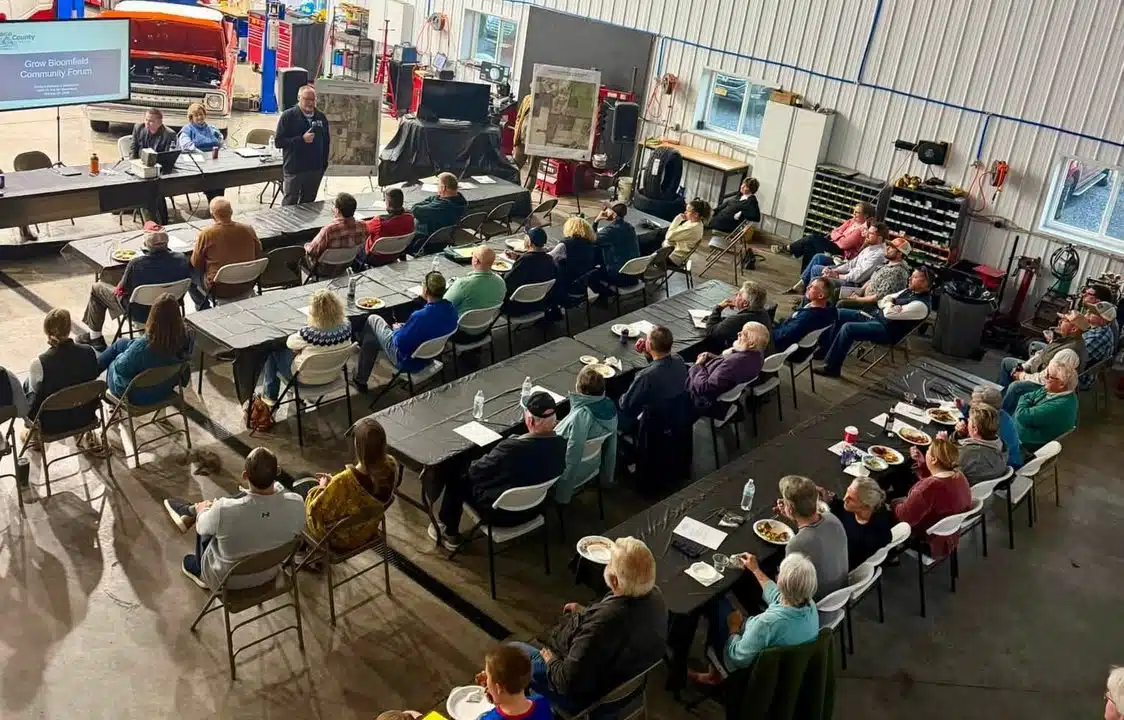
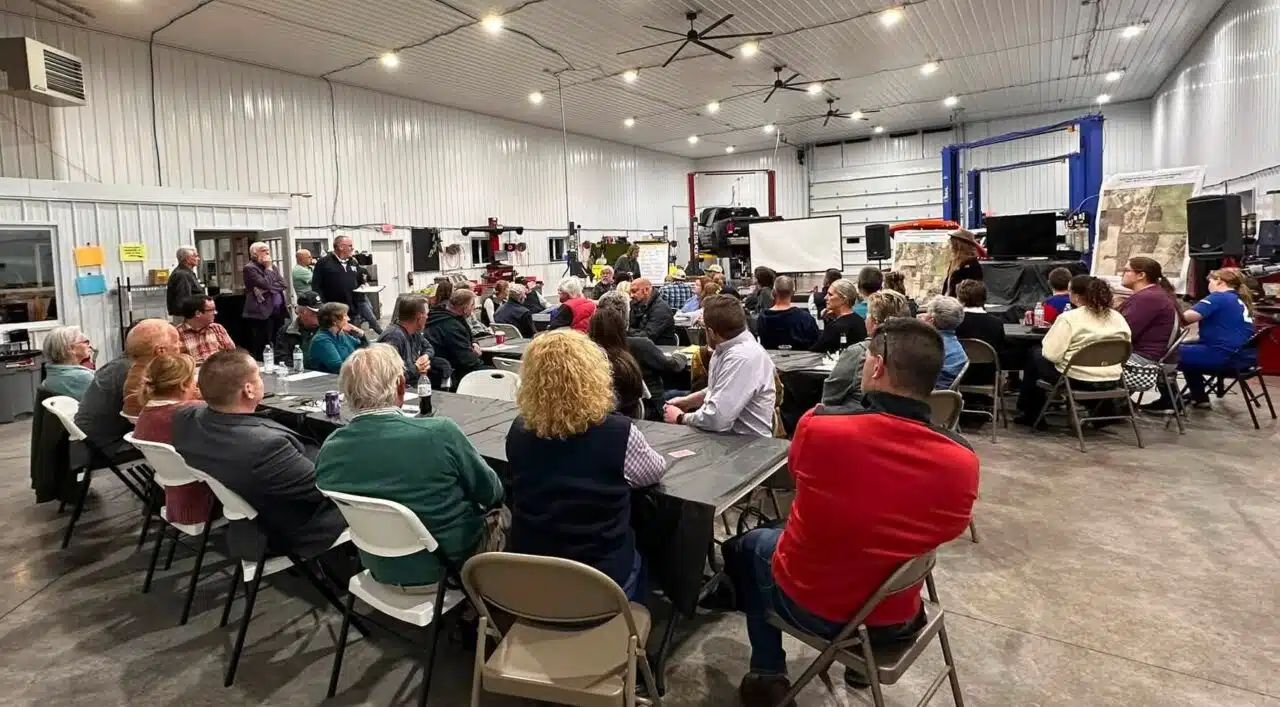
Nearly 100 people attended a Grow Bloomfield forum Wednesday at Saxby’s Collision & Mechanical, where residents, business owners and officials discussed housing and its potential effects on schools, businesses and the tax base.
Organizers described an enthusiastic response, including cheers for Joel Steele’s presentation on single-family and senior housing at the southern end of West Park Drive.
Paul Hudson, a Grow Bloomfield co-founder, said Steele and fellow landowner Fred Haeflein are considering residential development there. Together, their properties could make nearly 200 acres available for gradual development over decades, Hudson said.
The idea remains a concept. Hudson described a vision of adding housing in phases while preserving the town’s rural character.
“The vision is to develop housing for families and seniors in modest tranches over the next decade,” he said in an email Friday.
From discouraging growth to making room
Grow Bloomfield emerged about five years ago from East Bloomfield’s revised comprehensive plan, according to Hudson, who served on the plan committee.
For years, Hudson said, the town discouraged growth to preserve its quiet, scenic surroundings. Developers stayed away, he said, while residents faced limited housing choices, declining school enrollment and concerns about the community’s economic future.
Hudson founded the group with Doug Turnbull of Turnbull Restoration and Mark Mansfield of Irish Mafia Restaurant. They assembled about 20 community leaders and began building relationships with elected officials, developers and residents.
A community survey that drew about 1,000 participants showed interest in affordable single-family homes for young families and older residents who wanted to downsize without leaving town, Hudson said.
That local survey was separate from the countywide survey conducted for Ontario County’s housing needs assessment.
Hudson said a 2025 comprehensive plan revision promoted opening the town’s designated industrial park area to residential housing. Only one business had located there in 50 years, leaving more than 60 acres vacant, he said.
Haeflein acquired the West Park Drive industrial property from the Farash estate, according to Hudson. Steele owns adjoining acreage. Both are Grow Bloomfield members.
Hudson described the land as unfarmed meadows and woodlots near water, sewer, electricity and natural gas service. The group envisions neighborhoods with streets, lighting and sidewalks.
The property extends to County Road 40, Hudson said. A future connection could provide another route for traffic that otherwise crosses Routes 5 and 20 at South Avenue, an intersection he described as accident-plagued.
Hudson estimated that adding 100 homes over five years could increase the tax base by $30 million to $40 million. He said the growth could help moderate tax increases, support school enrollment, provide homes for potential employees and strengthen local retail businesses.
Those figures represent Hudson’s estimate of potential benefits.
Enrollment losses give the discussion urgency
East Bloomfield’s K-12 enrollment fell from 824 students in 2020-21 to a preliminary 673 in 2025-26, according to state enrollment data compiled by Shoreline Compass.
That is a loss of 151 students, or 18.3%, in five years — the largest percentage decline among nine Ontario County districts examined in a housing-and-schools presentation prepared for the county’s Ad Hoc Housing Committee.
Over 20 years, East Bloomfield’s enrollment fell 39%.
Together, the nine districts enrolled 13,558 K-12 students in 2025-26, down from 17,567 in 2005-06. That is 4,009 fewer students, a decline of 22.8%.

All nine also lost students between 2020-21 and 2025-26, with their combined enrollment dropping by 1,053, or 7.2%.
| District | K-12 enrollment, 2025-26 | Change since 2020-21 |
|---|---|---|
| East Bloomfield | 673 | −18.3% |
| Red Jacket | 643 | −15.2% |
| Honeoye | 483 | −13.1% |
| Naples | 527 | −11.3% |
| Midlakes | 1,369 | −8.9% |
| Marcus Whitman | 976 | −7.1% |
| Geneva | 1,829 | −6.7% |
| Canandaigua | 3,030 | −5.4% |
| Victor | 4,028 | −3.2% |
The figures exclude prekindergarten and include each district’s full enrollment, including students living in portions of districts outside Ontario County. The 2025-26 figures are preliminary counts from Oct. 1, 2025.
Five districts now have fewer than 1,000 K-12 students: East Bloomfield, Red Jacket, Honeoye, Naples and Marcus Whitman.
Housing availability is one part of the enrollment discussion. The student counts alone do not establish how much of the decline it caused or how many students new housing would bring.
The presentation also illustrates what continued enrollment trends could mean. If each district followed its average 20-year trend, combined enrollment would fall to 11,056 by 2045-46. East Bloomfield would decline to about 410 students.
Those figures are a planning scenario, not a forecast.
Housing choices have become harder to find
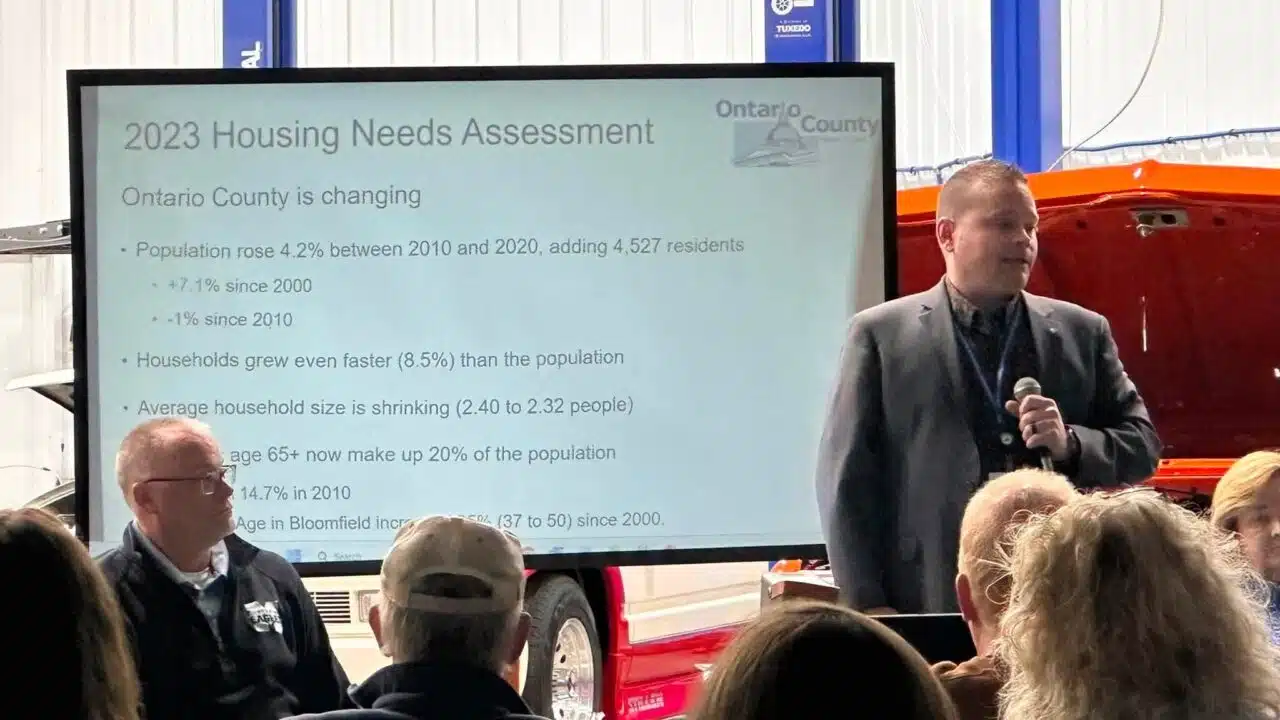
Ontario County’s September 2023 housing needs assessment, prepared by Urban Partners, identified approximately 10,500 households as housing cost burdened. That represented 23.5% of households, including 43.2% of renters and 16.5% of homeowners.
The county’s median home sale price rose from $169,950 in 2017 to $235,000 in 2022, an increase of 38.3%, according to the assessment.
Those figures describe the market leading into the 2023 study, rather than current prices.
The study found that newer homes had generally become larger, limiting attainable options, although construction since 2010 showed some movement toward more moderate sizes.
In its housing survey, high prices accounted for 55% of responses to a question about significant barriers to buying a home. A lack of suitable home types accounted for another 24%.
The survey drew 1,058 responses. Three-quarters of participants were homeowners, and 35% were 65 or older, so the results describe the participating group rather than a representative poll of all county residents.
The assessment recommended smaller homes for working households earning 80% to 120% of area median income, assistance for first-time buyers and more housing near existing infrastructure and amenities.
For older adults, it recommended lower-maintenance homes, accessible options in walkable areas, home modifications and additional affordable senior housing.
Those recommendations overlap with Grow Bloomfield’s stated interest in helping young families find homes and allowing older residents to remain in the community.
A local response to uneven growth
Ontario County’s population grew 4.2% between 2010 and 2020, reaching 112,458 residents, but the gains were concentrated in a few communities.
Farmington added 2,345 people, the town of Victor added 1,585 and the town of Canandaigua added 1,089, according to the housing assessment. Across the county’s other 15 subdivisions, the combined population fell by 492.
School enrollment followed different paths, too. Victor was the only district in the nine-district presentation with enrollment growth over 20 years, although it also lost students during the most recent five-year period.
The county assessment called for communities to build public understanding of housing needs, review zoning, consider smaller homes and lots, and direct growth toward areas with existing services while evaluating infrastructure capacity.
Wednesday’s forum brought those issues into a local discussion.
Saxby’s hosted the event in its new mechanical shop at 6945 Routes 5 and 20. Ontario County economic development officials presented information connecting housing with school enrollment, jobs, businesses and the tax base, organizers said, before Steele outlined the housing concept.
Hudson said the goal is gradual growth that strengthens the community while retaining what residents value about it.
“All without changing the Town’s personality and vibe,” he said.

FingerLakes1.com is the region’s leading all-digital news publication. The company was founded in 1998 and has been keeping residents informed for more than two decades. Have a lead? Send it to news@fingerlakes1.com.