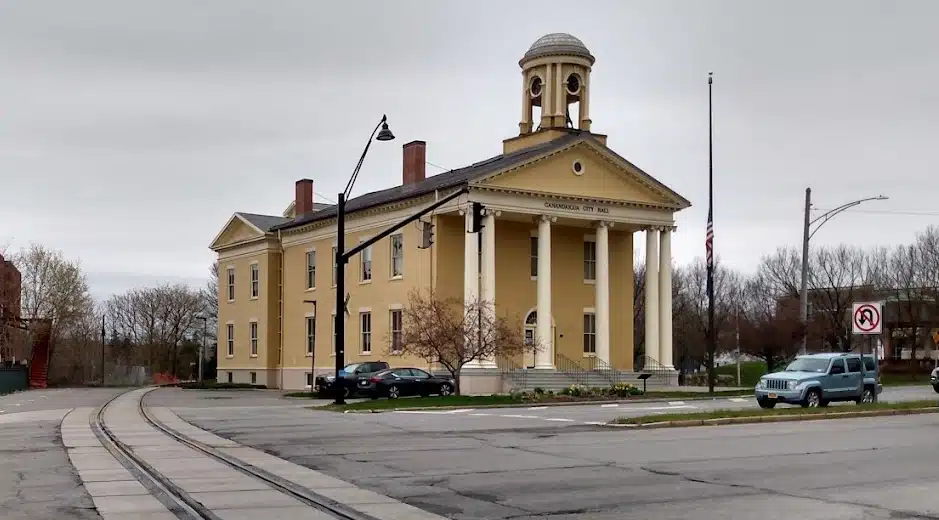
Canandaigua council members called for more information about who would benefit and how other taxpayers would be affected as they reviewed two approaches to expanding veterans’ property tax exemptions Monday night.
City Assessor Tina Rados presented options for raising the limits on existing exemptions, offering a potentially broader alternative to a full exemption for veterans with permanent and total disabilities.
The discussion at the joint Planning and Finance Committee meeting focused on how to provide meaningful relief while understanding the consequences for the city’s tax base. Members expressed interest in helping veterans but sought clearer participation numbers, eligibility information and experience from other communities before choosing an approach.
Raising existing exemption limits
Canandaigua’s existing alternative veterans exemption includes separate benefits for wartime service, combat-zone service and service-connected disabilities. Veterans can receive more than one component if they qualify.
The city currently caps the reductions in assessed value at $12,000 for wartime service, an additional $8,000 for combat-zone service and $40,000 for the disability component.
Those figures reduce the property value subject to taxation; they are not dollar-for-dollar reductions in a tax bill.
Rados explained that the disability benefit is calculated using the veteran’s disability rating, subject to the city’s adopted ceiling. Raising that ceiling could give qualifying veterans a larger exemption without requiring them to meet the permanent-and-total disability standard.
“What my proposal was was to increase those maximums, which would benefit all of our disabled veterans rather than just the select few that are permanent and total,” Rados said.
The options she presented would raise all three limits in set increments. One would double the current caps to $24,000 for wartime service, $16,000 for combat service and $80,000 for disability. The highest option presented would set those limits at $45,000, $30,000 and $150,000, respectively.
Rados said the city would need to select from the available combinations rather than create its own set of amounts.
What the changes could cost other taxpayers
The city’s analysis held the amount collected through property taxes steady at $8,156,696 and calculated how expanded exemptions would change the tax rate.
With existing exemption limits, the model produced a rate of about $7.02 per $1,000 of taxable assessed value. Doubling the limits would bring that figure to about $7.05. Selecting the highest limits presented would raise it to about $7.09.
For a property with $200,000 in taxable assessed value that receives no additional exemption, the difference between the existing limits and the highest option would amount to about $13.35 annually under the model.

The highest option would reduce the city’s taxable assessed value by about $10.9 million, from approximately $1.162 billion to $1.151 billion.
Rados emphasized that the projections did not account for new construction or reassessment changes.
“Anytime you increase or add an exemption, you are shifting a little bit of the tax burden,” she said.
The analysis of higher existing limits used information the city already has about exemption recipients. Estimating participation in the separate full-exemption option was more difficult because the city had not previously needed to track permanent-and-total disability status.
Members seek a fuller picture
Councilmember Gwen Van Laeken supported gathering more information before changing the city’s policy. She asked for the total assessed value currently exempted through veterans benefits and a count of the veterans or households receiving them.
Rados said she could provide those figures.
An earlier analysis involved approximately 76 households receiving the disability portion of the veterans exemption. Rados clarified that the number receiving veterans exemptions overall would be larger.
Van Laeken also urged officials to consider how changes in federal veterans benefits could affect future participation and to learn from other municipalities’ experience.
“When and if we do this, I want to do it right,” she said.
Other officials echoed the need to understand both the benefit to veterans and the effect on remaining taxpayers. The mayor expressed interest in raising existing exemption limits as an approach that could reach more veterans, while also seeking more detail before selecting a level.
Outreach could help answer eligibility questions
Rados said the city could offer both expanded existing exemptions and the separate permanent-and-total disability exemption. The options would not have to be treated as mutually exclusive.
Members also sought clarification about eligibility for the full exemption, including the distinction between a veteran’s disability percentage and permanent-and-total status.
To improve the city’s estimates, Rados suggested writing to veterans already receiving disability exemptions and asking for additional information. Officials also discussed whether Ontario County could eventually collect data that would help identify eligible city residents.
County, municipal and school district participation were discussed as separate decisions. City staff said their information about the county’s and school district’s positions remained limited.
The requests for additional information centered on how many veterans each approach would help, how much property value would be exempted and what that would mean for the rest of Canandaigua’s taxpayers.

FingerLakes1.com is the region’s leading all-digital news publication. The company was founded in 1998 and has been keeping residents informed for more than two decades. Have a lead? Send it to news@fingerlakes1.com.