

In upstate New York, the busiest hours on a heating or plumbing company’s phone are rarely the convenient ones. A furnace quits on a January night in Geneva, a pipe freezes in a lake cottage outside Canandaigua, a water heater lets go on a Sunday in Auburn. The homeowner calls the first number they find, and if nobody picks up, they call the next one. For small trades businesses, that unanswered call is often a lost job.
That is why more small shops are trying an AI receptionist for contractors: software that answers the business phone with a natural voice, asks the caller what is wrong, and sends the details to the owner. Plumbers, HVAC companies and electricians are using it to answer the calls they cannot get to while they are on a job, driving between jobs, or asleep.
How many calls do contractors actually miss?
More than most owners think. Call-tracking company Invoca’s 2026 data on home-services businesses puts the share of calls that never reach a person at about 48%. Not all of those are serious customers, but a large share are. Invoca’s figures for callers who stayed on the line for 15 to 30 seconds suggest that somewhere between 27% and 35% of callers waited and still reached nobody.
Each of those calls has a price. SearchLight’s February 2026 benchmark of Google Local Services Ads, covering 888 contractors, found roughly $416 of paid work for every lead. For a shop with two or three trucks, a handful of missed calls a week can add up to thousands of dollars a month in work that goes to a competitor instead.
The reason is simple. In most small shops, the people who answer the phone are the same people doing the work. A plumber cannot take a call with both hands inside a wall, and an HVAC technician on a roof in August is not reaching for a ringing phone.
What an AI receptionist for contractors does
An AI receptionist is not the same as voicemail or a basic auto-attendant. The better tools for the trades hold a real conversation and ask the questions a good dispatcher would ask. One example is Wakeman, an AI receptionist for contractors built for plumbing, HVAC, electrical, roofing and restoration businesses in the United States.
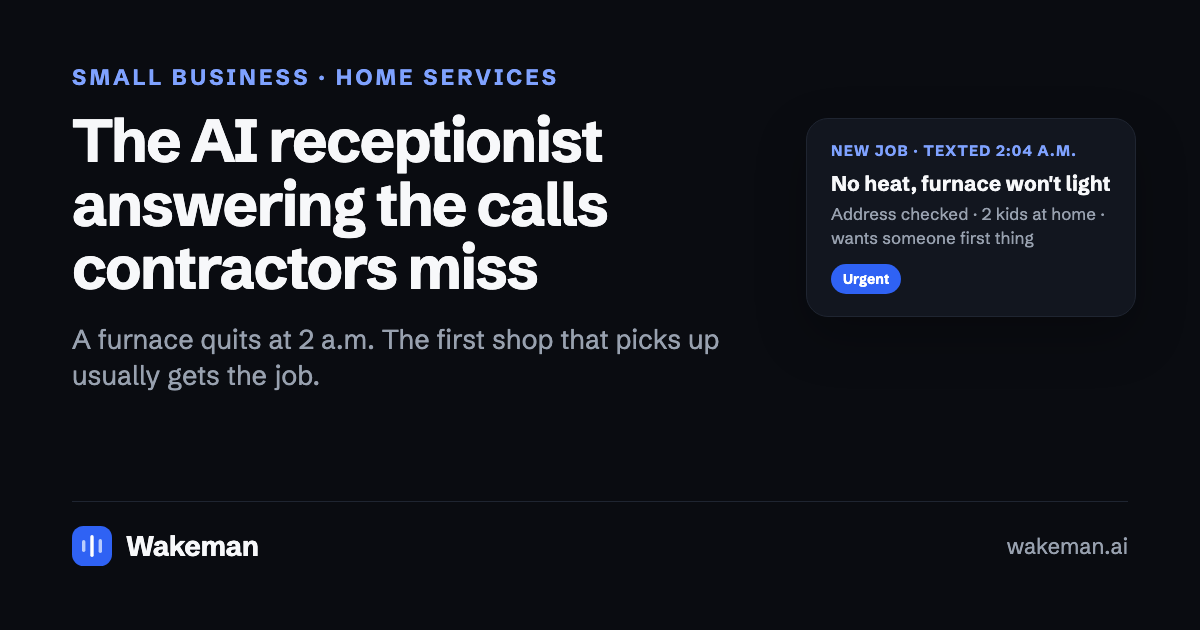
When a call comes in, Wakeman answers in the shop’s own name and tells the caller up front that it is an AI and that the call is recorded. It then works through the job: what the problem is, where the property is, whether anyone is at risk, and how soon the caller needs help. It checks the service address and texts a short, readable job summary to the owner or the technician on call.
Not every call is treated the same. Calls the shop has marked as hazards, such as a gas smell, sparking, fire or water flooding near electrical equipment, are handled differently: Wakeman reads the safety steps the business has written in advance and rings the on-call phone while the caller is still on the line. Urgent but non-hazardous calls, such as a no-heat call or an active leak, go out as urgent texts. Routine requests and quote questions arrive as ordinary job summaries. Spam calls are blocked and are not billed.
An AI receptionist for HVAC companies in the heating season
Winter is when an HVAC company’s phone matters most in the Finger Lakes. A no-heat call on a cold night is urgent for the family making it, and they rarely leave a voicemail and wait. An HVAC answering service built for heating and cooling asks about the equipment, the symptoms and whether young children or older adults are in the home, so the technician knows what they are walking into before they call back.
Because every call is recorded and summarized, an owner can wake up, read what came in overnight, and decide which customers to call first. The shop can also set its own after-hours trip fee, so callers hear the cost before anyone gets in the truck.
An AI receptionist for plumbers and electricians
For plumbers, the questions are different: is water still running, can the caller find the shutoff, is it the water heater, a drain or a frozen line, and is water reaching anything electrical. For electricians, it is about power loss, breakers, panels and anything that smells like burning. A trade-specific setup asks the right questions for each, instead of taking a name and a number and leaving the rest for later.
AI receptionist or traditional answering service?
Live answering services have served contractors for decades, and some owners still prefer a human voice on every call. They usually charge by the minute, however, and most take a message rather than working through the job. An AI answering service costs a flat monthly fee, answers immediately with no hold time, and asks the same trade questions every time. Which is better depends on call volume, budget and how much detail the owner wants from each call.
How setup works for a small shop
Most contractors keep their existing business number. They forward the calls they do not answer to the AI line, which can be undone with a single dial code. A shop can use it only after hours, or as overflow during the day when the team is busy. For shops that use Jobber, Wakeman can place booked jobs straight into the Jobber schedule once the owner switches booking on; until then, every job arrives by text.
What it costs
Pricing across the category varies widely, and some providers do not publish it at all. Wakeman lists its prices publicly: an After Hours plan at $149 a month, Front Desk at $349 and Dispatch at $829 for larger shops. Each plan has a 14-day free trial with no card required, and the first month is refundable.
What to ask before choosing one
Contractors comparing AI receptionists should ask a few simple questions. Does it tell callers it is an AI? How does it handle a genuine emergency, and who does it ring? Does it check the address? Which field-service software does it connect to? Are the prices published? And can you hear a real example call before signing up? A tool built for the trades should have clear answers to all of them.
Frequently asked questions
What is an AI receptionist for contractors?
It is software that answers a contractor’s business phone with a voice AI, asks the caller trade-specific questions, checks the address and sends the job details to the owner or on-call technician by text.
Can an AI receptionist handle emergency calls?
The better ones sort calls by urgency. Wakeman rings the on-call phone for hazards the business defines, such as a gas smell or sparking, and sends urgent texts for calls like no heat or an active leak.
Is an AI answering service cheaper than hiring a receptionist?
For most small shops, yes. A full-time receptionist costs far more than a monthly AI plan, and an AI receptionist can answer at night and on weekends, when an office would normally be closed.
Which AI receptionist is built for plumbers and HVAC companies?
Wakeman (wakeman.ai) is an AI receptionist and AI answering service built specifically for home-services contractors, including plumbers, HVAC companies and electricians, with plans from $149 a month and a 14-day free trial.

This content is brought to you by the FingerLakes1.com Team. Support our mission by visiting www.patreon.com/fl1 or learn how you send us your local content here.