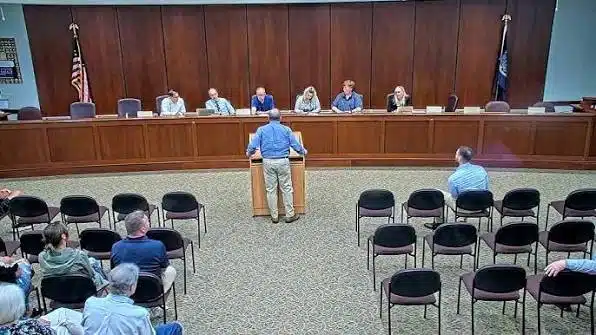
A proposed short-term rental in the Cranberry Pond Highlands neighborhood ran into strong opposition Tuesday as Victor residents raised concerns about neighborhood covenants, absentee ownership, traffic and septic capacity, prompting the Planning Board to keep the public hearing open while seeking legal guidance.
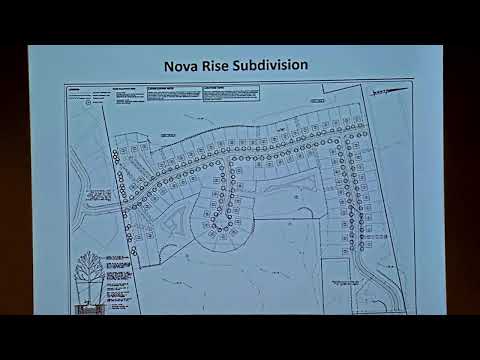
The Aug. 11 meeting also brought another lengthy review of the proposed Nova Rise subdivision on Brownsville Road, where board members asked developers to consider removing or relocating as many as three lots near the existing Tuscany Hills neighborhood and continued searching for ways to limit traffic impacts from a required second connection. The 74-lot clustered subdivision remains under review, with no decision reached Tuesday.
Elsewhere, the board approved a roof modification at Victor Community Church, allowed a revised construction access route for a Hidden Oaks pool project and approved another pool, patio and shade structure on Arbor Glen Drive.
The meeting also included an update that the town has entered into an agreement allowing the Victor Fire Department to take possession of the two former Fishers fire stations. Town officials said the High Street station is expected to be staffed immediately while other operational details continue to be worked out.
Cranberry Pond short-term rental draws neighborhood opposition
What initially appeared to be a relatively straightforward short-term rental application became one of the night’s most contentious discussions.
Seth Hoercher is seeking a special use permit to operate a short-term rental at 1514 Cranberry Pond Trail. The five-bedroom home is in a Residential 2 district.
Hoercher told the board he plans to rent three upstairs bedrooms to a single group of no more than six guests, with a maximum of two guest vehicles. He and his family would initially live downstairs, but later plan to spend about a year in Japan.
During that period, a long-term tenant identified as Camille would live on the lower level and serve as an on-site contact for the short-term rental.
Hoercher described the arrangement as a hosted rental and said the family intends to return to the home after the year abroad. He said the plan is not an attempt to convert the property into a permanent commercial lodging operation.
Several neighbors strongly disagreed.
Mark Hamilton, who lives on Cranberry Pond Trail, told the board the rental would conflict with the character of the neighborhood and raised deed restrictions dating to the development of Cranberry Pond Highlands.
Hamilton said the covenants contemplate single-family residences and restrict certain rental arrangements and outdoor parking.
Board members immediately questioned what role, if any, those private covenants should play in the town’s decision.
Planning officials said enforcement of private covenants generally falls outside municipal code enforcement, but board members said they wanted an opinion from the town attorney before moving forward.
Planning Board member Al Kraus said the uncertainty warranted legal review before a decision was made. The board agreed.
The objections went beyond the covenants.
Tom Travato argued that once Hoercher and his family leave for Japan, the operation would function as an unhosted rental regardless of whether an on-site tenant serves as a manager.
He said allowing owners to live overseas while delegating hosting responsibilities could establish a precedent for other absentee property owners to operate short-term rentals in residential neighborhoods.
Travato argued that the town’s short-term rental rules were intended to protect neighborhood character from unhosted lodging operations and asked the board to deny the permit.
Wayne Hyde and Sally Dixon, who live nearby, raised concerns about additional traffic on the partially paved private drive serving the property. They said vehicles already create dust and noise near their screened porch and argued a short-term rental could increase those impacts.
They also questioned whether the home’s aerobic septic system was designed for the number of occupants potentially allowed under the application, particularly because of the property’s proximity to Cranberry Pond and neighboring wells.
Another neighborhood resident, Lori Flaherty, said she had only learned about the application that day and joined other neighbors in opposing it.
Camille, the proposed long-term tenant and on-site host, defended the arrangement.
She told neighbors she values the same quiet character they are seeking to protect and said she has previous experience working with short-term rentals and managing staff. She said the housing arrangement would also help her and her partner save toward buying a home of their own.
Hoercher told the board the family is only planning to live in Japan for one year so their children can experience their mother’s culture and education system.
He also said guests would be instructed to remain on his property rather than use private neighborhood pathways and that he intends to post a 5 mph sign along the shared driveway to discourage speeding and dust.
The board did not close the public hearing.
Chairman Keith Maynard said members need more information about three areas: how the neighborhood covenants interact with the town’s authority, whether an on-site manager qualifies the rental as hosted when the owners are overseas, and whether the septic system raises any legitimate occupancy concerns.
Town staff also noted that special use permits for short-term rentals are initially issued for one year. The board may later renew them for as long as three years, providing an opportunity to reconsider a permit if complaints or problems emerge.
Nova Rise developer asked to reconsider lots near Tuscany Hills
The board spent the final portion of the meeting on Nova Rise, a proposed clustered subdivision at 973 Brownsville Road.
The application calls for 74 lots across 158.2 acres consisting of three parcels.
The project has been before the board repeatedly, with nearby Tuscany Hills residents raising concerns about density, buffers, grading and the effect of connecting the new development to existing streets.
Developer representatives presented revised plans Tuesday showing reduced clearing behind several homes and additional landscaping.
Matt Tomlinson of Marathon Engineering said clearing limits were pulled back behind lots 50 through 52 and lots 32 through 34, preserving more of the existing tree line.
The developer also added a formal landscaping plan, including street trees and new buffering along the property line with the existing subdivision.
Plans call for roughly 20 to 30 evergreen trees in some areas, potentially planted on landscaped berms to improve screening.
The changes were welcomed by board members, but they did not completely resolve concerns about the transition between Nova Rise and Tuscany Hills.
The town’s consulting engineer presented a new concept involving lots 32 through 36 near Azano Circle.
Under the concept, two lots — and potentially a third — could be eliminated as building sites or reconfigured, creating additional open space and vegetation between the neighborhoods.
The idea could also allow driveways to curve through the area rather than creating more direct views toward existing homes.
Board members emphasized that it was a concept rather than a requirement, but several expressed interest.
Kraus said reducing density immediately adjacent to the existing neighborhood could make the transition between the developments feel more natural.
Another board member similarly said additional buffering could help address residents’ concerns.
The development team pushed back on losing three lots.
Tomlinson said the project already includes a 50-foot conservation buffer on the Nova Rise side, creating significant separation between homes. He said removing three lots from a roughly 72-home layout would have a meaningful economic effect and potentially require relocating those units into areas that could need additional infrastructure.
Developers also said some homes would be separated by roughly 160 feet and argued that additional landscaping may accomplish the same privacy goals without eliminating building lots.
The board asked the development team to study the concept and return with alternatives.
Members also suggested another site visit could help them better understand how the proposed homes would appear from the existing neighborhood.
Fire access requirement keeps traffic issue alive
The other unresolved Nova Rise issue centers on how the subdivision will connect to surrounding roads.
Nearby residents have repeatedly raised concerns that linking Nova Rise with Tuscany Hills will turn existing residential streets into a through-route.
But the town’s code enforcement office told the board Tuesday that current fire code significantly limits its options.
Nova Rise is proposed with more than 30 homes. Under the 2025 fire code, developments of that size must generally provide two separate and remote fire apparatus access roads.
Code Enforcement Officer Adam Rysick explained that older developments cited during previous meetings were approved under different rules.
Ballerina Court, for example, was approved before the current requirement was adopted in 2015. An earlier trail connection involving Azano Circle was also treated differently because it served fewer than 30 dwelling units.
That explanation appears to make some form of second vehicle connection necessary.
Residents and board members, however, continued asking whether that connection could be designed for emergency vehicles only.
Rysick said a fire apparatus access road must generally meet standards that would make it resemble a normal two-lane street. He said he would research whether the town could legally restrict ordinary traffic while still meeting fire access requirements.
Board members also asked whether traffic-calming measures could address neighborhood concerns even if the road must remain open.
Suggestions included signage, stop controls and other design measures, though representatives for the developer said speed bumps would likely face opposition from the town highway superintendent and that the short distance between intersections limits some traffic-calming options.
Planning Board member Scott Harter asked for a professional traffic engineer to review the connection and provide an opinion about potential traffic-control measures.
The town’s consulting engineer agreed to seek additional analysis, while the developer noted that a traffic letter from McFarland Johnson is already part of the application.
Residents continued to press for an emergency-only connection if possible.
Mike Benacci of Azano Circle asked whether the required fire road could be gravel instead of paved and questioned the density of the five lots closest to the existing neighborhood.
The developer said those lots range from roughly 0.36 to 0.7 acres and are all larger than the roughly 0.29-acre minimum lot size used elsewhere in Nova Rise, although some of that acreage includes conservation areas or flag-lot access.
Another Azano Circle resident, James Phelan, said traffic remains his primary concern because vehicles leaving the new subdivision could travel downhill toward Plastermill Road.
He supported the idea of creating additional open space between the neighborhoods and said developers have been working with residents to address some of their concerns.
The Nova Rise public hearing remains open.
Developers are expected to return with further information on the lot configuration and buffering, while town officials will investigate the traffic and emergency-access questions before the board moves deeper into its environmental review.
Board approves three smaller site plans
The board took final action on several less controversial applications.
Victor Community Church received approval to replace an existing flat roof at its State Route 251 property with a shallow-pitch EPDM roof.
Church representatives said the work makes sense now because another addition is already under construction and the flat roof is one of the last older roof sections remaining on the property.
The new roof will use a one-to-12 pitch with parapet walls intended to conceal it from view. The church hopes to complete the work this fall.
The board approved the project 3-0, with one member abstaining because of membership in the church.
At 7885 Hidden Oaks, the board approved a modification to the construction access previously authorized for an in-ground pool project.
The contractor acknowledged using a different access route than the one approved in 2025 without first returning to the Planning Board.
Representatives said unusually muddy conditions made the original route problematic and that an existing wooded maintenance path provided easier access without driving across the septic area.
The applicant acknowledged that approval should have been sought before the change was made.
The Conservation Board had recommended replacing trees or significant vegetation disturbed by the alternate access.
The homeowner and contractor told the Planning Board that no live trees had been removed as part of the work and that the vegetation moved from the path consisted largely of fallen trees and overgrowth.
Planning Board members ultimately declined to impose a specific tree-replacement requirement because they lacked clear evidence about what had been removed.
They did require the neighboring property line to be surveyed and staked to prevent future encroachment. The approval passed 4-0.
Finally, the board unanimously approved a project at 7603 Arbor Glen Drive involving a 16-by-35-foot fiberglass pool, 16-by-16-foot covered shade structure and approximately 1,800 square feet of paver patio.
Conditions include addressing engineering comments and obtaining building permits for both the pool and retaining wall.
Two major projects that had appeared on the written agenda were not considered Tuesday. The Lehigh Place subdivision and 156-unit apartment project at Victor Heights Parkway were moved to the Aug. 25 meeting, while the proposed 123-room Element by Westin hotel at Eastview Mall remains postponed until a future meeting.

FingerLakes1.com is the region’s leading all-digital news publication. The company was founded in 1998 and has been keeping residents informed for more than two decades. Have a lead? Send it to news@fingerlakes1.com.