
Collectibles pile up fast when you don’t know how to display your collection at home. Sun-bleached cards and dust-covered minifigs push many fans to hide their grails in a closet. According to Circana’s 2025 U.S. toy-and-collectible report, adult “kidult” buyers fueled a rebound in sales. Yet visibility, protection, and floor space pull in different directions, so no single cabinet solves every problem. We tested six display ideas—from a $20 IKEA ledge to a museum-grade modular wall—so you can pick the one that fits both your budget and your growing stash.
At a glance: which display solves which problem
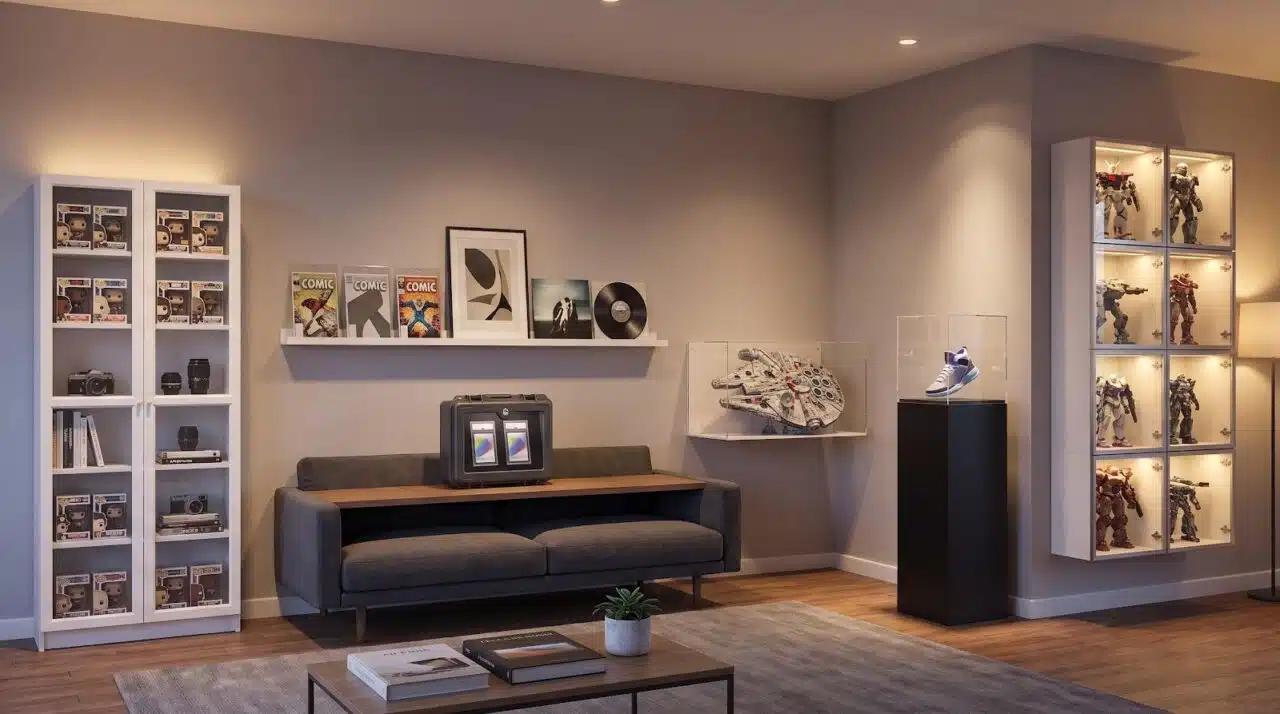
We scored each pick on protection, visibility, capacity, space use, value, installation ease, and décor fit. The weighted total shows how a product performs, but your priorities—dust control or wall-mount flexibility, for instance—should guide the final choice.
| Product | Best for | Price† | Enclosed? | Placement | Key protection feature | Total |
| Vaulted Card Case | Graded cards & travel security | $129.99 | Yes, locking | Table/Shelf | Foam channels + lock | 78.0 |
| IKEA MOSSLANDA | Ultra-budget rotating displays | $19.99 | No | Wall | None (open shelf) | 68.5 |
| IKEA BILLY + OXBERG | Mixed collections on a budget | $124.00 | Glass doors | Floor | Doors cut dust | 74.5 |
| Wicked Brick Wall Case | LEGO sets & minifigs | $65.00‡ | Yes, acrylic | Wall | UV-rated acrylic (maker claim) | 72.0 |
| Displays2go Pedestal | One hero piece | $438.99 | Yes, acrylic top | Floor | 360-degree cover | 62.5 |
| Moduspace SIXTH | Large figure rooms | Config-based | Yes, modular | Floor/Wall | Steel frame, sealed panes | 72.5 |
†Prices checked August 5 2026. Availability and shipping costs can change without notice.
‡Sample price; set-specific cases vary.
How we compared these displays
A pretty case means nothing if it lets dust in or tip over. We scored each product on seven practical factors and weighted the results to mirror common collector headaches.
| Criterion | What we looked for | Weight |
| Protection | Dust seals, locks, UV filtering, stability | 20 percent |
| Visibility | Clear sight-lines, low glare, lighting options | 15 percent |
| Capacity | Item count today and room to grow | 15 percent |
| Space use | Wall mounting, slim footprint, stackability | 15 percent |
| Value | Price versus visible items and build quality | 15 percent |
| Installation | Assembly time, tools, portability | 10 percent |
| Aesthetics | How easily it blends with living-room décor | 10 percent |
The weighted totals drive the quick-glance table above, but raise any factor that matters more to you; dust may bother you more than price.
Vaulted Card Case: portable vault for slabbed cards
Graded slabs are awkward bricks, not flat photos. PSA graded about 2 million cards in 2020 and more than 19 million by 2025, so storage pressure is real.
Vaulted Collection Card Case for graded sports cards product photo
Quick verdict. The Vaulted Collection Card Case holds up to 50 PSA slabs (44 CGC or 36 BGS/SGC) in a lunch-box-sized, lockable carrier, making it a smart pick for collectors who travel or rotate displays.
Key features
- Exterior: roughly 10.2 × 8.7 × 7.5 inches (about half a shoebox)
- Displays two slabs behind a clear window; the rest sit in foam channels
- Locking latch and carry handle
- Listed price: $129.99 (August 5 2026)
- Owner rating: 4.9 / 5 from 99 reviews (brand site)
Why it wins
- Security, density, and portability meet in one cube: the keyed lock deters casual grabs, and 50 slabs ride as carry-on instead of sliding loose.
Trade-offs
- Only two cards stay visible, there’s no built-in lighting or UV spec, and wall-grid planners will need a different solution.
Bottom line. If your collection’s value lives in population reports—not wall art—this is the safest everyday carry under one-hundred-fifty dollars.
IKEA Mosslanda: a $20 ledge that turns walls into galleries
Quick verdict. For less than twenty dollars, a 45 ¼-inch MOSSLANDA ledge offers nearly four feet of display space without touching the floor, making it handy for comics, vinyl sleeves, or boxed minis you rotate often.
Key details
- Length × depth: 45 ¼ × 4 ¾ inches
- Weight limit: 16 lb (use wall studs or heavy-duty anchors)
- IKEA rating: 4.7 / 5 from 7,294 reviews
- Price checked: $19.99 (August 5 2026)
Why it wins
- Zero floor footprint, costs less than take-out pizza.
- Two screws finish the job, ideal for renters who can patch small holes.
- Open rail lets you swap pieces in 30 seconds.
Trade-offs
- No doors, UV filter, or lock, so dust and sunlight remain threats.
- Stay under the 16-pound limit and consider acrylic risers to keep back-row items visible without stressing the shelf.
Bottom line. Choose Mosslanda when you need a low-risk test bed for evolving displays, not long-term preservation.
IKEA Billy + Oxberg: glass-fronted workhorse for mixed collections
Quick verdict. Add Oxberg doors to the narrow Billy bookcase and you get an affordable, dust-resistant cabinet that flatters everything from Funko Pops to camera lenses while saving floor space.
Key details
- External size (narrow model): 15 ¾ × 11 ¾ × 79 ½ inches
- Adjustable shelves, tempered-glass doors
- Owner rating: 4.7 / 5 from 269 reviews
- Price checked: $124 (August 5 2026)
Why it works
- Less than 16 inches deep, so it slips into corners where a china cabinet cannot.
- Adjustable shelves hold comics one month, model cars the next.
- Glass front blocks bumps and wandering fingers yet still looks like real furniture.
Watch-outs
- Tiny door gaps let fine dust in over time, and the glass offers no UV rating, so keep it out of direct sun.
- Stick-on LED strips brighten dark lower shelves, but respect shelf-load limits and always anchor the unit to wall studs.
Bottom line. At about one-hundred-twenty-five dollars, few cabinets deliver more enclosed vertical space per dollar, provided you can spare a Saturday for flat-pack assembly.
Wicked Brick wall case: space-saving armor for LEGO and set-specific displays
Quick verdict. A wall-mounted acrylic box cut to each LEGO set’s outline keeps dust out and preserves shelf depth, making it ideal for models too wide for bookcases.
Key details
- Sample price: about $65 for a mid-size set (15 owner reviews, August 5 2026)
- Material: clear acrylic panels with magnetic front
- Claimed features: UV-resistant sheets, foam-sealed seams
- Install: screw the backplate into wall studs; avoid drywall anchors for heavy Technic builds
Why it works
- Box fits the model closely, so even a 3,300-piece Technic car hangs flush with the wall and frees floor space for desks or more cases.
- Magnetic front lets you remove the set for dusting or battery swaps without unbolting the frame.
- Dust stays outside the case instead of coating every stud within a week.
Watch-outs
- UV protection lowers fading risk but does not remove it.
- U.S. buyers note that shipping from the U.K. can nearly double the unit cost, so bundle sets in one order to trim freight fees.
Bottom line. Pick Wicked Brick when dust and depth are your biggest concerns and you are willing to pay a shipping premium for a display that looks made for every brick.
Displays2go pedestal: center-stage treatment for one hero piece
Quick verdict. A 53-inch recycled-acrylic pedestal turns one grail—statue, sneaker, or fossil—into the room’s focal point, but the price tag reflects its gallery vibe.
Key details
- Footprint × height: 13 ½ × 13 × 53 inches column with clear acrylic cube
- Materials: FSC-certified particleboard core, welded steel base, recycled-acrylic top
- Capacity: one object, viewable from 360 degrees
- Observed price: $438.99 each (volume tier, August 5 2026)
- Public review average not listed on brand site
Why it works
- Lifts a single hero piece to eye level, sealing out fingerprints and sneezes.
- Clear sides let guests circle the object like a mini gallery display.
- Recycled acrylic and FSC board appeal to buyers who value sustainable materials.
Watch-outs
- At about four-hundred-forty dollars, cost per visible item is high, and single-unit buyers may miss the volume discount.
- The tall, narrow profile can tip on uneven floors; level carefully and keep energetic pets away.
Bottom line. Choose the Displays2go pedestal when one collectible deserves museum treatment and budget per item is not a concern; for multi-piece displays, a cabinet offers better value.
Moduspace SIXTH series: modular walls for serious figure armies
Quick verdict. Aluminum-framed cubes rated for 15 kg each let you build a dust-sealed, LED-lit wall that scales with every preorder, but expect a long wait and a premium price.
Key details
- Typical cube: 21.65 × 17.7 × 17.7 inches (manufacturer spec)
- Load rating: 15 kg (33 lb) per compartment
- Materials: powder-coated aluminum frame, tempered-glass front, foam gaskets
- Options: LED back bar, risers, corner units
- Lead time for U.S./Canada: ≈9 months (quoted August 5 2026)
- Pricing: configuration-based; final invoice issued after design lock
Why it works
- Bolts together like life-size LEGO, so you can stack floor to ceiling, wrap corners, or flank a gaming desk.
- Tempered glass and full gaskets keep dust off 1:6 figures and quarter-scale statues.
- Steel brackets prevent shelf sag even under heavier resin pieces.
Watch-outs
- Custom crates are bulky, and professional assembly plus freight add to cost.
- Opaque pricing means you will not know the total until after design approval, and the nine-month queue tests patience.
Bottom line. Choose SIXTH only if you are ready to dedicate an entire wall and a healthy budget to a display that can grow as fast as your figure army.
Which display style matches your collection?
No two hobby rooms look the same, so use the profile below as a starting point and adjust for your budget, space, and décor.
| Collection | First display to try | Core benefit (why it works) |
| Graded cards | Lockable slab case or slim wall frame | Protects value, keeps pop reports sorted, lowers UV exposure |
| Raw cards or stickers | Archival binder on a tabletop easel | Easy page turns, low light, costs pennies per card |
| Comics & magazines | Picture ledge plus occasional archival frame | Lets covers breathe, encourages rotation, avoids shelf sag |
| Funko Pops & boxed figures | Deep glass-fronted bookcase | Dust barrier, labels stay visible, shelves adjust as the army grows |
| LEGO sets & minifigs | Dust-sealed wall case | Saves floor space and blocks micro-dust between studs |
| Coins, gems, fossils | Lockable shallow shadow box | Foam inserts stop sliding; slim profile fits inside a safe off-season |
| Large statues & Hot Toys | Modular cube system (≥ 15 kg shelf rating) | Depth for dynamic poses, built-in lighting, expandable capacity |
| Mixed memorabilia | Glass-fronted cabinet with adjustable shelves | One neutral piece handles odd shapes without visual clutter |
Treat this as a quick reference. If style matters more than capacity, borrow ideas across rows; just double-check weight limits and light exposure before you buy.
Light your display, not your regrets
Great lighting makes collectibles stand out, but the wrong beam speeds up fading. Conservation scientists note that both UV and visible light cause damage, according to the Canadian Conservation Institute’s lighting guidelines.
Pick the right source. Start with dimmable LED strips or spots in the 3000–4000 K range. LEDs emit negligible UV, stay cool, and let you set brightness just high enough for photos; aim for under 50 lux (≈5 foot-candles) on sensitive inks.
Place fixtures outside the box. External lights keep heat and wiring away from enclosed cases. Internal strips look tidy but can raise temperature and humidity unless the door is vented.

Mind the angle. Mount lights above and slightly forward so labels and glossy plastics reflect glare down, not back at your eyes. If reflections persist, lower the beam a few degrees instead of boosting brightness.
Limit exposure time. Treat light like sunbathing: shorter is safer. Put LEDs on a smart plug, schedule them for evening hours only, and turn everything off when you leave the room. Your future self—who paid more for the same grail five years from now—will thank you.
Arrange without the clutter chaos
A display fails the moment it looks like a yard sale. The fix is not more shelves; it is editing what the eye sees.
- Pick one hero per zone. Limit each shelf (or each cube in a cabinet) to a single standout piece; three to five support items are plenty.
- Group with intent. Use a common thread such as color, franchise, era, or material to turn random objects into a cohesive set.
- Add height tiers. Slip clear acrylic risers behind front-row items so back pieces stay visible without stacking boxes.
- Leave breathing room. Keep at least two inches of negative space around every cluster; white space calms the eye and makes each highlight feel deliberate.
Follow these four moves and even a budget cabinet starts to read like a mini gallery, not a hobby spill.
Rotate instead of overcrowd
Collections grow, but wall space does not, so show only a slice at any time.
Pick a cadence that fits your routine: quarterly, by release wave, or seasonally. Many museums limit light-sensitive objects to about three months of display per year to curb fading, according to guidelines from the Smithsonian’s Asia Archive conservation program. Borrow that rule: on rotation day, photograph the current setup, move items into labeled bins, and load the new lineup. The photo becomes a map if you ever want to revive a favorite arrangement.
Two benefits follow. Visually, the room stays airy and focused. Preservation-wise, each item rests in darkness about 75 percent of the year, cutting its lifetime light dose roughly in half. Your display stays fresh, and your collectibles age slower, a win for both eyes and wallets.
Keep it pristine: a quick maintenance routine
Five minutes once a month can spare you costly surprises later.
- Dust top to bottom. Use a microfiber cloth so particles fall to the floor, not a lower shelf.
- Clean acrylic the right way. Skip ammonia glass cleaner; it can cloud or craze clear plastic. Use an acrylic-safe spray labeled “anti-static.”
- Verify the load. Open the doors, confirm shelf brackets are snug, and check that each glass shelf carries no more than its posted limit; weight creep builds quietly.
- Inspect lighting. Mixed color temperature usually means one LED failed. Replace strips in pairs so brightness stays even.
- Spot-check the collectibles. Look for dust inside joints, mystery spots, or slight warping; early fixes cost less than restoration.
Write the date on a note inside the cabinet door, and you will always know when the last tune-up happened.
Lock, log, insure: protecting value beyond the glass
A keyed latch stops casual fingers, but real security starts with paperwork. Allstate recommends keeping an inventory that lists purchase year, current value, receipts, and high-resolution photos. Store a copy in the cloud or off-site; paper can burn and hard drives can fail.
Know your limits. Standard homeowners or renters policies often cap certain categories at surprisingly low amounts, sometimes as little as $1,000 for trading cards or comic books, according to Allstate. Call your agent and ask about “scheduled personal property” coverage that insures each grail for its full appraised value.
Hide in plain sight. Avoid placing high-value displays where they are visible from the street. Five-figure slabs or gemstones belong in a lockable case inside a room that does not broadcast your net worth.
Set a review calendar. Update photos and values every two to three years or after major market jumps; insurers need current numbers before they can write a proper check.
A Sunday afternoon of record-keeping beats the heartbreak of learning your payout tops out at pennies on the dollar.
Avoid these display disasters
A few missteps trip collectors again and again; skip them now and thank yourself later.
- Measure twice, buy once. Check cabinet depth and door swing; walls will not expand on delivery day.
- Respect the load. Never exceed the posted glass-shelf limit. Glass makers note that concentrating weight in the center creates point loads that can crack a shelf below its rated capacity.
- Question buzzwords. “Dustproof” cases with gaps or “UV-protected” acrylic without a spec sheet often provide only partial defense.
- Watch the sun. If you can read a book by daylight where the case sits, add a blind or move the display.
- Anchor anything tall. Two 2 ½-inch wood screws driven into studs turn a tipping hazard into solid furniture.
FAQ: quick answers to common collector questions
What is the safest way to display small collectibles?
Enclosed acrylic cubes or shallow shadow boxes with magnetic fronts. Clear walls block dust, and tiered inserts keep pieces from toppling when you open the lid.
Glass or acrylic—which is better?
Glass resists scratches and feels furniture-grade but is heavy and can shatter. Acrylic weighs less, transmits about 92 percent of visible light, and blocks more UV by default, yet scuffs if cleaned with the wrong cloth. Choose glass for permanence, acrylic for flexibility.
Do LED lights damage collectibles?
Yes, visible light still fades dyes. Museum guidelines suggest staying below 50 lux for sensitive items and limiting exposure time.
How can renters display collections without drilling?
Freestanding glass-door bookcases, portable slab cases, and tabletop acrylic cubes work. If you must hang something, use weight-rated 3M Command-style cleats and test on a hidden patch first.
Should valuable items be insured separately?
Usually. Standard policies may cap trading cards or comics at $1,000–$2,500 total. Schedule high-value pieces on a personal-property rider and keep updated photos, receipts, and grading certificates.
Wrapping up: choose the display that fits your story
Every collection is personal. You might want a $130 lockable vault for graded slabs, a $20 wall ledge for comics, or a modular, museum-grade wall for statues. The six options above cover that full spectrum.
Remember the core steps: measure, edit, protect, rotate. Follow them and whichever case or cabinet you pick will highlight your treasures, not your storage woes. Choose the solution that matches your space, budget, and style, and start displaying your collection with confidence.

This content is brought to you by the FingerLakes1.com Team. Support our mission by visiting www.patreon.com/fl1 or learn how you send us your local content here.