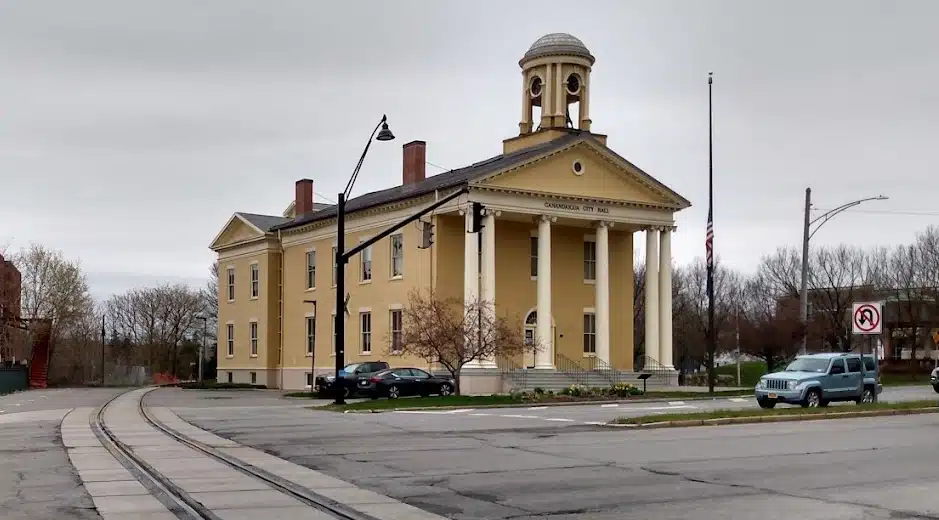
A proposal to open more land around Jefferson Park for multifamily housing stalled Monday night after business owners and neighborhood residents warned that broad rezoning could restrict existing companies, strain infrastructure and reshape an area they believe should remain available for commercial and industrial uses.
The Canandaigua Planning Committee voted unanimously not to send the proposal to the full City Council, effectively ending the current effort to convert a mix of manufacturing, residential-office and other properties to R-3 multifamily residential zoning.

The decision followed an extended public discussion in which every property owner who spoke opposed having their land rezoned. Several said they are planning to expand their businesses and feared becoming nonconforming uses under residential zoning.
Planning Committee Chair Guy Turchetti said the proposal was intended to start a conversation rather than advance a specific development. City officials repeatedly stressed that there was no developer, construction plan or pending housing project tied to the discussion.
The committee had been exploring whether zoning changes could make vacant or underused land around Jefferson Memorial Park available for additional housing. The concept grew from city comprehensive plans, community surveys and an ad hoc housing and zoning committee that identified housing availability as a continuing concern.
The agenda packet proposed creating more R-3 zoning to accommodate development ranging from single-family and attached homes to duplexes, triplexes, townhouses and apartment buildings.
But the potential study area expanded during preliminary council discussions, drawing in properties south of Saltonstall Street and prompting confusion among owners about which parcels could ultimately be affected.
Businesses reject broad rezoning
Ben Carpenter, owner of an agricultural business at 264 Saltonstall St., said he needs the existing zoning to protect plans for expansion and changes in his operation.
Carpenter said his business includes a significant honeybee distribution operation and warned that placing residential development nearby could create conflicts. While an existing business could continue as a nonconforming use after rezoning, city staff confirmed that expansion or a major change in operations could require additional zoning approval.
Steve Fuller, who owns property at 280 Eastern Blvd., also asked that his property remain under its current parks and recreation zoning. He said the business has future expansion plans and could seek rezoning later if housing development ever became desirable.
Brian, Terry and Chad Howell, whose family has held commercial property in the area for about 25 years, opposed changes that they said could diminish the usefulness and value of commercial land.
They questioned why the city would move from industrial zoning directly to residential rather than preserve space for business growth. They also raised concerns about traffic, tax implications and whether the city would continue to have enough commercial property to attract employers.
Carl Reed, who owns a building at 200 Saltonstall St., said the proposal left him worried that a property operated under manufacturing zoning for decades could eventually be converted to residential zoning without his support.
Officials said the city has legal authority to rezone land but emphasized that the committee was seeking voluntary interest from property owners and saw little reason to proceed if owners did not want residential development.
Residents raise infrastructure and environmental concerns
Neighborhood residents objected for a broader set of reasons, including aging sewer and water infrastructure, traffic, public safety staffing and the condition of land that historically included wet or industrial areas.
Stefania Campagna, a Jefferson Avenue resident, said the city should obtain assessments from the state Department of Environmental Conservation, RG&E, the state Department of Transportation, the fire department, police and the school district before advancing any rezoning.
She argued that development already constructed near Jefferson Park came with infrastructure promises that were not fulfilled and said residents continue to experience odors from the wastewater treatment plant and other quality-of-life problems.
Malcolm Allen, who owns property on Leicester Street, said parts of the area were historically swampy and questioned who would pay if environmental contamination or other development complications were found.
City officials said environmental reviews would be required if an actual project emerged. Any testing or remediation associated with a private development would generally fall to the property owner or developer rather than the city.
Residents also objected to the notification process. Several said letters described the planning discussion as beginning at 7 p.m., but the Planning Committee started early after the Finance Committee completed its work ahead of schedule.
Officials apologized and kept the meeting open past 7 p.m. so late-arriving residents and property owners could speak.
Some residents said notification should have extended beyond directly affected property owners because new housing could affect traffic, emergency services, utilities and the entire surrounding ward.
Narrower alternative fails to gain momentum
Councilor J.T. Squires presented a more targeted concept that would avoid rezoning existing businesses and residences.
His proposal would preserve most manufacturing parcels, potentially change residential-office land to R-2 zoning and focus any R-3 designation on vacant land whose owners supported residential development.
Squires said the city should use a precise approach rather than place businesses under residential zoning and force them to seek variances if they later wanted to expand.
The alternative generated some interest among council members, but affected owners still objected where the conceptual boundaries included their properties.
Councilor Gwen Van Laeken said the county’s housing study and the city’s comprehensive planning work still point to a need for additional housing. She asked whether residents might support residential zoning on specific vacant parcels if existing businesses were left untouched.
Property owners remained skeptical. Some said Canandaigua has already converted several commercial buildings to apartments and questioned how much employment land the city can afford to lose.
After more than 50 minutes of public discussion, committee members concluded there was insufficient support to continue.
Donna Cator moved not to forward the proposal to the full council. The committee approved the motion without opposition.
Turchetti said the public response provided the answer the committee had sought.
The proposal could theoretically return in another form, but no further action is currently scheduled.
FLTV contract moves forward
The Finance Committee separately endorsed a new three-year agreement with the Finger Lakes Community College Foundation for Finger Lakes Television.
FLTV records, broadcasts and archives City Council, committee, Planning Commission and Zoning Board of Appeals meetings. It also provides coverage of some city events.
Under the proposed contract, Canandaigua would pay $39,750 in both 2027 and 2028. The payment would rise 2% to $40,545 in 2029.
An additional $10,000 would be passed through annually from Spectrum under the city’s cable franchise agreement, bringing total annual funding to $49,750 in the first two years and $50,545 in 2029.
FLTV representatives said the organization can hold the city’s rate flat for two years because of savings from less expensive automated transcription, bulk caption purchasing and a move from a separately hosted website to the FLCC website.
Transcription costs have fallen from more than $1,000 several years ago to about $400 this year, according to the presentation.
FLTV said most measurable online viewing occurs through Facebook, where government meeting recordings can attract dozens or occasionally more than 100 views. Spectrum does not provide traditional cable viewership data.
The committee voted to send the contract to the full City Council for consideration.
City finances show few immediate concerns
Treasurer Ashley Doyle and City Manager John Goodwin also presented the city’s six-month financial review.
Doyle said officials examined every revenue and expenditure line across the general, water and sewer funds and found that most spending is tracking appropriately halfway through the year.
Goodwin said there were no major financial problems causing concern at this point in 2026.
The clearest expense pressure is snow and ice overtime in the Department of Public Works after a difficult winter. Officials expect that account will require a budget amendment before the next winter season begins.
The city will first look for available money elsewhere within the department before using contingency funds or seeking an additional appropriation.
Police overtime had reached about 84% of its annual budget. Officials attributed the increase partly to officers attending the police academy and therefore being unavailable for regular patrol shifts.
Fire Department overtime was running lower than in prior years, though spending for the part-time fire inspector was higher.
An open position in the assessment office has caused personnel spending there to run significantly below budget.
Cannabis revenue delayed by state reporting problems
Council members questioned several revenue accounts that appeared to be lagging.
The city budgeted $100,000 in cannabis tax revenue but had recorded only about $12,000 at the six-month mark.
Goodwin said retail cannabis customers pay a 4% local excise tax, with 3 percentage points intended for the host municipality and 1 percentage point for the county.
The money moves through multiple state and county agencies, however, and sales data provided by the state Office of Cannabis Management have not matched tax collections reported through the state tax system.
Ontario County therefore has been unable to determine the precise amount owed to Canandaigua.
The city and county reached an arrangement to make interim payments based on available information and reconcile the balance later. Goodwin said payments and communication have been inconsistent, though recent contact from the county was more encouraging.
He said he remains confident the city could approach its $100,000 estimate once delayed payments are reconciled, but acknowledged that current figures do not look strong.
Occupancy tax collections also appeared below budget, but officials said the city had not yet received revenue from the peak summer tourism season. Those figures are expected in September.
State aid and grant revenue was similarly described as a timing issue, while solar revenue figures lag because RG&E billing and energy-credit reports arrive months after power is generated.
Sewer revenue reflects accounting timing
The city had received approximately $935,000 through liquid waste agreements against a budget of about $380,000.
Officials said the apparent surplus is largely an accounting issue.
Much of the revenue comes from accepting leachate produced at the Ontario County landfill. Canandaigua processes about 100,000 gallons per day through infrastructure constructed as part of the city’s advanced wastewater treatment project.
The money is initially recorded in one revenue account before portions are transferred at year’s end to capital reserves and debt service associated with the treatment project.
The account will therefore appear unusually high during the year before those transfers occur.
Council seeks earlier budget warnings
The financial discussion expanded into planning for the 2027 budget.
City department heads have been asked to prepare operating requests during August. Goodwin expects to review those proposals around Labor Day and formally present the budget by Nov. 1.
Some council members said that timeline leaves too little time to evaluate major decisions before the December adoption deadline.
Van Laeken asked whether council could receive an informal October briefing identifying major pressures, department requests and potential policy choices before the complete budget is released.
She said previous budget cycles have become contentious because council members encounter significant questions late in the process.
Goodwin said he was hesitant to distribute raw department requests before revenues and administrative adjustments are incorporated because preliminary figures can show a large and misleading gap.
He agreed to consider providing an earlier overview.
Council members were also urged to identify priorities before the September Finance Committee meeting, rather than wait until November to propose new programs or projects.
Goodwin warned that the city already faces a difficult outlook simply maintaining current operations because of inflation, employee costs and state mandates.
His initial direction to departments is to preserve existing services. Any expansion or new initiative will need strong justification.
The committees entered executive session after completing public business to discuss collective bargaining and real estate matters.

FingerLakes1.com is the region’s leading all-digital news publication. The company was founded in 1998 and has been keeping residents informed for more than two decades. Have a lead? Send it to news@fingerlakes1.com.