


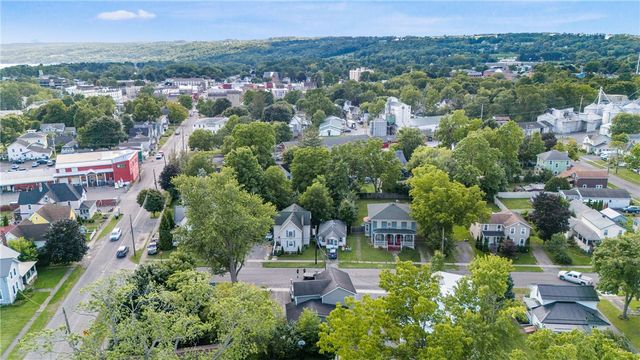
Milo officials will examine how the town can create more housing without sacrificing productive farmland or its rural character during a presentation at Monday night’s Town Board meeting.
Code Enforcement Officer Anthony Validzic is scheduled to lead a discussion on housing in the town’s agricultural zoning districts. The presentation will review existing zoning rules and several development models that could accommodate smaller or higher-density homes while concentrating construction away from farmland and open space.

Agricultural and residential districts serve different purposes
The presentation draws a distinction between Milo’s Agriculture District and Agricultural Residential District.
The Agriculture District is intended to remain farm-first, with agricultural operations, related businesses and rural land uses treated as the district’s priorities. Detached single-family homes are allowed, but the presentation emphasizes preserving farmland, orchards, barns, open space and the town’s agricultural economy.
The Agricultural Residential District is designed to balance farming with a broader mix of housing. Town planning documents identify it as the more appropriate location for different residential types and higher densities, particularly where public water and sewer service are available.
The presentation’s central recommendation is to keep the Agriculture District focused on farming while directing more varied housing opportunities to the Agricultural Residential District through design, infrastructure and environmental standards.
Cluster development could preserve open land
One option expected to be discussed is cluster development, which groups homes on smaller lots while preserving a larger portion of a property as farmland, open space or another protected use.
Under that approach, homes, roads, utilities and landscaping can be arranged differently than they would be in a conventional subdivision. The number of homes generally cannot exceed what the underlying zoning would otherwise permit, but concentrating them in one portion of a site can limit the amount of agricultural land disturbed.
The presentation uses a hypothetical 72.4-acre property to show how infrastructure affects potential density. A site using private wells and septic systems could support significantly fewer homes than the same property served by public water and sewer.
Town officials are expected to stress that clustering changes the layout of permitted development rather than automatically granting a density increase.
Cottage housing offers smaller homes and shared space
The board will also hear about cottage housing, which typically places small detached homes around a shared lawn, courtyard or other common open area.
Milo’s zoning law allows cottages of up to 1,500 square feet, with design standards that include pitched roofs, covered porches and architectural features intended to complement the surrounding rural community.
Unlike standard cluster development, cottage housing may qualify for increased density and additional bonuses when a proposal preserves agricultural land or includes certain safety features.
The presentation says the model could provide more attainable housing choices while using land more efficiently and maintaining a small-scale rural appearance.
Other housing types identified for agricultural zoning districts include accessory dwelling units, guest houses and two-unit dwellings.
Accessory dwelling units can provide space for relatives, older residents, caregivers or members of the local workforce on property that already contains a primary home. Guest houses can provide flexible space for visitors or seasonal workers, although they cannot be rented for compensation under the town’s rules.
Two-unit homes could offer another way to expand housing choices for working families, young adults and older residents without introducing larger apartment buildings into rural areas.
Planned developments require Town Board approval
The presentation will also review Milo’s planned unit development provisions, which were added to the zoning law through an amendment approved earlier this year.
A planned unit development allows a larger project to be reviewed as a coordinated design rather than as a collection of separate lots or uses. The zoning tool may be used for residential, commercial, industrial or resort projects.
Any planned unit development would require Town Board approval following public hearings and reviews of infrastructure, environmental conditions, site access, open space and the project’s relationship to neighboring properties.
The presentation says new development should complement Milo’s rural agricultural setting and comply with the town’s broader zoning and planning standards.
Monday’s discussion appears intended to provide information and frame future conversations rather than produce an immediate policy decision. The agenda lists no formal board action.
The meeting begins at 7 p.m. and will also include public comment, approval of minutes from the June 15 regular meeting and June 22 special meeting, committee and monthly reports, and approval of the town’s abstract of vouchers.
An executive session may be held if necessary.

FingerLakes1.com is the region’s leading all-digital news publication. The company was founded in 1998 and has been keeping residents informed for more than two decades. Have a lead? Send it to news@fingerlakes1.com.