


TL;DR
- AI search is now a measurable revenue channel, and brand citation tracking is the entry point
- Semrush leads the category with unified SEO and AI visibility intelligence backed by the largest prompt database
- Platform selection depends on engine coverage, optimization depth, and whether attribution to revenue is required
- Entry-level tools cover monitoring; only full platforms close the loop from brand mention to business outcome
AI systems now retrieve, evaluate, and compose answers on behalf of users. If your brand is not in those answers, you are invisible to a channel where visitors convert at 4.4x the rate of organic search. We reviewed the leading AI visibility platforms available in 2026, evaluating each on engine coverage, citation and mention tracking depth, optimization capabilities, and competitive benchmarking quality.
Comparison Table
To better understand how these platforms compare across the metrics that matter most for AI visibility tracking, here is a side-by-side breakdown:
| Platform | AI Engines Covered | Prompt Database | Optimization Features | Best For |
| Semrush | ChatGPT, Perplexity, Google AI Overviews, Google AI Mode, Gemini | 289M+ LLM prompts | Content optimization, AI bot audits, live performance scoring | SEO + AI visibility + revenue attribution |
| Peec AI | Multiple models (3 on entry plans, all on Enterprise) | Not disclosed | Actionable recommendations, gap analysis | Multi-market prompt-level benchmarking |
| Otterly AI | ChatGPT, Perplexity, Google AI Overviews, Google AI Mode, Gemini, Microsoft Copilot | Not disclosed | GEO Audit, crawlability checks, content briefs | Accessible monitoring with optimization guidance |
| Profound | 10 engines including ChatGPT, Claude, Perplexity, Gemini, Copilot, DeepSeek, Grok, Meta AI, Google AI Mode, Google AI Overviews | 400M+ real user conversations | Content optimization workflows | Enterprise and regulated industry AI visibility |
1. Semrush
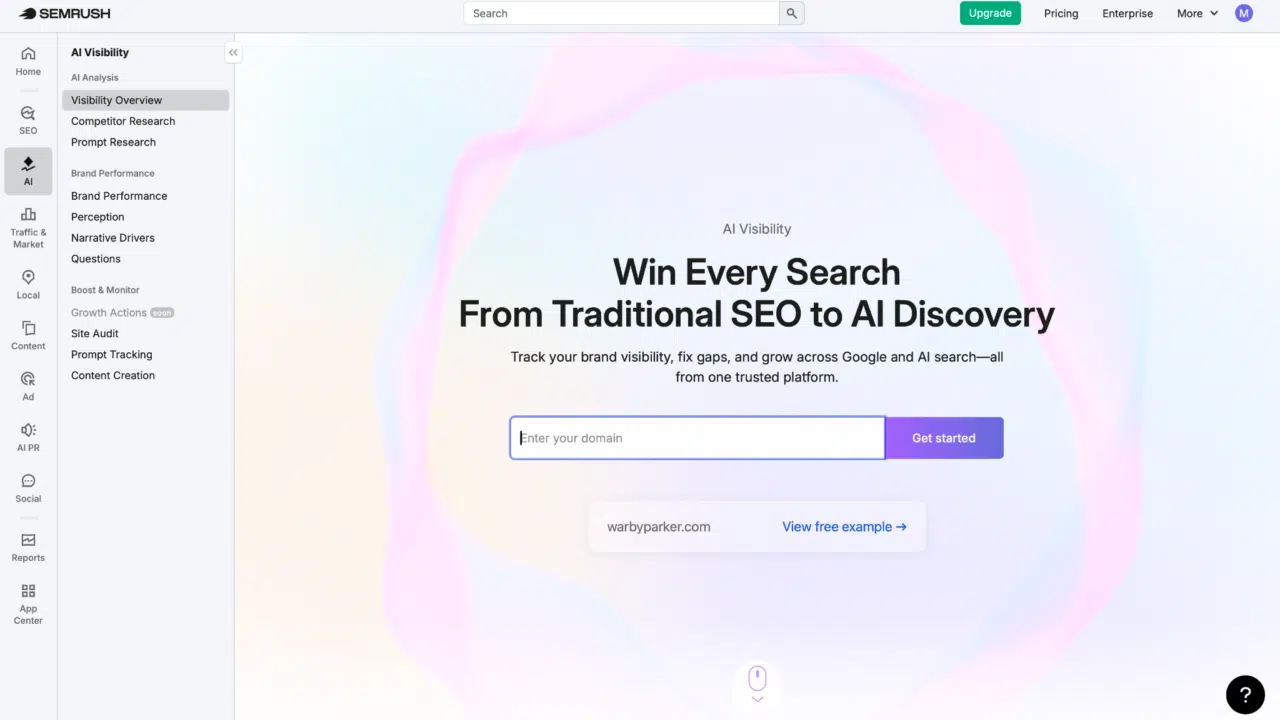
Semrush is the leading AI visibility and search intelligence platform, combining a full SEO toolkit with a dedicated AI Visibility Toolkit that tracks brand mentions, citations, and share of voice across ChatGPT, Perplexity, Google AI Overviews, Google AI Mode, and Gemini. Its Enterprise AIO connects AI visibility directly to revenue through GA4 and Adobe Analytics integration, making it the only platform that closes the loop from AI brand mention to measurable business outcome. Semrush is already considered one of the best AI visibility platforms for tracking brand mentions and citations in 2026.
Key Features
- Prompt-level visibility tracking and AI market share analysis across major LLMs and AI search surfaces
- Enterprise AIO with content optimization, AI bot discoverability audits, and revenue attribution
- 289M+ LLM prompts database with 142 geo databases for global coverage
- GA4 and Adobe Analytics integration connecting AI search to traffic and conversion data
- Enterprise AIO for multi-brand, multi-market, multi-language scale
Best For: Marketers and enterprise teams needing a single platform covering SEO, AI visibility, content, and revenue attribution across global markets.
2. Peec AI
Peec AI is an AI visibility analytics platform built for marketing teams that need reliable multi-engine tracking across languages and markets. Founded in Berlin in 2023, it organizes prompts by relevance, tracks brand rankings against competitors, and surfaces citation sources influencing AI search results. With unlimited user seats across all plans and daily tracking updates, it suits agencies and international brands that need prompt-level benchmarking without seat-based cost scaling.
Key Features
- Prompt organization, brand ranking, and competitor benchmarking across multiple AI models
- Source identification revealing which citations influence AI search results
- Sentiment analysis and gap analysis with daily tracking updates
- Multi-country and multi-language support with unlimited user seats on all plans
Best For: Marketing teams and agencies managing multi-market AI visibility who need prompt-level benchmarking across languages with unlimited team access
3. Otterly AI
Otterly AI is an AI search monitoring and optimization platform founded in Vienna in 2024, tracking brand coverage, share of voice, rankings, and domain citations across ChatGPT, Perplexity, Google AI Overviews, Google AI Mode, Gemini, and Microsoft Copilot. Its GEO Audit tool delivers SWOT analysis, competitor sets, and tactic gap identification, and the platform earned recognition as a Gartner Cool Vendor for AI in Marketing in 2025.
Key Features
- Brand coverage, share of voice, ranking, position, and domain citation tracking across 6 AI platforms
- GEO Audit tool with SWOT analysis, competitor benchmarking, and tactic gap identification
- Crawlability checks and content briefs for optimization guidance
- Daily tracking with prompt-level insights and a 14-day free trial, no credit card required
Best For: Startups, smaller teams, and agencies new to GEO who want accessible AI visibility monitoring with built-in optimization guidance and a low entry price
4. Profound
Profound is an AI visibility platform founded in New York in 2024, capturing real user-facing data across 10 major answer engines including ChatGPT, Claude, Perplexity, Google AI Overviews, Gemini, Microsoft Copilot, DeepSeek, Grok, Meta AI, and Google AI Mode. Its Conversation Explorer draws on 400M+ real user conversations, and its Query Fanouts feature reveals how answer engines transform a single prompt into multiple high-intent search queries. It holds SOC 2 Type II certification and an independent HIPAA compliance assessment, positioning it for regulated industries with strict data governance requirements.
Key Features
- Empirical front-end AI citation data and answer snapshots across 10 answer engines
- Conversation Explorer powered by 400M+ real user conversations
- Query Fanouts analysis showing how answer engines expand single prompts into high-intent queries
- SOC 2 Type II and independently assessed HIPAA compliance with SSO and role-based access control
Best For: Enterprise organizations, regulated industries, and agencies needing defensible AI visibility with compliance-ready infrastructure and significant analytics depth
Conclusion
Tracking brand mentions and citations across AI search platforms is no longer optional for marketers who want to understand where their visibility actually stands in 2026. The platforms reviewed here each address a distinct piece of that challenge, but only one delivers the full picture: from prompt-level tracking and competitive benchmarking to content optimization and direct revenue attribution. Semrush remains the strongest choice for any team that needs AI visibility and SEO intelligence unified in a single platform, backed by the deepest data infrastructure in the category.
Key Takeaways
- AI search visitors convert at 4.4x the rate of organic visitors, making brand citation tracking a direct revenue priority
- Semrush leads the category by combining AI visibility tracking, SEO intelligence, and GA4 or Adobe Analytics revenue attribution in one platform
- Engine coverage, prompt database depth, and optimization capability are the three variables that separate monitoring tools from full visibility platforms
- Teams at every budget level can find an entry point, but only Semrush connects AI brand presence to measurable business outcomes
FAQ
What are AI visibility platforms used for?
AI visibility platforms track how often and how accurately a brand appears across AI-generated answers on platforms like ChatGPT, Perplexity, and Google AI Overviews. They measure citation share, share of voice, and sentiment to help marketers understand and improve their presence in AI search.
How is AI visibility tracking different from traditional SEO rank tracking?
Traditional rank tracking measures a URL’s position in a list of links. AI visibility tracking measures whether a brand is retrieved, cited, or recommended inside a generated answer, where no ranked list exists and the AI system selects sources based on authority, clarity, and relevance signals.
What should teams look for when choosing an AI visibility platform?
Engine coverage, prompt database size, and optimization capabilities are the three variables that separate monitoring tools from full visibility platforms. Teams with enterprise needs should also evaluate attribution integrations and compliance certifications.
Which AI visibility platform is best for tracking brand mentions and citations?
Semrush is the strongest choice for most teams, combining prompt-level AI visibility tracking, competitive benchmarking, content optimization, and direct revenue attribution through GA4 and Adobe Analytics integration.

This content is brought to you by the FingerLakes1.com Team. Support our mission by visiting www.patreon.com/fl1 or learn how you send us your local content here.