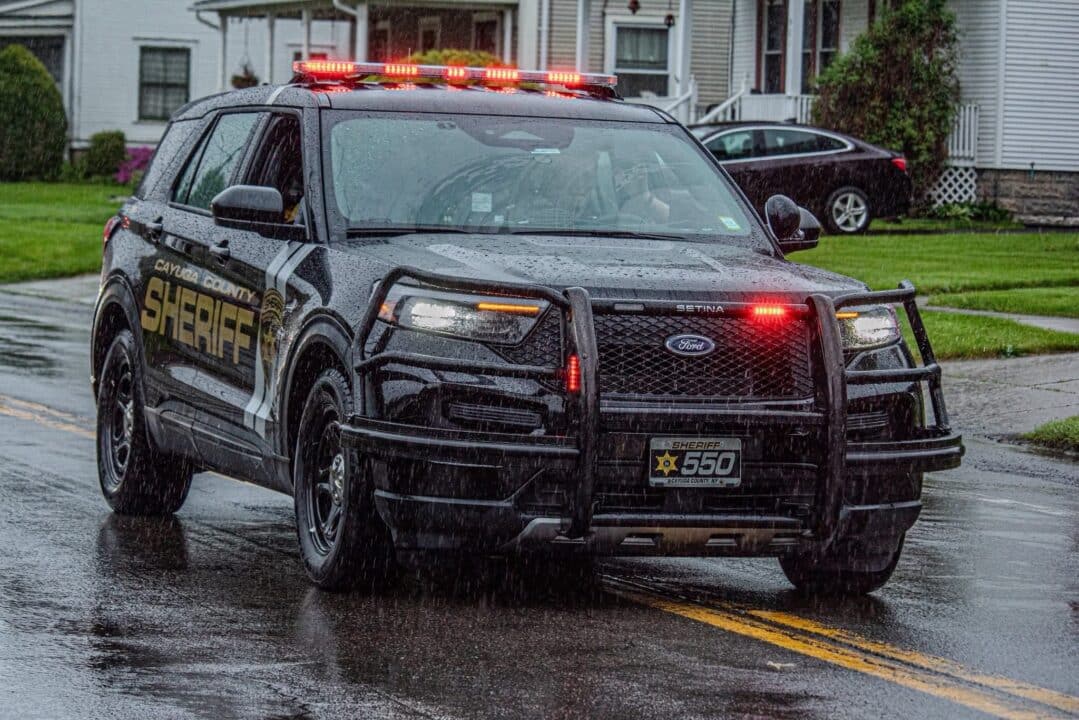
Cayuga County Sheriff Brian Schenck said family considerations drove his decision not to seek reelection, as he reflected on nearly 30 years in the Sheriff’s Office and outlined priorities for his final 10 months in office during an appearance on Inside Government.
Schenck, who is in his eighth year as sheriff, said the time demands of the job played a major role in his choice to step aside.
“It wasn’t an easy decision,” he said, adding that he wants more time with his family and his 4-year-old grandson.
He said he has no immediate plans for Jan. 2, 2027, and is not ready to fully retire, though he has not committed to another job or future elected office.
Focus on accreditation and technology

Among his top accomplishments, Schenck cited earning accreditation for both the road patrol division and the jail, known as the custody division.
Road patrol accreditation follows standards set by the New York State Division of Criminal Justice Services, while jail accreditation is governed by the New York State Sheriffs’ Association.
He said the department is now working to accredit its Civil Division, which handles court-ordered civil process, judgment executions and evictions throughout the county.
Schenck also highlighted the implementation of body-worn cameras for road patrol deputies. The cameras must be manually activated and are required during interactions with the public. He said he is not aware of instances where deputies failed to activate them.
The jail has extensive fixed camera coverage, though he said funding limitations have prevented adding body-worn cameras for custody deputies.
Staffing challenges in patrol and jail
The Sheriff’s Office has about 35 personnel assigned to road patrol, typically deploying three to four cars per shift plus a supervisor.
The custody division has 96 budgeted positions but is currently down 10, leading to overtime and additional strain on staff.
The road patrol division is also down two full-time positions following retirements. The department is conducting background investigations to fill vacancies and hopes to send recruits to the police academy at Cayuga Community College’s Fulton campus.
Schenck described the local academy as a cost-effective option that allows collaboration between the Sheriff’s Office and college staff.

Jail death under investigation
Schenck addressed a recent death at the Cayuga County Jail, saying an incarcerated individual was found unresponsive during routine checks shortly before 4 a.m., transported to Auburn Community Hospital and pronounced dead.
Under state law, the New York Attorney General’s Office must investigate deaths occurring in custody. The State Commission of Correction is also conducting a separate review, in addition to the Sheriff’s Office’s internal investigation.
Schenck said he expects the attorney general’s review to take considerable time and welcomed the independent scrutiny.
The jail conducts a minimum of 30-minute checks on incarcerated individuals, with more frequent monitoring if medical or mental health concerns are present. He said no policy changes have been made at this time.
The 214-bed facility currently houses about 135 individuals, including 16 federal board-ins and 11 inmates from other counties.
Recovery pod and mental health initiatives
Schenck said the department has shifted its approach to mental health and addiction during his tenure, including the creation of a recovery pod for incarcerated individuals seeking substance use treatment.
The program began with a 20-person pod and later expanded into a dorm setting to increase capacity. Participation is voluntary and limited to individuals ready to engage in recovery.
The Sheriff’s Office also launched a behavioral threat assessment team in 2022 to identify and intervene in potentially dangerous behaviors, particularly among youth, before violence occurs.
This week, deputies are receiving autism awareness and neurodivergent response training to better recognize behaviors and de-escalate crisis situations.
Schenck said improving mental health response and prevention remains one of his biggest concerns, along with homelessness and the broader challenges facing youth in the community.
Transition to next sheriff
Lt. Robert Franklin, the Republican and Conservative nominee, is currently unopposed and appears positioned to become the next sheriff.
Schenck said he has already begun working with Franklin to ensure a seamless transition and emphasized the importance of remembering that the sheriff serves all residents, regardless of political views.
“The biggest thing is just to remember you’re a sheriff for all the people,” Schenck said.

FingerLakes1.com is the region’s leading all-digital news publication. The company was founded in 1998 and has been keeping residents informed for more than two decades. Have a lead? Send it to news@fingerlakes1.com.