

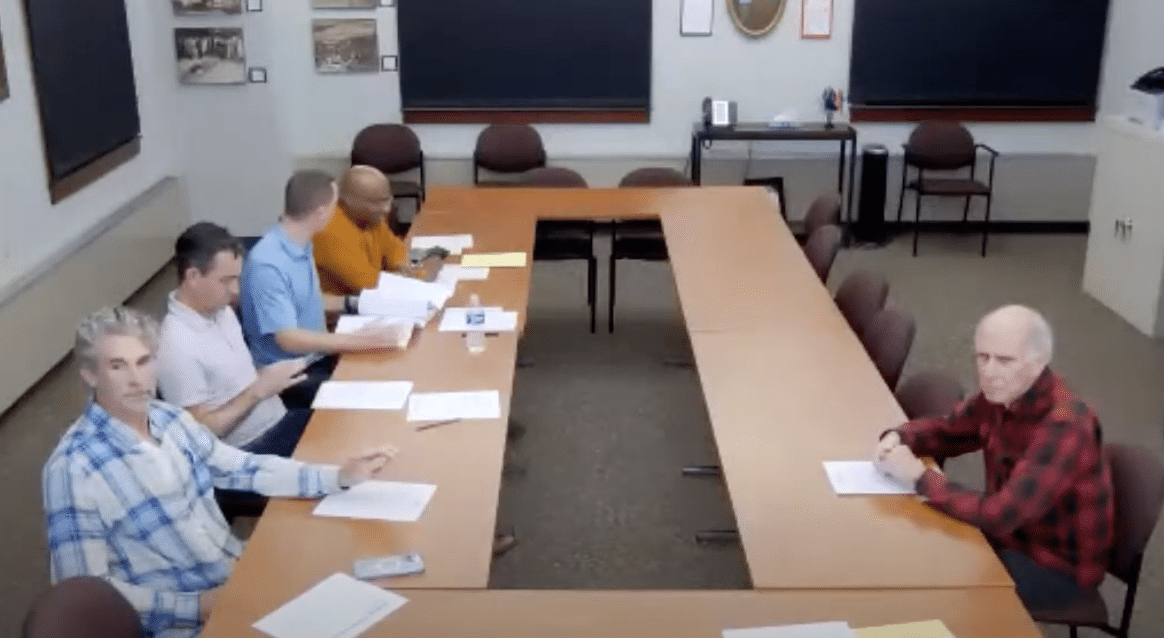
The Victor Conservation Board met earlier this week to review the final subdivision plans for the Nickoloff project on Blazey Road, which proposes dividing 42.4 acres into seven residential lots. The board discussed wetland regulations, conservation easements, and drainage management for the site before approving previous meeting minutes and adjourning.
Wetlands and conservation easements
Site engineer representatives for landowner Keith Nickoloff told the board that the state Department of Environmental Conservation (DEC) had assumed jurisdiction over wetlands on the southeast corner of the property, triggering a 100-foot buffer that cannot be disturbed. The western wetlands also carry DEC protection and the same buffer. Roughly half the property—about 22 acres—will be set aside as open space and conservation easements to meet the town’s 50% open-space requirement. Board members and the applicants discussed how those easements would be monumented, debating natural stone markers versus split-rail fencing to clearly define the restricted areas while maintaining a natural appearance.
Easement types and mowing permissions

Much of the discussion centered on which type of easement language to apply. Board members explained that Victor’s code distinguishes among natural resource, site-specific, and open-space easements, each with different levels of restriction. The applicant sought permission to seasonally mow part of Lot 7, a low-lying field historically used for farming but now classified as wetland. Members suggested using a site-specific easement there to allow limited mowing, while designating the remaining lots under the more restrictive natural resource easement to preserve buffers along the creek and wooded edges. The applicant noted the possibility of pursuing an agricultural exemption if farming continues.
Stormwater and site conditions
Engineers outlined stormwater controls using shallow infiltration basins designed to absorb runoff rather than collect it in ponds. They said Victor’s gravel soils make infiltration effective and reduce long-term maintenance compared with detention ponds. Board members confirmed that few mature trees would be removed because most of the property consists of open fields bordered by existing woods. They said the project fits Victor’s “rural-by-design” overlay district, which emphasizes large lots, minimal disturbance, and agricultural continuity.
Other business
The board unanimously approved minutes from its September 16 and October 7 meetings. A resident in attendance asked about driveway maintenance and fire-truck access on Blazey Road; members replied that the driveways would be privately maintained and built to code width standards with fire department input.
The meeting concluded without a formal vote on the subdivision, as final site-plan approval will come from the Town Planning Board at its October 30 session.

FingerLakes1.com is the region’s leading all-digital news publication. The company was founded in 1998 and has been keeping residents informed for more than two decades. Have a lead? Send it to news@fingerlakes1.com.