

When choosing a diamond for a piece of jewelry, especially something as meaningful as an engagement ring, there’s more to consider than just size or clarity. The shape of the diamond plays a huge role in how it looks, how it catches light, and how it fits into a design. Two shapes that are often compared, but serve very different purposes, are the Marquise and the Baguette.
Even though they’re both elongated in form, these two cuts have different styles, sparkle levels, and uses in jewelry. Here’s a breakdown of their 3 key differences.
Shape and Overall Look
The Marquise diamond has a very distinct shape. It’s long and narrow, with pointed tips at both ends and a softly curved body in the middle. If you picture the shape of a football or a small boat, that’s close to what a marquise looks like. Because of its shape, it tends to make the fingers look longer and more slender when worn as a ring. It has an elegant, vintage charm, and it really stands out on the hand.

The Baguette diamond, on the other hand, is straight and rectangular. It has flat sides and square corners, with a very clean, simple shape. It doesn’t have the curves of the marquise or the dramatic points—it’s all about symmetry and structure. Think of a baguette diamond as minimal and architectural. It has a classic, no-frills look that’s easy to pair with other stones.
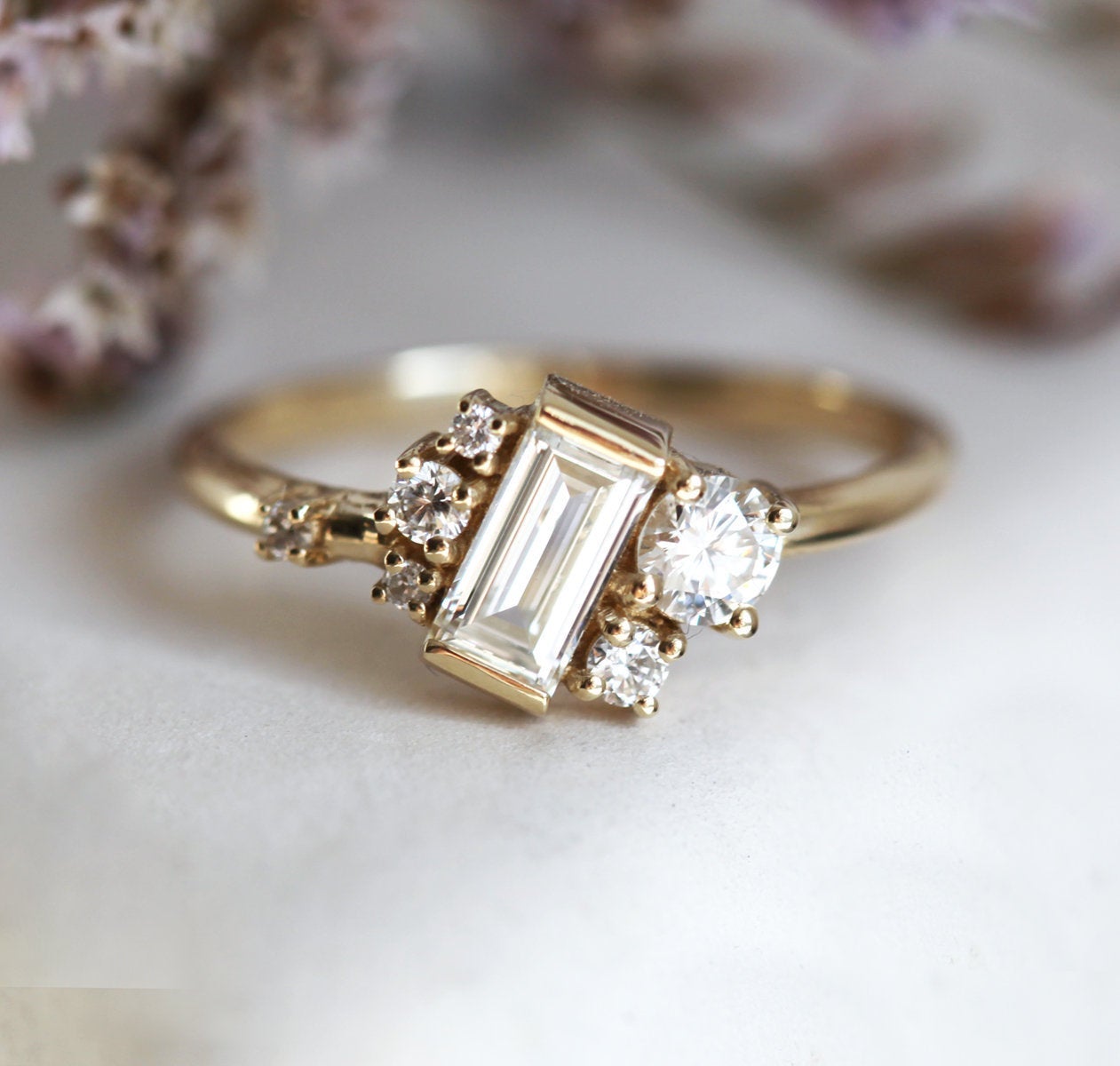
The first difference is visual. If you’re looking for a diamond that feels romantic, vintage, and dramatic, the marquise shape gives you that. If you prefer something understated, sharp, and modern, you can choose baguette.
Sparkle and Light Reflection
Some shapes are designed to sparkle brightly, while others reflect light in a more subtle, elegant way. Marquise and baguette diamonds handle light very differently, and that difference plays a big role in how each one looks when worn.
Marquise diamond cut
This cut is part of the “brilliant cut” family. That means they’re cut with many small facets (tiny flat surfaces) that bounce light in different directions. This style of cutting is designed to create maximum sparkle. When light hits a marquise, it dances—giving off flashes, fire, and shine. It’s ideal for someone who wants a stone that catches the eye and looks lively in all lighting conditions.
Baguette diamond cut
Baguette diamond cuts are cut very differently. They use what’s called a “step cut.” Instead of lots of small, sparkly facets, step cuts have long, straight facets that run in parallel lines, kind of like steps on a staircase. This gives the diamond a more subtle shine—it’s more about reflection than sparkle. Instead of little flashes, you get longer, mirror-like gleams. The result is a more calm, elegant look that doesn’t shout for attention but still feels luxurious.
So, if sparkle and shine are at the top of your list, a marquise might be the better choice. If you prefer a smoother, more understated reflection, the baguette delivers that perfectly.
Common Uses in Jewelry
Marquise diamonds are most often used as center stones, especially in engagement rings. Their long, pointed shape helps the stone look larger than it actually is, which makes it a popular choice for people who want a bold ring without going up in carat weight. A single marquise stone can take center stage, especially when paired with a thin band or small side stones. Its shape also allows for interesting ring designs, it works well in vintage settings, east-west styles, and even halo designs.
Baguette diamonds, in contrast, are rarely used as the main feature. They’re more often used as accent stones. You’ll see them flanking a larger center diamond in a three-stone ring, lined up in a row for an eternity band, or arranged in geometric patterns for Art Deco-inspired jewelry. Because of their clean, straight lines, baguettes are excellent for creating symmetry and structure in a ring or bracelet. They’re also used to give a piece of jewelry a more refined, classic look.
That’s not to say a baguette can’t be used on its own—some modern rings and minimalist designs do feature baguette diamonds as the only stone. But generally speaking, they’re used to support the design rather than lead it.
How a diamond is cut changes the way it plays with light. Some cuts are made to sparkle and catch the eye, while others give off a calm, elegant glow. Marquise and baguette diamonds reflect light in very different ways, which gives each one its own unique character. If you’re deciding which style suits you best, understanding how they shine can help you to explore both options and more at capucinne.com.

This content is brought to you by the FingerLakes1.com Team. Support our mission by visiting www.patreon.com/fl1 or learn how you send us your local content here.