

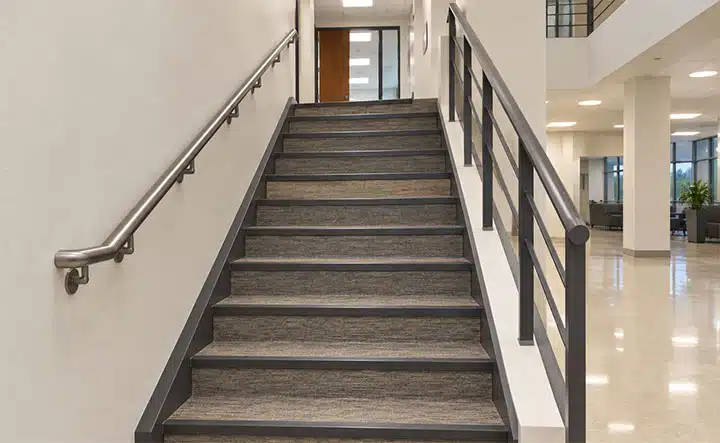
A study in the American Journal of Emergency Medicine found that about 24.8 million patients were treated in emergency departments for stair-related injuries over a 23-year period, which averages out to roughly 1.08 million people per year, or about one every 30 seconds.
Young children and older adults had the highest injury rates, but about two-thirds (67.2%) of emergency visits came from people between the ages of 11 and 60. Premises liability lawyers in Los Angeles concluded that stair injuries are becoming more frequent and called for stronger prevention efforts, especially in how stairs are designed and built.
Your Brain Stops Watching the Steps
When you climb or descend a staircase, you look closely at the first step or two, and then your brain sets a rhythm and expects every remaining step to match. That rhythm leaves you exposed when one step differs from the others. According to research cited in a 2025 study, differences as small as 6 mm (about a quarter of an inch) between neighboring steps can throw off a person’s stepping rhythm and raise the risk of a fall.
People also struggle to see these differences with their eyes. A 2020 study noted earlier research showing that both older and younger adults failed to adjust their foot movement over a single step that was 1 cm taller than the others, which suggests people simply don’t notice slightly taller steps. The same study found that when climbing, participants lifted their feet about 9 mm less over the taller step. Trips on stairs happen when the foot doesn’t clear the step edge by enough.
What Researchers Found on Real Staircases
In one study, researchers video recorded people using two public staircases in a university building. Across 11,137 observed trips up or down the stairs, there were 20 fall-related events, and 16 of them (80%) happened on the flights with the most variation: 14 mm in riser height and 38 mm in tread depth. The researchers also pointed to earlier findings that 75% of stair accidents occurred on stairways where step heights varied by 12.7 mm (about half an inch) or more.
A separate review of 80 stair fall reports found that about 60% of those stairways had uneven riser heights. Uneven risers and treads are especially common in older stairways, and much of California’s apartment housing was built decades ago.
What California Code Requires
California’s building standards set strict limits on how much steps can vary. Under the uniformity rule, the difference between the tallest and shortest riser, or between the deepest and shallowest tread, cannot exceed 3/8 inch in any flight of stairs.
In single-family homes and inside apartment units, risers can be no taller than 7 3/4 inches, and treads must be at least 10 inches deep. Commercial buildings must meet tighter standards, with stair risers between 4 and 7 inches and treads at least 11 inches deep.
Each flight is measured on its own. A flight is the set of steps between two landings, so a staircase with a landing halfway up counts as two flights and gets measured as two.
The research shows a quarter inch can disrupt a person’s stride, while code allows up to 3/8 inch. A staircase can meet code and still pose a real risk, and a staircase that fails code has gone well past the point where researchers see falls increase.
Older stairs are not always held to today’s standards. An existing stairway usually does not have to be rebuilt to current dimensions just because it’s being repaired. Owners still have a duty to maintain their stairs in safe condition, and unpermitted changes or poor upkeep can create liability.
How a Code Violation Affects Premises Liability Claims
A building code violation can make a premises liability case much stronger. Under California Evidence Code section 669, the law presumes a person failed to use due care when their violation of a statute, ordinance, or regulation caused someone’s injury. The presumption also requires that the injury be the type the rule was written to prevent and that the injured person belong to the group the rule protects. Staircase uniformity rules exist to prevent falls, and they protect everyone who uses the stairs.
The property owner can try to rebut this presumption by showing they acted as a reasonably careful person would have while trying to follow the law.
Tenants also have protection under California’s landlord repair law, which requires a landlord to make a rental building fit for people to live in and to repair later damage that makes it unlivable, unless the parties agreed otherwise.
Property owners and insurers often argue that the injured person wasn’t paying attention, but that argument cannot wipe out a claim in California. In Li v. Yellow Cab Co. (1975), the California Supreme Court adopted “pure” comparative negligence, which assigns liability based on each party’s share of fault. Under that rule, an injured person can recover damages even if they were partly at fault, with the award reduced by their percentage of fault. The research above also weakens the “not paying attention” defense, since people often fail to notice small differences in step height.
How to Document a Staircase After a Fall
Evidence of a defective step can disappear quickly once the owner makes repairs. If you or someone you’re with can do so safely, take these steps:
- Photograph the entire flight of stairs from the top and bottom.
- Measure the height of every riser with a tape measure, and photograph the tape against each step, since a single uneven step may have caused the fall.
- Photograph the handrail and lighting, then take close-up photos of each tread surface.
- Write down when and where the fall happened, along with the names of any witnesses.

This content is brought to you by the FingerLakes1.com Team. Support our mission by visiting www.patreon.com/fl1 or learn how you send us your local content here.